

The figure of the witch is a pervasive and potent archetype in global folklore, representing a nexus of cultural anxieties surrounding power, gender, and the unknown. Historically, individuals identified as witches were believed to possess supernatural abilities, enabling them to manipulate reality through esoteric means. The interpretation of this figure, however, has varied dramatically across cultures and epochs. In some contexts, the witch was a respected healer or wise elder; in others, a diabolical agent of chaos and evil. This evolution reveals less about the empirical reality of magic and more about the societies that conceptualized, celebrated, or condemned such figures. An examination of the witch in folklore provides a crucial lens through which to analyze historical power dynamics, religious orthodoxies, and the construction of social order.
This article will trace the development of the witch archetype not as a literal supernatural being, but as a documented historical and cultural phenomenon. Beginning with the earliest recorded concepts of magic in ancient civilizations, we will follow the folkloric and legal threads to the demonized stereotype that fueled centuries of persecution in Europe and beyond. By analyzing primary sources, historical records, and scholarly research, we can deconstruct how this powerful figure was assembled and understand its enduring hold on the collective imagination.
Historical Origins: Ancient Precursors to the Witch Archetype
To comprehend the witch figure of later European folklore, one must look to its antecedents in the ancient world. The core concepts—the practice of harmful magic, the manipulation of natural forces, and the resulting social ostracization—did not originate in the medieval period but are rooted in some of humanity's oldest legal and literary records. While these early figures were not "witches" in the diabolical sense later conceived, their roles and the societal responses they provoked established a foundational framework for what would follow.
Mesopotamian Law and Magical Practice
Long before the European witch hunts, Mesopotamian societies had already codified a distinction between licit and illicit magic. While healers, priests, and diviners held respected roles, those believed to wield destructive supernatural power were both feared and legally condemned.
The Code of Hammurabi, a Babylonian legal text dated to approximately 1754 BCE, provides one of the earliest documented legal systems to address witchcraft directly. Law #2 of the code is explicit in its handling of accusations of malevolent spell-casting, prescribing a trial by ordeal for the accused.
"If any one bring an accusation of any crime before the elders, and does not prove what he has charged, he shall, if it be a capital offense charged, be put to death."
This statute indicates that an accusation of sorcery was considered a capital offense. It reflects a society attempting to legislate against unseen forces, ultimately deferring judgment to divine intervention through the ordeal. This established a critical legal precedent linking accusations of harmful magic to the death penalty—a principle that would re-emerge with devastating consequences millennia later.
Greco-Roman Distinctions: Maleficium and Socially Disruptive Magic
Ancient Greek and Roman cultures further refined the conceptual divide between socially sanctioned ritual and forbidden sorcery. In Greek mythology, powerful figures such as Circe and Medea embody this duality. They are formidable sorceresses, capable of extraordinary magical feats, yet their power is consistently portrayed as dangerous, deceptive, and existing outside the norms of established society.
In Homer's Odyssey, Circe is described as a pharmakis—a practitioner skilled in potions and herbs—who transforms Odysseus's men into swine. She represents a form of untamed feminine power capable of subverting the male-dominated social order.
The Romans, known for their legal pragmatism, integrated this distinction into their legal framework. They differentiated between state-sanctioned religious rites (religio) and harmful magic, or maleficium. While official priestly colleges practiced divination for the benefit of the Roman state, laws such as the Twelve Tables (c. 450 BCE) explicitly prohibited the casting of spells intended to harm individuals or damage crops.
Crucially, the crime was not magic itself, but the intent to cause tangible harm. An individual was punished for the perceived outcome of their curse—a dead animal, a failed harvest—rather than for trafficking with supernatural entities. This focus on maleficium was a key legal concept that would later be absorbed into and redefine the European understanding of witchcraft. For a more detailed examination of these foundational ideas, refer to our article on the origins of witchcraft.
Development Over Time: The European Witch Trials
The folkloric witch—the practitioner of localized magic, the village healer—underwent a profound and sinister transformation during Europe's early modern period. Scattered folk beliefs about magic coalesced into a systematic, theological, and legal framework for persecution that spread across the continent. This era, often referred to as "the burning times," marks a critical juncture where folklore, religious doctrine, and state power converged with devastating outcomes. A scholarly analysis of this period requires moving beyond sensationalism to examine the documented historical realities.
The Scale and Scope of Persecution
Between approximately 1450 and 1750, a wave of legal persecution related to witchcraft swept through Europe. Scholarly estimates place the number of trials between 80,000 and 100,000, with an estimated 40,000 to 60,000 documented executions.
The epicenter of this phenomenon was the Holy Roman Empire, a complex political entity encompassing modern-day Germany, the Netherlands, Switzerland, and parts of France, Austria, and Czechia. This region alone is estimated to have held around 50,000 trials and carried out 25,000 to 30,000 executions, constituting roughly 40% of all witchcraft prosecutions in Europe. A detailed overview of this data can be found in historical resources on the European witch hunts.
During this period, witchcraft was formally defined as a crime against both God (crimen exceptum) and the state, prosecuted in secular and ecclesiastical courts. The statistics reveal a story of profound societal anxiety, where the folkloric witch became a tangible scapegoat for complex social, economic, and religious problems.
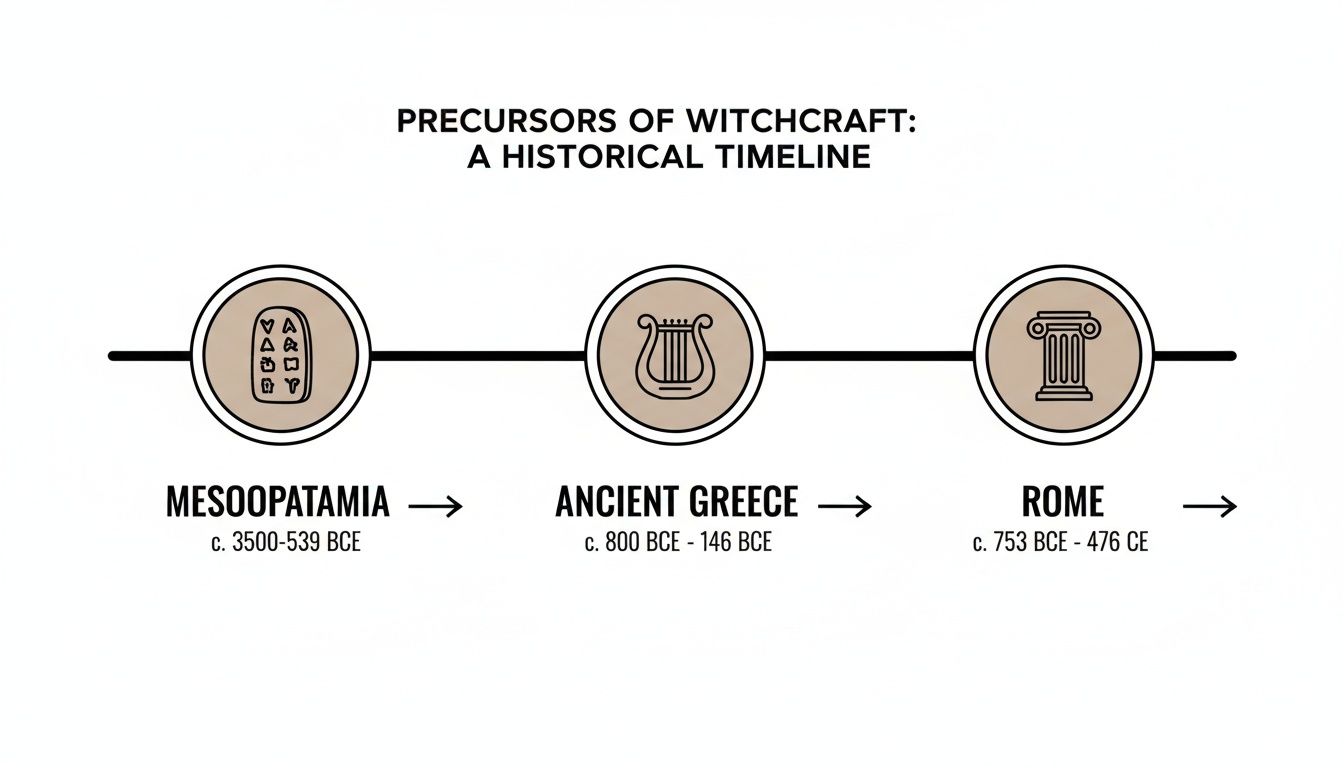
The timeline above illustrates the long historical trajectory from punishing specific acts of harmful magic (maleficium) to prosecuting individuals for the perceived heretical status of being a witch.
Regional Variations and Chronological Peaks
The intensity of the witch hunts was not uniform across Europe. The severity of the trials was heavily influenced by local legal structures, political stability, and the degree of centralized governmental control.
- High-Intensity Regions: The German-speaking territories of the Holy Roman Empire were the primary hotspot. Political fragmentation gave local magistrates immense autonomy, allowing localized panics to escalate into mass trials.
- Moderate-Intensity Regions: France, Switzerland, and parts of Italy experienced significant trials, but they often occurred in concentrated, violent outbreaks rather than as sustained campaigns.
- Low-Intensity Regions: Nations with strong, centralized judicial systems, such as Spain and Portugal, saw far fewer executions. The Spanish Inquisition, contrary to popular belief, was often skeptical of witchcraft accusations, prioritizing the repentance of the accused over execution.
The absolute peak of the witch-hunting phenomenon occurred between 1560 and 1660. This century coincided with periods of intense religious warfare, political upheaval, and the climatic crisis known as the "Little Ice Age," which caused widespread crop failure and famine.
During times of immense societal stress, communities often seek scapegoats. The trials surged in regions grappling with profound hardship, offering a tragically simplified explanation and a tangible target for collective fear and anger.
Cultural and Religious Context: The Theological Framework of the Hunts
To understand how localized fears of malevolent magic could escalate into a continent-wide persecution, it is essential to examine the volatile religious landscape of early modern Europe. The witch archetype familiar today was not born solely from folklore; it was forged within the crucible of a profound theological shift and intense inter-confessional conflict.
This transformation hinged on the doctrine of diabolism: the belief that a witch's power was not derived from folk knowledge or natural forces, but was granted through a formal, explicit pact with the Devil. This concept reframed witchcraft entirely. No longer was it merely a secular crime of causing harm (maleficium); it was elevated to the level of heresy and high treason against God. The witch was redefined from a malicious neighbor to an enemy combatant in a cosmic war between good and evil.
The Malleus Maleficarum and the Codification of Witchcraft
This new, terrifying conception of the witch was codified and disseminated in 1487 with the publication of the Malleus Maleficarum ("The Hammer of Witches"). Authored by the Catholic clergyman Heinrich Kramer, this text served as a comprehensive manual for witch-hunters. It provided theological arguments for the reality of witches, described their purported demonic pacts in lurid detail, and outlined systematic procedures for their identification, prosecution, and execution.
The Malleus Maleficarum employed a powerful logical trap: it argued that to even express skepticism about the existence of witchcraft was itself a form of heresy. This effectively silenced dissent and provided inquisitors with theological justification for their actions.
The book's influence was profound and devastating. Reprinted dozens of times, it became an authoritative guide for magistrates and clergy across Europe. Furthermore, its contents were deeply misogynistic, asserting that women were constitutionally weaker, more impressionable, and thus more susceptible to demonic temptation. This not only solidified the stereotype of the witch as female but also provided a script for the torture-induced confessions that became a hallmark of the trials.
The Reformation and Competitive Persecution
While the doctrine of diabolism provided the theological framework, the religious and political chaos of the 16th-century Protestant Reformation acted as an accelerant. Martin Luther's challenge to papal authority in 1517 shattered the religious unity of Western Christendom, ushering in a century of violent competition between Catholic and emerging Protestant faiths.
In this climate of acute religious anxiety, the figure of the witch became a politically useful tool. Both Catholic and Protestant authorities used witch hunts to demonstrate their piety and to accuse their rivals of being lax in the fight against Satan. This rivalry created a grim cycle of competitive persecution. Protestant leaders sought to prove they were more zealous in purging evil from their lands than the Catholics. In turn, the Catholic Counter-Reformation launched its own purges.
The correlation is striking: the period of the most intense witch trials, from 1555 to 1650, coincides precisely with the peak of Catholic-Protestant conflict. A review of academic analysis of prosecution data confirms that regions with the most intense inter-confessional warfare also experienced the most brutal witch hunts. The great European witch hunt was not a relic of medieval superstition but a thoroughly modern phenomenon, born from the anxieties of a society undergoing profound religious and political transformation.
Modern Interpretation: The Witch as a Cultural Symbol
The archetype of the witch, once a figure of profound societal terror, has undergone a radical reinterpretation in the modern era. Far from being eradicated, the figure has demonstrated remarkable resilience, evolving from an object of fear into a potent symbol of rebellion, feminine power, and connection to the natural world. This transformation is visible across contemporary culture, from academic scholarship and modern spiritual movements to popular media.

The genesis of this re-evaluation can be traced to the mid-20th century, when feminist scholars began to re-examine the historical witch hunts. They posited that the trials were not primarily about suppressing supernatural evil but were, in fact, a systematic persecution of women who existed outside the narrow confines of patriarchal society. In this revisionist view, the accused witch was recast from a demonic conspirator into a proto-feminist figure—a symbol of resistance against an oppressive social and religious order.
From Diabolical Villain to Empowered Icon
A pivotal moment in this transformation was the emergence of modern neopagan religions in the 1950s, most notably Wicca. These new spiritual movements deliberately inverted the historical narrative. They redefined the witch as a wise practitioner who revered nature and utilized magic for healing and personal empowerment, explicitly rejecting the diabolical stereotype.
This reimagining shifted the witch from a social outcast to an icon of empowerment. She became a figure whose power was derived not from a demonic pact, but from self-knowledge, ecological awareness, and a connection to a sacred feminine principle that had been historically suppressed.
The documented history of the witch trials, such as the events in Salem, provides essential context for this modern interpretation. Understanding the reality of the persecution helps to explain why the witch archetype resonates so powerfully today as a symbol of survival and resilience. To better understand this historical backdrop, consider our detailed analysis of what the Salem witch trials were.
The Witch in Contemporary Media and Scholarship
The evolution of the witch is clearly reflected in popular culture, where portrayals have grown increasingly complex. The archetypal crone still exists, but now shares the cultural landscape with heroes, anti-heroes, and nuanced protagonists.
- The Wicked Witch of the West (The Wizard of Oz, 1939): This character codified the image of the evil, cackling witch for generations.
- Sabrina the Teenage Witch: Originating in comics, this character's popular television adaptations presented a relatable, normalized witch, stripping away the diabolical associations.
- Hermione Granger (Harry Potter series): In this narrative, witchcraft is presented as a learned skill rooted in intellect, discipline, and moral character, entirely separate from inherent evil.
- The Modern Folk Horror Witch (e.g., The Witch, 2015): Contemporary cinema has returned to the historical folklore, exploring the psychological terror, religious paranoia, and oppressive social conditions that fueled the original witch hunts, often framing witchcraft as a desperate but empowering form of rebellion.
These varied portrayals demonstrate an ongoing cultural dialogue with the legacy of the witch. Whether depicted as a villain, a hero, a misunderstood outsider, or a symbol of righteous fury, the archetype's capacity to embody these multiple meanings makes it one of the most enduring and powerful figures in collective human culture.
Conclusion: The Witch as a Reflection of Societal Anxieties
The historical and folkloric trajectory of the witch is a testament to the archetype's power as a cultural mirror. From the legally condemned sorcerers of ancient Mesopotamia to the diabolical heretics of early modern Europe and the empowered icons of contemporary culture, the figure of the witch has consistently reflected the deepest anxieties and power struggles of the societies that defined it.
The transition from a practitioner of localized folk magic to an agent of cosmic evil was not a natural evolution but a deliberate construction, shaped by theological doctrine, legal precedent, and social upheaval. The European witch hunts stand as a stark historical example of how folklore can be weaponized during times of intense stress, serving as a justification for the persecution of society's most vulnerable members. Today, the ongoing reinterpretation of the witch in media and modern spirituality demonstrates a collective effort to reclaim this figure, transforming it from a symbol of persecution into one of resilience, independence, and empowerment. The study of witches in folklore is, ultimately, a study of ourselves—our fears, our beliefs, and our enduring need to make sense of the world beyond the visible.
Frequently Asked Questions
What is the earliest historical reference to a witch?
The earliest documented legal proscriptions against harmful magic appear in ancient Mesopotamia. The Code of Hammurabi (c. 1754 BCE) includes laws that mandate the death penalty for those found guilty of casting malevolent spells. In literature, figures like Circe in Homer's Odyssey (c. 8th century BCE) and Medea in various Greek texts represent powerful, independent female magic-users who operate outside societal norms. These ancient figures, however, were practitioners of maleficium (harmful magic) and were distinct from the later European concept of a witch whose power stemmed from a diabolical pact.
Why were the majority of those accused of witchcraft women?
The persecution of witches in Europe disproportionately targeted women, with historical estimates suggesting that 75% to 80% of those executed were female. This gender bias was the result of a confluence of factors:
- Theological Misogyny: Influential texts like the Malleus Maleficarum explicitly argued that women were morally and intellectually weaker and therefore more susceptible to demonic influence.
- Social and Economic Vulnerability: Many of the accused were poor, elderly, and widowed women who lacked the social or familial power to defend themselves. They often became scapegoats for community misfortunes such as illness, crop failure, or livestock death.
- Association with Folk Medicine: Women frequently served as community healers and midwives, possessing knowledge of herbal remedies. This traditional role could be reinterpreted as evidence of witchcraft during times of panic.
It is important to note that while women were the primary targets, men constituted a significant minority of victims, accounting for 20-25% of the accused overall and even a majority in specific regions like Iceland and Normandy.
Was the Catholic Church solely responsible for the witch hunts?
While the Catholic Church provided the theological framework for the witch hunts, particularly the concept of the diabolical pact, the historical reality is more complex. The most intense period of persecution (c. 1560-1660) coincided with the Protestant Reformation and the subsequent religious wars. In this environment of fierce inter-confessional competition, both Catholic and Protestant authorities used witch trials to demonstrate their piety and condemn their rivals. The persecution was most severe in politically fragmented regions with high levels of religious conflict, such as the Holy Roman Empire. Conversely, in regions with strong, centralized Catholic authority like Spain and Italy, the official Inquisition was often skeptical of witchcraft claims and executed far fewer people for the crime. Therefore, it is more accurate to view the hunts as a product of religious competition and political instability rather than a monolithic campaign directed by a single church.
At Hidden Mythos, Michael Rupp and our team are passionate about digging into the documented history behind folklore and paranormal beliefs. If you enjoyed this, check out our archive for more research-driven analyses of mythology and historical trials.
