

The Salem witch trials represent a brief but harrowing chapter in colonial American history, unfolding in the Massachusetts Bay Colony between February 1692 and May 1693. This localized outbreak of legal and social panic resulted in the formal accusation of over 200 individuals, the conviction of thirty, and the execution of nineteen people by hanging. Several others died in prison. Historically significant, the event serves as a stark case study in mass hysteria, where deeply rooted religious beliefs, social anxieties, and legal failures converged into a deadly hunt for perceived malevolence. This analysis will examine the documented origins, development, and cultural context of this tragic episode, separating historical record from enduring folklore.
Historical Origins
The precipitating events of the Salem witch trials began not with a public outcry, but within the household of Reverend Samuel Parris in Salem Village during the winter of 1692. His nine-year-old daughter, Abigail Williams, and eleven-year-old cousin, Elizabeth “Betty” Parris, began exhibiting alarming behaviors. Primary accounts describe convulsions, contortions, and unintelligible speech. When a local physician, William Griggs, could identify no physical cause, he attributed their condition to supernatural affliction, stating they were “under an Evil Hand.” This diagnosis, grounded in the prevailing Puritan worldview, set the stage for a formal inquiry into witchcraft.
The Initial Accusations
Once witchcraft was identified as the cause, the magistrates sought the human agents responsible. The afflicted girls, whose circle soon expanded to include others like twelve-year-old Ann Putnam Jr., named three individuals. The selection of these first targets is historically significant, as all were socially marginalized figures, making them vulnerable to accusation.
- Tituba: An enslaved woman in the Parris household, whose non-English, likely Arawak or Carib, origins rendered her an object of deep cultural suspicion.
- Sarah Good: A destitute and homeless woman known for begging, whose muttering when turned away was reinterpreted as malediction.
- Sarah Osborne: An elderly woman of ill repute due to property disputes and a prior social transgression—cohabitating with a man before marriage.
The initial accusations were directed at those who existed on the fringes of Salem’s rigidly conformist society, a pattern that would recur throughout the crisis.
The Tituba Confession
The examinations of the three accused women were conducted by magistrates John Hathorne and Jonathan Corwin. While Good and Osborne maintained their innocence, the proceedings took a decisive turn with the testimony of Tituba. After days of intense and likely coercive interrogation, she confessed.
Her confession was not a simple admission of guilt. As documented in the court records, Tituba provided a detailed and sensational narrative that validated the community’s deepest fears. She spoke of signing the Devil’s book in blood, flying on a pole, and attending a witches’ sabbath in Salem Village. She described a widespread conspiracy of witches working to undermine the Puritan’s “City upon a Hill.”
“The devil came to me and bid me serve him,” Tituba testified, according to the official examination records.
This detailed account, extracted under duress, transformed the investigation. It appeared to confirm the existence of an organized, demonic plot, providing the magistrates with a framework for future interrogations and shifting the focus from isolated incidents to a colony-wide conspiracy. The hunt for Tituba’s alleged co-conspirators began in earnest, escalating the crisis dramatically.
Development Over Time
The Salem crisis evolved rapidly from a localized investigation into a regional legal catastrophe. The legal apparatus created to manage the growing number of accusations became an instrument that amplified, rather than contained, the hysteria.
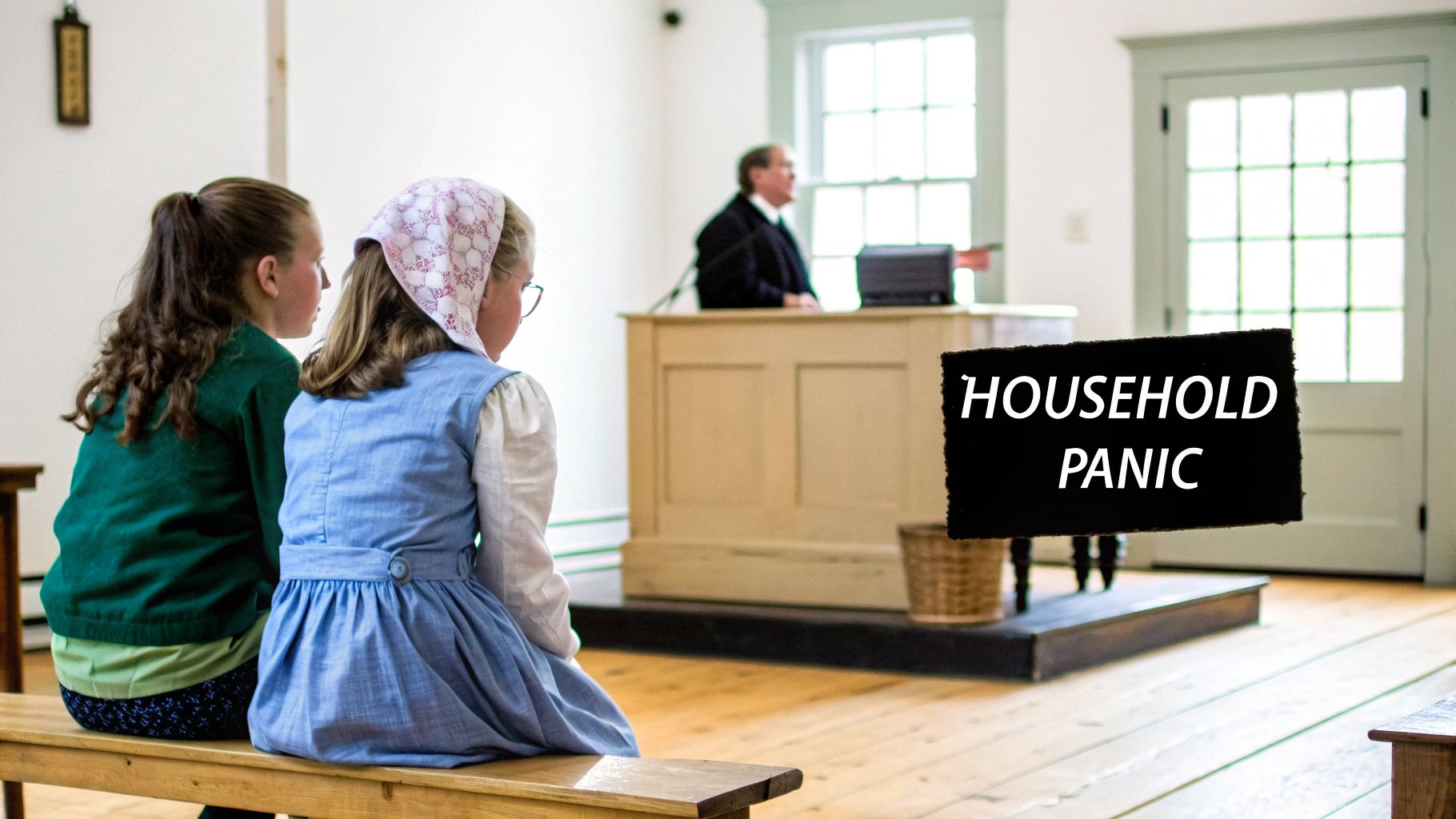
Operating under a provisional government without a valid royal charter, Governor William Phips established a special court in May 1692: the Court of Oyer and Terminer (meaning “to hear and to determine”). Presided over by Lieutenant Governor William Stoughton, the court’s mandate was to clear the overflowing jails and prosecute the accused swiftly.
The Role of Spectral Evidence
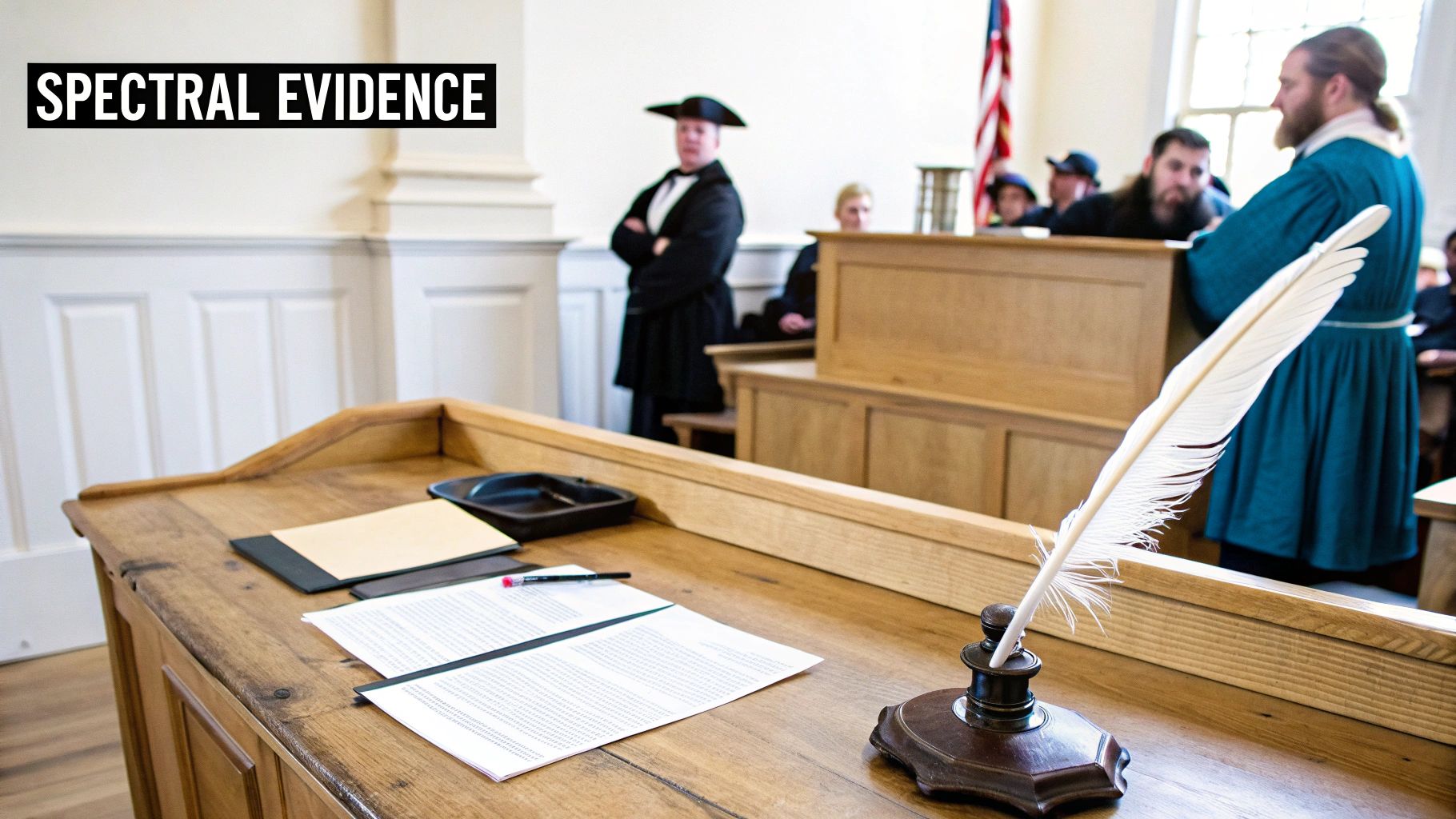
The court’s most consequential and controversial decision was its admission of spectral evidence. This referred to testimony from the afflicted individuals who claimed the apparition, or “specter,” of an accused person was physically tormenting them. This form of evidence was, by its nature, impossible to corroborate or refute. The legal burden shifted from the prosecution proving guilt to the accused proving their spectral innocence—a logical impossibility.
This legal decision was the lynchpin of the entire tragedy. By treating dreams and visions as hard evidence, the court validated the accusers’ hysteria and left the defendants with no realistic way to fight back.
The courtroom became a theater for the accusers’ afflictions, their fits and cries treated as de facto evidence of the defendant’s guilt. The first to be tried and convicted under these rules was Bridget Bishop, a woman known for her nonconformist behavior. Her execution on June 10, 1692, signaled the court’s unwavering commitment to its methods and sent a clear message that denial of charges would lead to the gallows.
The Escalation of Accusations
The initial accusations targeted social outcasts, but as the trials progressed, the circle of the accused widened to include respected and even prominent members of the community. Accusations spread from Salem Village to neighboring towns like Andover and Topsfield. You can explore the geographic scope of the crisis in the Massachusetts state digital archives. This expansion eventually proved to be the crisis’s undoing. When accusations were leveled against politically connected individuals, including the wife of Governor Phips, colonial elites began to question the validity of the proceedings.
The trials lasted approximately 15 months. The following table provides a statistical summary based on historical records.
The Salem Witch Trials by the Numbers (1692–1693)
| Metric | Total |
|---|---|
| People Formally Accused of Witchcraft | 200+ |
| People Indicted by a Grand Jury | 165 |
| People Who Confessed | 55 |
| People Convicted of Witchcraft | 30 |
| People Executed by Hanging | 19 |
| People Who Died in Prison | 5 |
| Men Executed | 5 |
| Women Executed | 14 |
| Pressed to Death for Refusing to Plea | 1 |
These figures, drawn from surviving legal documents, illustrate the scale of the tragedy. For a detailed chronology, see this complete timeline of the Salem witch trials.
Cultural and Religious Context
Understanding the Salem witch trials requires an examination of the 17th-century Puritan worldview, in which the supernatural was an immediate and tangible reality. The Puritans of the Massachusetts Bay Colony believed they were engaged in a cosmic battle against Satan, who sought to destroy their holy commonwealth.
Within this framework, witchcraft was not folklore; it was a pact with the Devil, an act of high treason against God and the community. Any misfortune—illness, crop failure, or livestock death—could be interpreted as an act of diabolical aggression. This belief system, combined with existing social tensions, created a fertile environment for suspicion. Salem Village was already beset by internal conflicts, including disputes over land, church leadership, and longstanding family rivalries. The witchcraft accusations provided a spiritual justification for acting upon these secular grievances.
The Puritans’ belief in an active, malevolent Devil was not a fringe idea; it was the central organizing principle of their society. This conviction transformed personal anxieties and community disputes into evidence of a divine struggle, making a witch hunt not just possible, but logical.
Gender and Social Order
The patriarchal structure of Puritan society significantly influenced who was accused. Rooted in biblical interpretation, the prevailing belief held that women were spiritually weaker than men and thus more susceptible to demonic temptation. This is reflected in the statistics: of the 19 people hanged, 14 were women.
Many of the accused were women who deviated from the societal norm of the pious, submissive wife. These included women who were economically independent (often widows), outspoken, or involved in public disputes. The accusations served as a mechanism for enforcing social and gender conformity, punishing those who challenged the established patriarchal order. The witch trials became a religiously sanctioned means of policing female behavior.
Modern Interpretation
The Salem witch trials concluded by May 1693, collapsing as accusations reached the upper echelons of society and influential ministers like Increase Mather began to publicly denounce the use of spectral evidence. In October 1692, Governor Phips dissolved the Court of Oyer and Terminer, effectively ending the period of mass execution.
In the years that followed, the colony engaged in a process of public atonement. In 1697, Judge Samuel Sewall issued a public apology, accepting the “blame and shame” for his role. In 1711, the Massachusetts legislature passed a bill restoring the good names of many victims and authorizing financial restitution to their families. The final victims were not formally exonerated by the state until 1957. You can explore the official records from the Massachusetts state digital archives.
Scholarly Perspectives and Legacy
Modern scholarship interprets the Salem witch trials through multiple lenses, including sociology, psychology, law, and economics. Theories for the underlying cause of the accusers’ behavior range from clinical hysteria and post-traumatic stress to social and economic motivations. One theory, now largely debated, even suggested the cause was ergotism, a physical illness caused by consuming rye grain contaminated with a fungus.
While smaller in scale than the European witch hunts, which resulted in tens of thousands of deaths over several centuries, the Salem crisis holds a unique place in American consciousness. Its legacy is most pronounced in the realm of law. The gross miscarriage of justice directly influenced the development of the American legal system, reinforcing principles that are now foundational:
- The presumption of innocence.
- The right to legal counsel.
- The right to confront one’s accuser.
- The separation of church and state.
The trials serve as a powerful historical allegory, most famously invoked in Arthur Miller’s 1953 play The Crucible, which used the events of 1692 to critique the anti-communist McCarthy hearings of the 1950s. The term “witch hunt” has entered the popular lexicon to describe any unjust persecution of a marginalized group fueled by mass panic. For more on its modern commemoration, see the Salem witch trials memorial and its historical context on the Smithsonian’s Folklife website.
Conclusion
The Salem witch trials were not a paranormal event but a documented human tragedy born from a confluence of religious extremism, social anxiety, and systemic legal failure. The historical records demonstrate how a community, convinced of its own righteousness and under siege by perceived diabolical forces, abandoned due process in favor of religiously sanctioned persecution. The events of 1692–1693 are a testament to the dangers of unchecked authority, mass hysteria, and the weaponization of fear. Its primary lesson is not one of supernatural belief, but of the critical importance of reason, skepticism, and robust legal safeguards to protect individual rights against the pressures of a panicked collective.
Common Questions About the Salem Witch Trials
Were People Burned at the Stake in Salem?
No. This is a common misconception derived from European witch trials. The legal penalty for witchcraft in colonial Massachusetts, which followed English law, was hanging. All 19 individuals executed as part of the trials were hanged on Gallows Hill.
Why Was Giles Corey Pressed to Death?
Giles Corey, an 81-year-old farmer, was not executed for witchcraft but died during interrogation. He refused to enter a plea of “guilty” or “not guilty” to the court. The legal procedure for this refusal was peine forte et dure (strong and harsh punishment), where heavy stones were placed on his chest to coerce a plea. Corey endured this for two days, reportedly saying only “more weight.” By refusing to plead, he avoided a conviction, which would have allowed the state to seize his property. His death ensured his land passed to his sons. You can review the legal framework and key events of the trials for more detail.
Could You Save Yourself by Confessing?
Yes, paradoxically. The historical record shows that none of the approximately 55 individuals who confessed to witchcraft were executed. The court appeared more focused on validating the existence of a demonic conspiracy through confessions than on punishing the confessed. This created a perverse incentive: maintain innocence and face execution, or confess to a capital crime to save one’s life. This dynamic encouraged false confessions, which often implicated others, thereby fueling the cycle of accusations.
Was an Animal Put on Trial?
While court records indicate two dogs were killed after being accused of witchcraft, there is no evidence that any animal was formally indicted or subjected to a legal trial. The killing of the dogs reflects the depth of the community’s paranoia, where the belief held that Satan’s influence could manifest through animals, but it was not a formal legal proceeding.
At Hidden Mythos, we delve into the documented history behind legendary events to separate fact from folklore. Explore our archive of historically grounded research at https://www.hiddenmythos.com.
