

The distinction between myth and legend is a foundational concept in the study of folklore and history. In scholarly analysis, these terms are not interchangeable. They describe two distinct categories of traditional narrative, differentiated primarily by their relationship to historical reality and their function within a culture. Myths are understood as sacred, symbolic narratives that explain the cosmos, the divine, and the fundamental nature of existence without a basis in documented history. Legends, conversely, are narratives rooted in a specific historical event, person, or place, which have been embellished and magnified through generations of storytelling. Understanding this distinction is historically significant as it allows for a more precise analysis of how societies construct their worldviews, record their pasts, and transmit their core values.
Historical Origins
To delineate the difference between myth and legend, one must examine their earliest recorded forms. Textual and archaeological evidence reveals two separate narrative impulses. One path originates from a verifiable event or individual, forming a historical nucleus around which a story accrues. The other emerges from a symbolic or theological imperative to rationalize the world, unanchored from any specific historical moment. This bifurcation is not a modern academic construct but is evident in the foundational texts of ancient cultures.
Legends: Narratives Rooted in Historical Events
Legends are characterized by their origin in a kernel of historical fact. This factual basis—however obscured by subsequent embellishment—is their defining feature. A frequently cited example is the legend of King Arthur. The earliest references, such as the 9th-century Historia Brittonum, mention a war leader (dux bellorum) named Arthur who reportedly led Romano-British forces against Saxon invaders following the Roman withdrawal from Britain in the 5th or 6th century CE.
These early accounts lack the familiar elements of Arthurian legend, such as the Round Table, the quest for the Holy Grail, or the figure of Lancelot. Such details were later additions, integrated over centuries by chroniclers and poets like Geoffrey of Monmouth and Chrétien de Troyes. The core of the legend, however, remains its connection to a plausible historical figure from a specific, documented period of conflict. The narrative process is one of accretion, where a historical seed serves as a scaffold upon which generations build, layering cultural values and aspirations onto a recognized past.
Myths: Symbolic Narratives of Sacred Origin
Myths, in contrast, lack this historical anchor. Their purpose is not to commemorate but to explain. The Greek myth of Prometheus, documented in Hesiod’s Theogony (c. 700 BCE), serves as an illustrative case. Prometheus is not a historical figure whose actions were exaggerated; he is a symbolic construct created to address fundamental existential questions:
- The origin of humanity: Prometheus is described as having formed humans from clay.
- The source of human ingenuity: His theft of fire from the gods is an allegory for the advent of knowledge and technology.
- The existence of suffering: His eternal punishment by Zeus serves as a theological explanation for hardship in the world.
Prometheus exists entirely within the sacred narrative, designed to function as an explanatory framework for the human condition. His reality is symbolic, not historical. This highlights the primary function of myth as a component of a belief system, a subject further explored in the broader history of mythology.
Development Over Time
The evolution of these narratives over centuries further illuminates their distinct characteristics. A story’s development is shaped by changing cultural norms, religious shifts, and political contexts. By tracing these transformations, one can observe how legends remain tethered to their historical origins, while myths demonstrate a symbolic fluidity that allows them to be reinterpreted by successive cultures.

The Legendary Development of Robin Hood
The figure of Robin Hood provides a clear example of legendary development. The narrative’s plausibility is anchored in historical records from Yorkshire, dated between 1228–1230, which mention a fugitive named Robert Hood (or “Hobbehod”). While not definitive proof, this provides a verifiable human starting point.
By 1377, William Langland’s poem Piers Plowman references Robin Hood as a well-known figure from popular ballads, indicating a rapid evolution from a local outlaw to a folk hero. Over time, the story became a vessel for social commentary. The character was elevated from a common yeoman to a dispossessed nobleman, embodying ideals of justice against a corrupt establishment. Figures like Maid Marian and Friar Tuck were incorporated, transforming a regional story into a national symbol of resistance. Throughout this evolution, the legend’s core—an outlaw operating in a specific historical context—remained intact.
The Mythic Reinterpretation of Ragnarok
The Norse myth of Ragnarok followed a different trajectory. Initially recorded in texts like the 13th-century Poetic Edda, Ragnarok was an integral part of pre-Christian Norse cosmology—a sacred prophecy detailing the destruction and rebirth of the world. Its function was theological, providing a framework for understanding cosmic cycles within a living pagan faith.
With the Christianization of Scandinavia, the religious system that supported Ragnarok dissolved. The narrative, however, persisted, but its function shifted dramatically. For later European cultures, Ragnarok was no longer an article of faith. It was reinterpreted as a literary motif, an allegorical tale exploring universal themes of destiny, conflict, and renewal. Severed from its sacred origins, the story of battling gods and giants was reborn as a cultural artifact, its potent symbolism adapted to new contexts by artists and writers. This process is common for myths, whose symbolic power often outlasts the belief systems that created them. Similar folkloric transformation can be observed in historical events that acquire legendary status, as documented in the case of the Salem witch trials.
Cultural and Religious Context
The core difference between myth and legend is most apparent in their societal function. These narratives are not merely forms of entertainment but integral components of a culture’s identity. Myths typically serve as a society’s sacred charter, providing a cosmological and moral framework. Legends, in contrast, function as historical and cultural touchstones, reinforcing a community’s sense of identity and shared past.

Myths as Foundational Blueprints
Myths operate on a cosmological level, providing a framework for understanding existence. Their primary functions include:
- Cosmological Explanation: Addressing fundamental questions about the origins of the universe, the natural world, and humanity’s place within it.
- Ritual Justification: Providing the narrative basis for religious ceremonies, social customs, and moral laws, grounding them in divine precedent.
- Moral Codification: Establishing a culture’s ethical system by delineating the relationships between gods and mortals.
The creation narrative in the Book of Genesis, for example, functions as the sacred blueprint for Abrahamic religions. It establishes a theological and moral order, defining humanity’s relationship with a single creator deity and introducing foundational concepts such as sin and redemption. Its purpose is not to provide a historical record but to establish a worldview. This sacred function, often intersecting with cultural beliefs about supernatural phenomena, can be seen throughout the history of witchcraft.
Legends as Cultural Touchstones
Legends function within the realm of collective memory and cultural identity. They ground a community’s values in a past that is perceived as historical, even if highly embellished. The power of a legend lies in its purported connection to the real world.
The legend of El Cid (Rodrigo Díaz de Vivar), an 11th-century Castilian nobleman, illustrates this role. A documented historical figure, his life was greatly romanticized in epic poems such as El Cantar de mio Cid. He was transformed into a national hero, symbolizing Castilian virtues of courage, loyalty, and faith during the Reconquista. The function of this legend was not to explain cosmology but to help forge a Spanish national identity. El Cid became a historical touchstone, a moral exemplar whose celebrated deeds provided a model for behavior and a rallying point for a nation.
Modern Interpretation
While the definitions of myth and legend are well-established in folklore studies, their boundaries can be porous. Many narratives exhibit characteristics of both, prompting scholars to develop analytical frameworks for classifying these borderline cases. Modern scholarship moves beyond simple categorization to a more nuanced analysis of a story’s structure and cultural resonance.
The Rank-Raglan Scale: Quantifying Hero Patterns
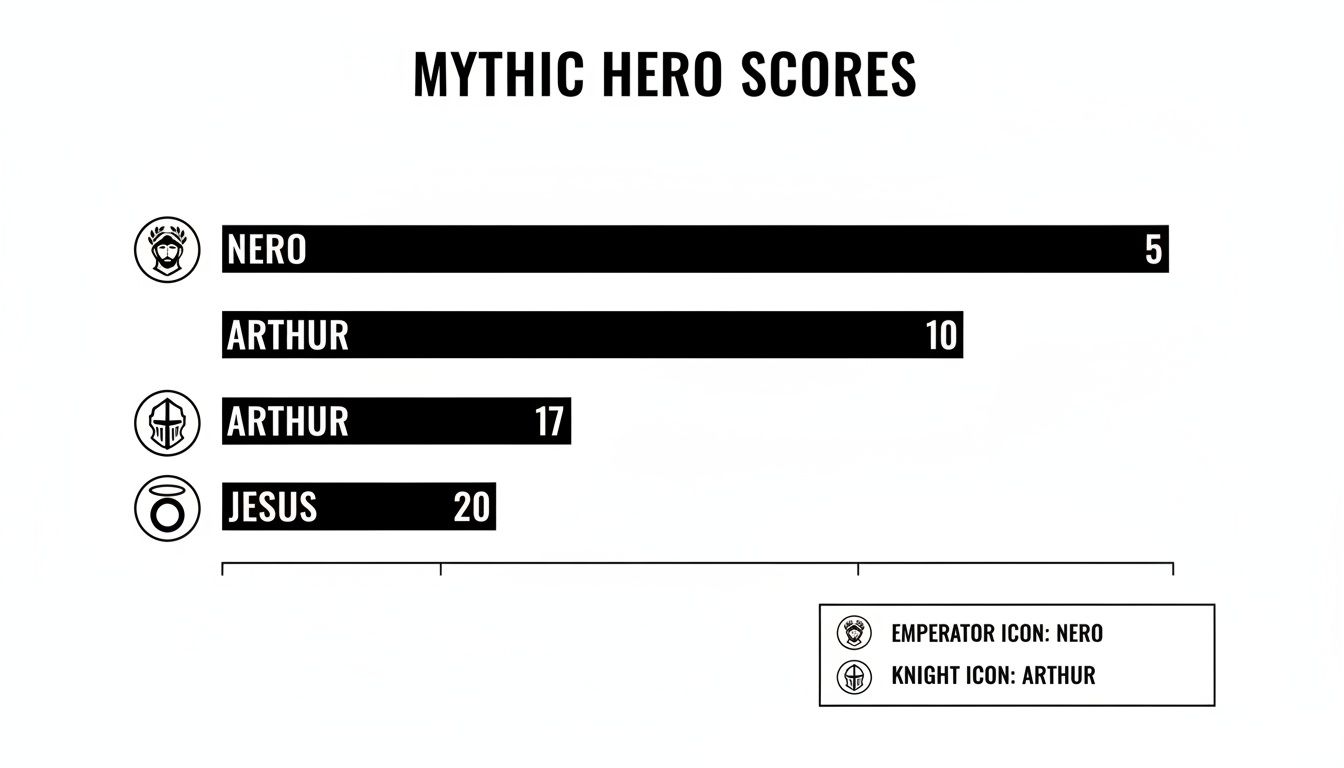
One such analytical tool is the Rank-Raglan scale, a 22-point checklist of archetypal traits common to hero narratives across cultures. Developed by Lord Raglan, the scale provides a quantitative method for assessing a figure’s alignment with universal mythic patterns versus a specific historical biography. A higher score suggests a character is more mythic in nature.
This method helps clarify the classification of complex figures:
- Historical Figures: The Roman Emperor Nero, a documented ruler, scores a 5.
- Legendary Figures: King Arthur scores a high 17, indicating his transformation from a potential historical figure into a legendary hero with strong mythic attributes.
- Mythic Figures: The founder of Rome, Romulus, scores an 18, suggesting his narrative is more myth than verifiable history. Jesus of Nazareth scores a 20, placing his narrative firmly within the mythic hero archetype, independent of scholarly debates about his historical existence.
These scores are not judgments on a figure’s historicity but analytical measures of a narrative’s structure. They reveal how deeply a story is woven into the universal patterns of mythic storytelling. Further exploration of such classification methods can be found in the field of comparative mythology on Wikipedia.
Euhemerism: The Theory of Deified History
The ancient theory of euhemerism, proposed by the Greek mythographer Euhemerus (c. 300 BCE), posits that the gods of mythology were originally historical human kings and heroes whose deeds became so exaggerated over time that they were eventually deified. This theory suggests that some myths may be ancient legends that have undergone a complete transformation from history to theology. While not universally applicable, euhemerism provides a valuable lens for examining certain mythologies, reminding us that the boundary between human hero and divine being can be fluid.
Conclusion
The fundamental difference between myth and legend lies in their connection to documented history. A legend is anchored, however tenuously, to a real person, place, or event, while a myth is a symbolic narrative operating outside of historical constraints to explain sacred origins and cosmic truths. This distinction informs their origins, their evolution, and their function within a society. Legends build a shared cultural identity by commemorating a common past, while myths provide the foundational charter for a community’s belief system.
From an analytical perspective, determining whether a story is “true” is less important than understanding its function. Both myths and legends are invaluable cultural artifacts that offer profound insights into the beliefs, values, and collective memory of the societies that produced them. Their value lies not in their factual accuracy, but in what they reveal about the human impulse to create meaning, structure society, and make sense of our place in the world. By approaching these narratives with scholarly rigor, we can appreciate their immense and enduring influence on human culture.
Frequently Asked Questions About Myths and Legends
Are myths and legends considered types of folklore?
Yes. In academic studies, both myth and legend are classified as major subcategories within the broader field of folklore. Folklore encompasses the entire body of a culture’s traditional beliefs, customs, and stories transmitted through generations. Folklorists categorize these narratives to analyze their origins and societal functions. Myths are sacred narratives concerning cosmology and the divine. Legends are stories grounded in a perceived historical reality. A third major category, folktales (or fairy tales), consists of fictional narratives, not presented as true, often set in an indeterminate time and place (e.g., “Once upon a time”).
Can a new, modern story be a myth or a legend?
In a strict scholarly sense, the terms “myth” and “legend” are typically reserved for traditional narratives that have evolved organically within a community over time, often through oral tradition. A modern novel or film created by a single author does not meet this classical definition. However, modern works can become legendary or develop mythic qualities. A historical film might create a portrayal of a real person that becomes more culturally influential than the documented facts, thus functioning as a modern legend. Similarly, a fantasy series can construct a “mythology” so comprehensive that it serves a similar cultural function for its audience. The key distinction remains the mode of origin: traditional myths and legends are collective, evolving cultural products, whereas modern stories are authored creations.
Why are the terms “myth” and “legend” so often confused?
The distinction becomes blurred in popular usage because both narrative forms are powerful cultural tools that often share common elements, such as heroic figures and extraordinary events. In casual language, “myth” is frequently used as a synonym for a falsehood, while “legend” can refer to any famous individual. This colloquial usage has diluted the more precise academic definitions. Furthermore, many traditional stories are hybrids, containing elements of both. The legend of King Arthur, for instance, is rooted in a supposed historical figure but is filled with mythic elements like the magical sword Excalibur. Such narratives do not fit neatly into a single category, requiring careful analysis to disentangle their historical and symbolic components.
