

Introduction: The Talisman as a Historical Document
The term talismanic describes an object believed to have been deliberately consecrated or “charged” with metaphysical properties to achieve a specific, active outcome. Distinct from a simple lucky charm or protective amulet, a talisman is historically understood as a constructed artifact, created through a precise, often ritualized process. This process might involve astrological timing, the inscription of specific symbols, or the use of materials believed to be in sympathetic resonance with cosmic forces.
For the researcher, a talisman is more than a folkloric curiosity; it is a tangible historical document. These objects offer a direct window into the cosmological, scientific (as it was then understood), and spiritual frameworks of the cultures that produced them. Studying what is considered talismanic allows us to trace the flow of ideas across civilizations—from Hellenistic philosophy and Arabic astral magic to European alchemy and modern psychological interpretations. This guide will provide a neutral analysis of the talisman’s origins, its evolution through different historical periods, and its place within various cultural and religious contexts.
Historical Origins: From Greek Rites to Arabic Science
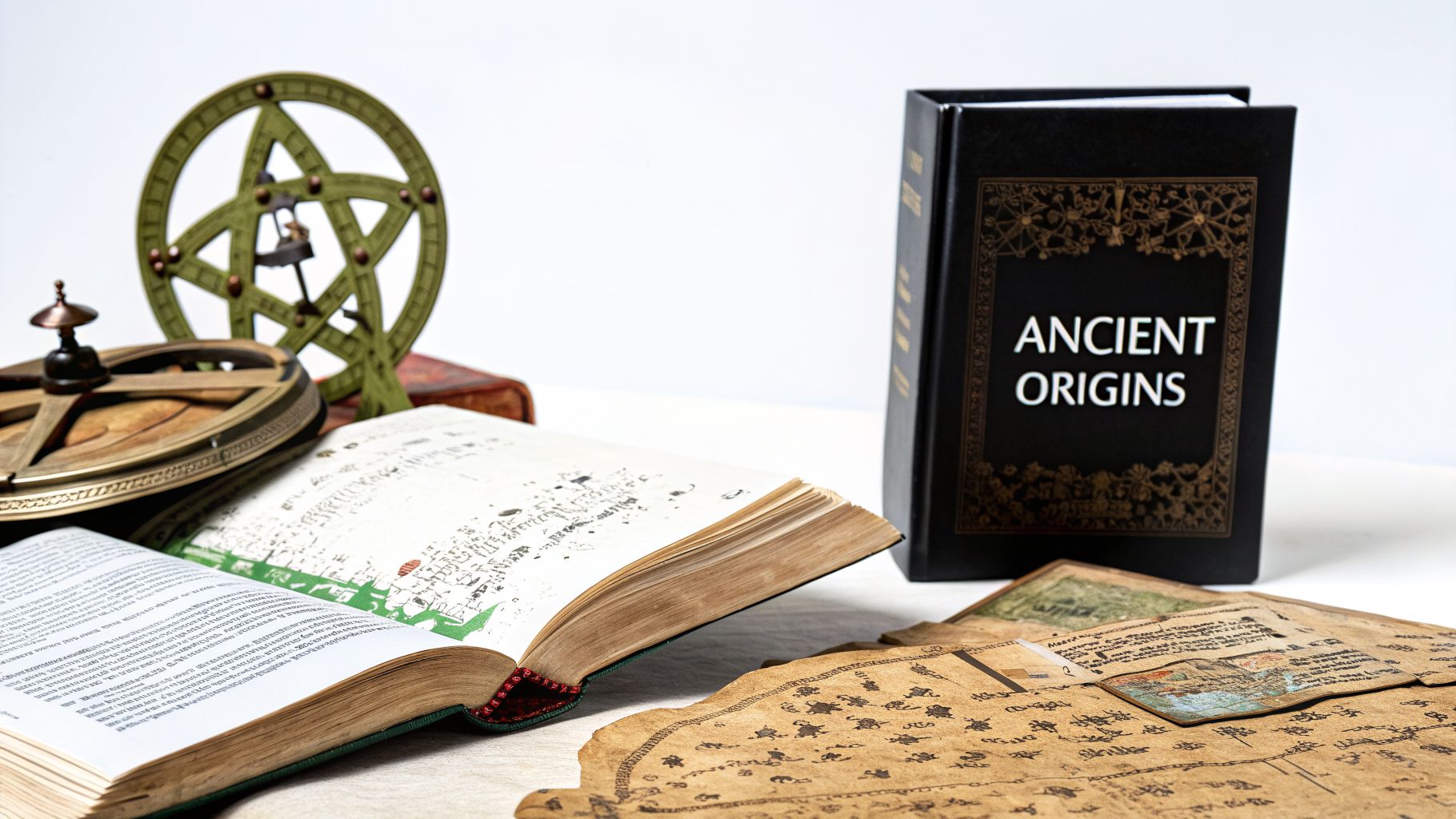
The etymological journey of the word “talisman” provides a clear map of its intellectual lineage. The term originates from the Byzantine Greek telesma (τέλεσμα), which translates to “consecration” or “initiation rite.” This linguistic root establishes a foundational concept: a talisman is not a naturally occurring object found by chance but is something intentionally perfected and imbued with purpose through a specific act of creation.
The Hellenistic Foundation and Arabic Elaboration
This Greek concept found fertile ground in the Arabic-speaking world during the Islamic Golden Age (c. 8th to 13th centuries). The Greek telesma was adapted into Arabic as ṭilasm (طلسم). It was within this intellectual milieu that the creation of talismans evolved into a sophisticated discipline, intertwining astrology, alchemy, and Neoplatonic philosophy.
Arabic scholars of the era viewed the cosmos as an interconnected system where celestial bodies—planets and stars—exerted tangible influences upon the terrestrial world. The talisman was conceptualized as a form of spiritual technology, a precisely engineered instrument designed to capture, store, and direct these cosmic energies toward a predetermined goal.
The prevailing belief was that if an object was constructed from appropriate materials, at a precisely calculated astrological moment, and inscribed with the correct symbols, it could function as a physical conduit for the powers of a specific celestial body.
The Picatrix: A Manual of Astrological Magic
The most comprehensive primary source for this practice is the Ghāyat al-Ḥakīm (“The Aim of the Sage”), an 11th-century Arabic grimoire that became known in Europe by its Latin title, the Picatrix. This text is effectively an operational manual for astrological magic, providing detailed instructions for creating talismans intended to produce a wide range of effects, from acquiring wealth to influencing the emotions of others. For broader context on the belief systems of this period, our guide to the history of mythology is a useful resource.
The Picatrix outlines a methodical, almost scientific, process for talismanic creation:
- Astrological Timing: Each operation had to commence at a specific celestial moment, typically during the planetary hour when the celestial body corresponding to the desired outcome was in its most astrologically dignified position.
- Material Correspondence: Every planet and star was associated with specific metals, stones, plants, and incenses. The use of these corresponding materials was considered essential to create the necessary sympathetic resonance to attract the desired cosmic influence.
- Symbolic Inscription: The object was required to be engraved with specific images, divine names, or characters believed to function as a metaphysical “address” for the celestial intelligence being invoked.
This highly structured methodology demonstrates that talismanic creation, within this historical context, was not a simple folk tradition but an intellectual discipline rooted in a complex cosmological worldview.
Distinguishing Talismans, Amulets, and Charms
To analyze historical artifacts and texts accurately, it is crucial to understand the functional distinctions between talismans, amulets, and charms—terms that historical practitioners rarely used interchangeably.
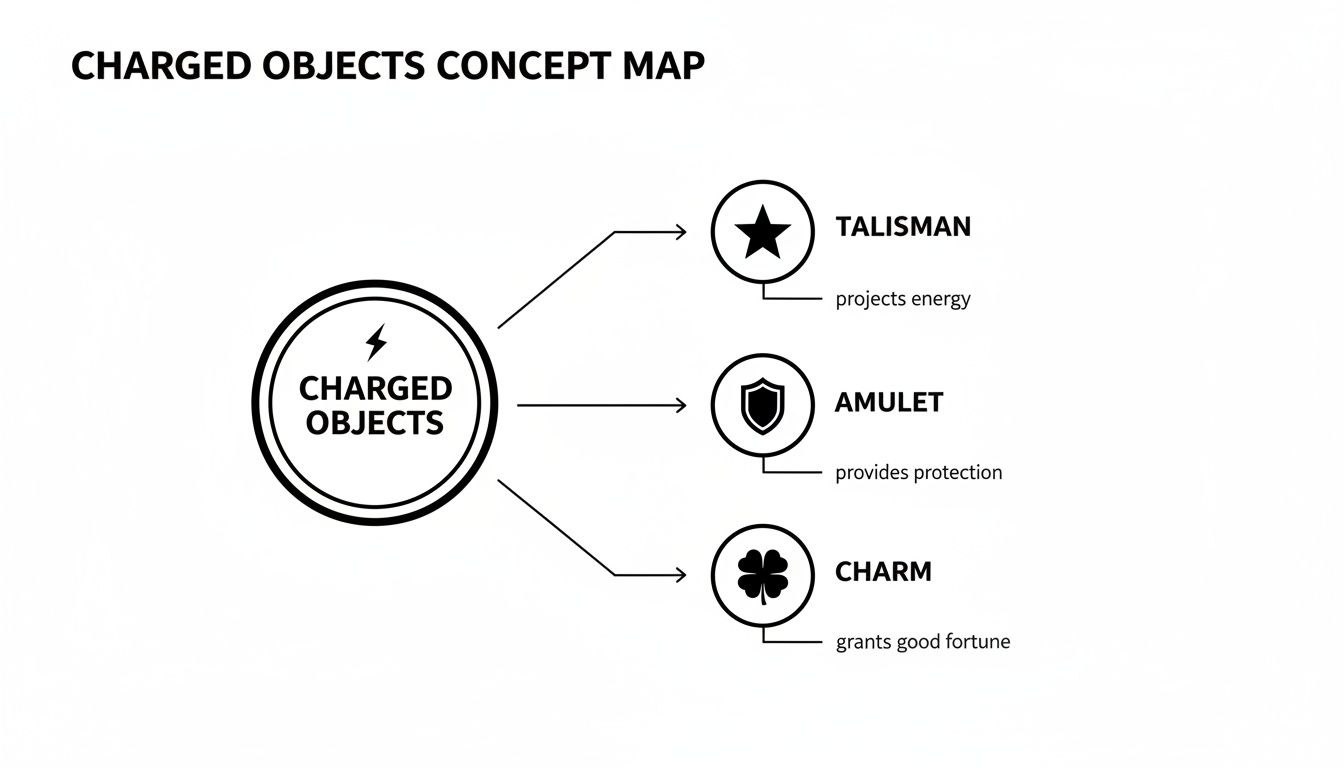
A talisman is designed to project power outward to achieve a specific goal. An amulet serves as a protective barrier for its wearer. A charm is intended to attract general good fortune. Acknowledging these differences is the first step toward understanding the specific intent behind these historical objects. For a more detailed examination, see our guide on the differences between amulets and talismans.
| Object Type | Primary Function | Creation Method | Belief System |
|---|---|---|---|
| Talisman | Active; to bring about a specific outcome or grant power (e.g., success, influence). | Intentionally created and “charged” through ritual, inscription, and astrological timing. | The object is a tool to actively channel and direct specific forces toward a goal. |
| Amulet | Passive; to protect the wearer from a general or specific danger (e.g., evil eye, illness). | Can be a natural object (e.g., a specific stone) or made, but its power is often seen as inherent. | The object serves as a protective shield, warding off negative influences or harm. |
| Charm | General; to attract good luck or positive fortune in a non-specific way. | Often a common, found object or a simple keepsake believed to hold good fortune. | The object is a passive bringer of luck, without the complex ritual of a talisman. |
Development Over Time: The European Renaissance and the Fusion of Traditions
The translation of Arabic scientific and philosophical works into Latin, beginning around the 12th century, introduced sophisticated talismanic concepts to European thinkers. This influx of knowledge from the Islamic world initiated a period of significant intellectual syncretism, where astrological magic blended with Europe's own traditions of folk belief and Christian theology.
In the courts and universities of Medieval and Renaissance Europe, talismanic construction was often viewed as a branch of natural philosophy—an attempt to understand and manipulate the hidden mechanisms of the universe. Simultaneously, among the general populace, the concept was simplified into the use of lucky objects crafted according to local folklore rather than complex astrological charts.
The Synthesis of Celestial Magic and Christian Relics
European talismanic practice was not a direct replication of Arabic models but a creative adaptation. Astrological symbols were often combined with angelic names, biblical verses, and Christian iconography, creating hybrid objects that navigated the ambiguous boundary between sanctioned religious devotion and proscribed magic.
A prime example of this synthesis is the Talisman of Charlemagne. This ninth-century artifact, likely created shortly after the emperor's death, is centered on a large sapphire and was reported to contain a relic—first a lock of the Virgin Mary's hair, and later a splinter of the True Cross. This object demonstrates the convergence of gemological lore, the artifice of a talisman, and the veneration of holy relics within a single piece.
The European talisman frequently served as a point of synthesis, where the perceived virtues of stars, gems, and saints were invoked collectively. An object might be crafted under a specific planetary alignment but consecrated with a Christian prayer, embodying the era's complex relationship with different sources of power.
This blending created a fundamental ambiguity that defined the talisman's societal role. Its interpretation as an instrument of divine will or a demonic pact often depended on the social status of its owner and the prevailing theological climate.
From Royal Prerogative to Heretical Artifact
The social perception of a talisman was heavily influenced by class. For monarchs and the nobility, commissioning talismans of precious metals and gems was a display of power and an assertion of a sophisticated command over natural forces. These objects were intended to secure a ruler's reign, ensure victory in battle, or protect health, and were generally seen as legitimate applications of science and faith.
For commoners, the practice was far more perilous. A village healer might create a simple charm to protect livestock or ensure a successful harvest. However, in the view of ecclesiastical authorities, particularly during the European witch hunts, the same act could be interpreted as evidence of malevolent witchcraft. Possession of an inscribed object or an unusual charm could be presented as proof of a pact with demonic forces. Our article on the history of witchcraft explores how these societal fears evolved.
This stark dichotomy illustrates the precarious position of talismanic belief. The meaning of an object—whether a tool of sacred protection or an artifact of heresy—was not inherent but was defined by its owner's social standing and the shifting boundary between sanctioned faith and condemned superstition.
Cultural and Religious Context: Sanctioned Objects and Folk Belief
The belief in ritually charged objects was not confined to esoteric circles but was often integrated into state and religious institutions, blurring the line between official practice and folk magic. This demonstrates that the desire for a tangible source of metaphysical power was a widespread human impulse, present at all levels of society.
The Royal Touch and Institutionally Approved Amulets
A clear example of this integration is the historical tradition of the royal touch. For centuries in England and France, it was believed that the monarch could cure scrofula (a skin disease known as "the king's evil") by laying on hands. In this context, the monarch's body functioned as a living talisman, a physical conduit for divinely sanctioned authority that produced a tangible healing effect.
This ritual was often supplemented by physical tokens. Special coins touched by the monarch were distributed to the afflicted to be carried as secondary talismans, believed to extend the king’s protective influence.
Even the Papacy, which officially condemned many forms of magic, occasionally sanctioned specific amuletic texts. These were documents containing prayers and divine names, designed to offer protection against demonic influence or physical harm.
In a notable case, Pope Urban VIII in 1635 officially approved certain protective formulae. These texts combined sophisticated demonological knowledge with Christian prayers, indicating that even the highest levels of the Church recognized a need for tangible, text-based objects to counter perceived supernatural threats.
Natural Talismans and Vernacular Belief
Beyond officially sanctioned rituals, everyday people found power in naturally occurring objects whose rarity or unusual origins marked them as special. One of the most valued was the caul—a fragment of the amniotic sac that occasionally covers a newborn's head.
The extreme rarity of a caul birth (occurring in fewer than 1 in 80,000 births) made it a potent natural amulet. For centuries, it was a highly sought-after item among sailors, who believed it offered protection against drowning. Advertisements for the sale of cauls could be found in 18th and 19th-century newspapers, showing how deeply this belief was embedded in popular culture.
These examples, from royal healing ceremonies to papally-approved prayers, illustrate that talismanic thinking was far from a purely occult practice. As documented in a scholarly article on the history of amulets, these objects were part of a worldview where the lines between early medicine, religious faith, and magical belief were often indistinct.
Modern Interpretation: The Talisman in a Secular Age
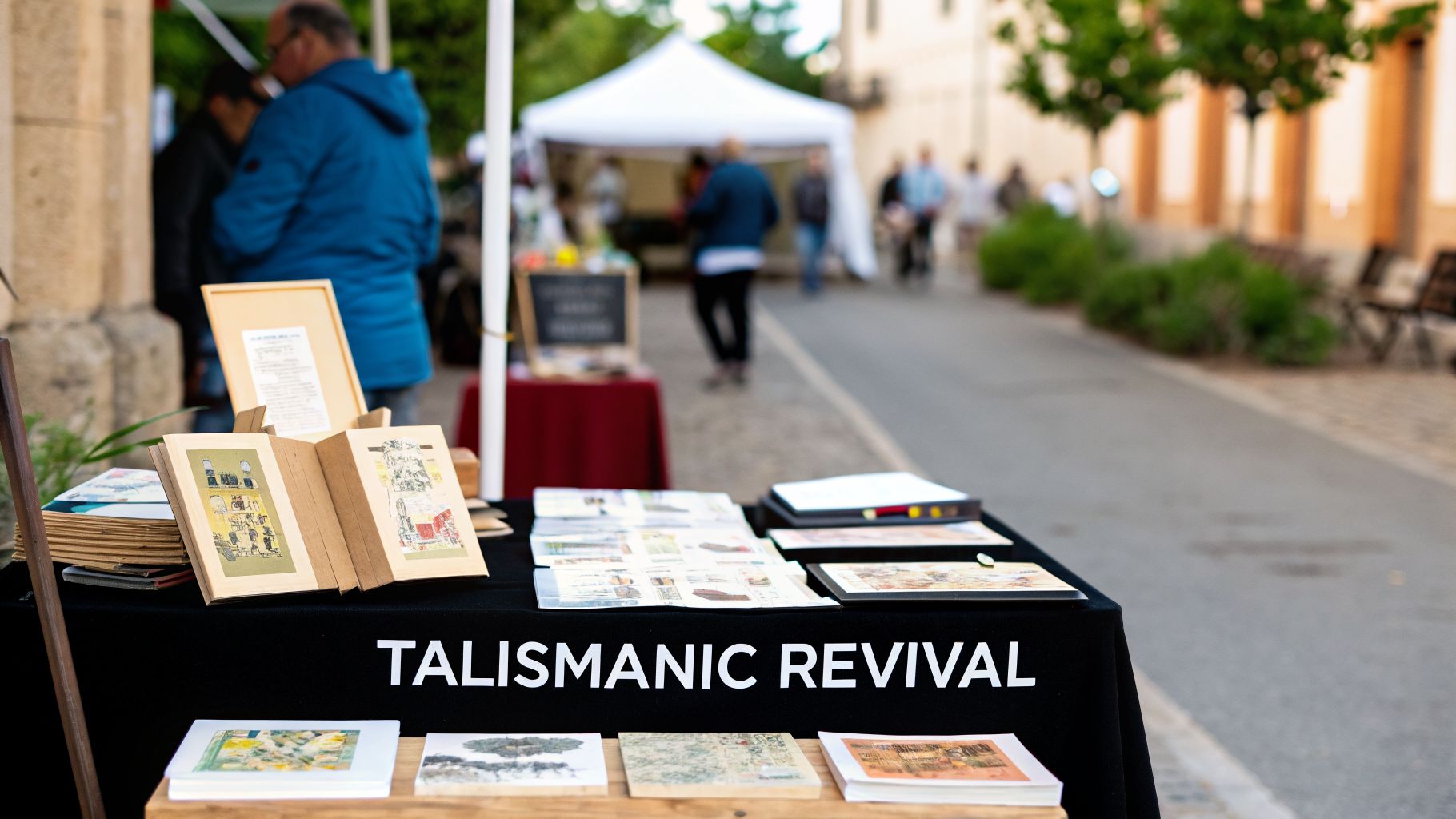
The 20th century witnessed a significant transformation in how talismanic knowledge was disseminated and perceived. For centuries, this information had been the domain of scholars and esoteric practitioners. However, the forces of mass media, global trade, and a rising public interest in occultism brought these practices into the public sphere. This shift led to a "democratization" of magical knowledge, moving it from a clandestine tradition to a commercial and cultural phenomenon.
Mass Media and the Commercialization of Magic
This transformation is particularly evident in Republican-era China (1912–1949). Amidst social upheaval, talismanic healing experienced a commercial boom. Practitioners moved from traditional temple settings into a competitive public marketplace. Figures like Yu Zhefu achieved celebrity status not by guarding their knowledge, but by mastering mass media and public performance.
Yu's Compendium of Talismans, published in 1922, became a bestseller, reaching its fifth edition by 1924. He built his reputation through elaborate public demonstrations, such as one in Shanghai in June 1924 that reportedly attracted over 1,000 spectators and lasted six hours. This marked a clear transition from a closed tradition to a form of mass-market occultism. However, by 1937, this public prominence led to a backlash from modernizers who re-framed the power of talismans not as supernatural but as a form of psychological suggestion—a debate that continues in modern discourse.
Globalization and the Material Culture of Talismans
This period also revealed the interconnectedness of talismanic traditions through global trade networks. The materials used in their creation began to reflect a blend of colonial exchange and local belief.
For instance, a collection of Islamic-African talismans from Togo, cataloged in 1914, provides a fascinating case study. These objects, created for spiritual protection, were inscribed not on traditional local materials but on paper bearing the watermarks of German and British paper mills. This detail shows how industrial goods from Europe were being integrated into traditional African spiritual practices.
The use of European paper in African talismans highlights a key feature of modern talismanic belief: adaptability. Practitioners were not rigid traditionalists but pragmatists, incorporating the most effective and available materials into their sacred work.
This fusion demonstrates that these traditions were not static but were dynamic systems that responded to changing global conditions. The perceived power lay in the ritual and inscription, not necessarily in the historical "purity" of the materials. Further analysis of these Chinese and African talismanic developments from this period provides deeper insight. The 20th century ultimately demystified much of the secrecy surrounding the talisman, transforming a hidden art into a public phenomenon and paving the way for the psychological and symbolic interpretations prevalent today.
Scholarly and Psychological Perspectives
Modern academic inquiry into talismans, primarily from fields like anthropology, folklore, and religious studies, does not focus on validating their supernatural claims. Instead, researchers investigate the complex human behaviors and belief systems that give these objects their profound meaning.
One prominent scholarly framework is psychological suggestion. From this perspective, a talisman functions as a powerful focusing tool for the bearer's intent. The belief in the object's power can enhance confidence, focus, and resilience, thereby influencing behavior and increasing the likelihood of achieving a desired outcome. The object serves as a "materialized belief"—a tangible representation of an abstract goal, making it feel more attainable.
From a material culture standpoint, talismans are seen as active agents in social life. The materials, craftsmanship, and history of an object all contribute layers of meaning. They can function as vessels of embodied knowledge (reflecting a society's cosmological understanding) and markers of social identity (signifying status or spiritual authority).
Finally, contemporary popular culture, particularly in fantasy literature and video games, has reshaped the modern understanding of the talisman. They are often depicted as "magic items" that provide quantifiable benefits, such as a numerical bonus to a character's attributes. While this has familiarized the concept globally, it also simplifies the historical reality, where a talisman's perceived efficacy was tied to a complex and deeply personal system of ritual, cosmic timing, and spiritual negotiation.
Conclusion: A Summary of a Documented Phenomenon
The historical record of the talisman reveals a fascinating narrative of human ingenuity at the intersection of science, faith, art, and medicine. To study these objects is not to endorse or dismiss their purported power, but to engage with the worldviews of those who created and used them. Each talisman is a physical artifact of a lived human experience, reflecting a fundamental desire to impose order on an uncertain world and to give hope a tangible form.
From the elaborate jewels crafted for Carolingian emperors to the mass-produced paper charms of 20th-century markets, these objects speak to a consistent human impulse. The enduring significance of the talisman lies in its ability to translate abstract concepts—power, protection, destiny—into a concrete, accessible form.
The talisman is not merely a relic of a "superstitious" past but a living tradition that has continuously adapted over millennia, incorporating new materials, technologies, and philosophical frameworks.
As historical documents, these artifacts offer an invaluable perspective on the societies that produced them. Whether forged in gold or drawn in ink, talismans remain a vital field of study, providing an unparalleled window into some of the most enduring patterns of human belief and behavior.
FAQ: Common Questions About the Talismanic Concept
What is the primary difference between a talisman and an amulet?
The core distinction is active versus passive function. An amulet is typically a passive object, often a natural item like a specific stone, believed to provide general protection by its inherent nature. It functions as a shield. A talisman is an active object, one that is deliberately constructed and ritually consecrated to achieve a specific, directed goal. It is designed to function as an engine or tool to actively cause change.
Are talismans found within major religions?
Yes, though often in a complex and contested relationship. Talismanic traditions have existed within or alongside major world religions, including esoteric Jewish traditions (Kabbalah), mystical Islamic schools (Sufism), and various folk Christian practices. Practitioners often incorporated religious elements—sacred names, scripture, holy symbols—into the construction of talismans. This frequently created tension with mainstream religious authorities, who often condemned such practices as superstition or heresy.
What did the historical creation of a talisman involve?
Based on historical sources like the Picatrix, the creation of a talisman was a precise, multi-stage process treated as a ritualized science. Key steps included:
- Material Selection: Choosing specific metals, stones, herbs, or other substances believed to be in sympathetic resonance with the desired celestial or spiritual forces.
- Astrological Timing: Performing the entire operation within a precise astrological window, such as a specific planetary hour on a specific day, to capture a cosmic influence at its peak potency.
- Symbolic Inscription: Engraving the object with planetary sigils, divine names, angelic scripts, or other relevant symbols intended to direct its power.
After construction, the object typically underwent a final ritual of consecration to "charge" it and formally activate its intended purpose.
At Hidden Mythos, we are dedicated to providing research-driven explorations of folklore, mythology, and historical belief systems. Discover more at https://www.hiddenmythos.com.
