

To understand the origins of witchcraft, one must peel back centuries of folklore, religious doctrine, and sensationalism. This subject’s history does not begin with a single event or in one specific place. Instead, it is a complex tapestry of beliefs concerning magic, sorcery, and supernatural harm that has been documented for millennia.
These concepts are woven into some of humanity’s earliest written records. They appear in Mesopotamian legal codes and in Roman laws designed to punish harmful magic, long before the European witch hunts of the early modern period. This indicates that the fear of witchcraft is not a recent invention but a deep-seated historical phenomenon, born from a timeless struggle to explain misfortune and exert control over an unpredictable world.
This guide provides a neutral, analytical overview of witchcraft’s documented development, examining it as a significant cultural and historical force.
Historical Origins

As an independent folklore researcher documenting historical belief systems for Hidden Mythos, my objective is to approach paranormal topics through an analytical lens. This guide serves as a scholarly map, tracing the evolution of witchcraft from ancient civilizations to its modern interpretations. The focus is not on magical practice but on understanding witchcraft as a concept that has shaped laws, societies, and human psychology for thousands of years.
At the core of this history is the concept of maleficium, a Latin term for the act of causing harm through supernatural means. Understanding how this idea became a focal point for social anxiety and legal persecution is fundamental to unlocking the historical narrative of witchcraft.
Our analysis is guided by historical records, not popular fiction. To construct a clear, evidence-based picture, this article relies on primary sources and scholarly work, which helps distinguish between documented historical beliefs and later myths.
We will examine:
- Ancient Legal Codes: How early societies like Mesopotamia and Rome legally addressed accusations of harmful sorcery.
- Theological Treatises: How religious texts and authorities gradually reframed and, eventually, demonized pre-existing folk practices.
- Trial Records: How legal documents from witch trials offer a direct window into societal fears and the mechanics of persecution.
- Folk Traditions: The role of village healers, “cunning folk,” and magical practitioners before the era of widespread hunts.
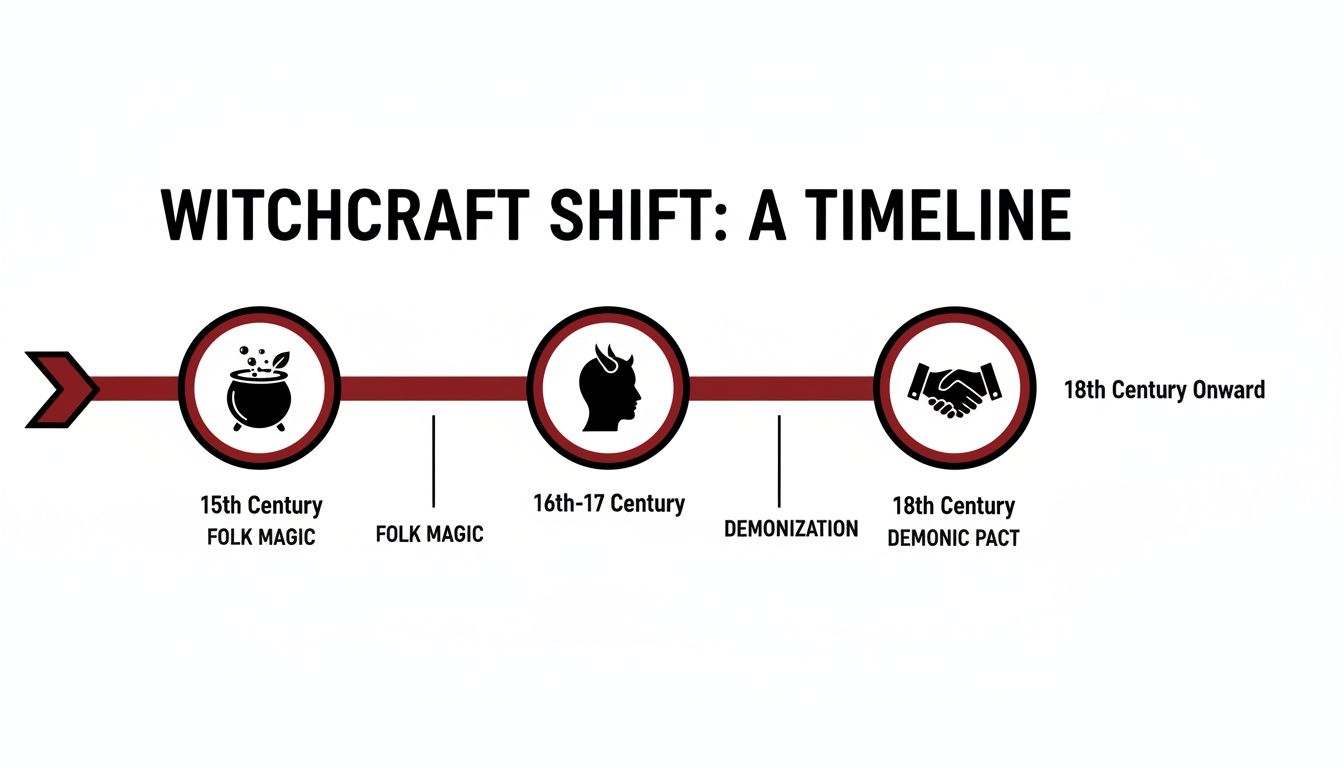
The distinction between localized folk magic and the later, elite theory of demonic witchcraft is crucial. For centuries, folk magic was often an accepted, if unregulated, part of community life. The significant shift occurred when religious and secular authorities began to interpret it not as simple sorcery, but as part of an organized, diabolical conspiracy against God and the state.
This guide is intended for those seeking a deeper, evidence-based examination of one of history’s most persistent and misunderstood subjects. Further research can be found in our section on witchcraft history. Together, we will examine how these beliefs formed, why they culminated in persecution, and what their complex legacy entails.
Development Over Time
To locate the earliest documented conceptions of witchcraft, one must look much further back than medieval Europe. The belief that individuals could use supernatural means to influence the world was a core component of how early societies interpreted their existence. For these cultures, magic was not necessarily distinct from religion or what would later be termed science; it was an integrated tool for navigating a world perceived to be teeming with invisible forces.
From the outset, these ancient cultures often drew a clear distinction between different forms of magic. On one side was sanctioned magic, performed by priests or state-approved specialists for purposes such as healing, protection, or divination. On the other was forbidden or malevolent sorcery, intended to harm individuals, damage crops, or cause chaos. This harmful magic, later termed maleficium, is where the conceptual seed of witchcraft was planted.
The Slow Demonization of Folk Traditions
As the ancient world transitioned into the Middle Ages, European conceptions of witchcraft began a slow but irrevocable transformation. The spread of Christianity across the continent initiated a lengthy process in which pre-Christian pagan beliefs and folk traditions were either assimilated into a Christian worldview or, more significantly, condemned as demonic.
In the early medieval period, magical practices were largely viewed as superstition rather than organized evil. Early legal codes, such as the Frankish Lex Salica (c. 500 CE), treated harmful magic as a secular crime, comparable to assault or property damage, with punishments typically involving fines. The legal focus was on the tangible harm caused, not the supernatural source of the power.
However, as the institutional power of the Church grew, theologians began to reframe these persistent traditions. A village healer known for herbal remedies could now be viewed with suspicion, with her knowledge attributed to a sinister, unholy source. This theological shift gradually morphed the figure of the local “cunning person”—a morally ambiguous but often necessary community member—into an agent of diabolical forces.
The Ideological Turning Point
The 15th century marked a critical turning point. During this period, the intellectual and legal framework for the great European witch hunts was constructed. This was not a panic that emerged from the peasantry; it was a top-down redefinition of the “witch” engineered by educated theologians, lawyers, and inquisitors.
Their central innovation was the concept of the demonic pact. According to this new doctrine, a witch was no longer merely a practitioner of harmful magic. She was a heretic who had made a conscious, formal agreement with Satan. By renouncing God, she purportedly received supernatural powers to aid the Devil in his war against Christendom.
This redefinition elevated witchcraft from a local crime to the ultimate act of treason against God. The witch was now conceptualized as a soldier in an organized, conspiratorial war against humanity.
This new demonic theory held that witches gathered for nocturnal Sabbaths, where they allegedly engaged in obscene rituals, cannibalized infants, and paid homage to their dark master. This horrifying narrative created a standardized template for accusations that would prove devastatingly effective in subsequent centuries.
This new theology was codified in the Malleus Maleficarum (“The Hammer of Witches”), published in 1487 by the German inquisitor Heinrich Kramer. This text became an influential manual for witch-hunters across Europe.
The Malleus Maleficarum was significant for several reasons:
- Systematized the Threat: It presented a systematic theological argument that a vast demonic conspiracy of witches was not only possible but actively at work.
- Provided Legal Framework: It offered a guide for prosecuting witches, detailing methods of interrogation, torture, and conviction.
- Gendered the Accusation: The book is profoundly misogynistic, arguing that women, due to their perceived moral and intellectual inferiority, were far more susceptible to demonic influence.
Aided by the invention of the printing press, the book’s ideas disseminated widely, providing inquisitors and secular courts with the intellectual justification to transform local superstitions into a battle for the soul of Christendom.
Cultural and Religious Context
The intellectual framework established in the late Middle Ages set the stage for one of Europe’s most tragic historical periods. The era between approximately 1450 and 1750 saw a dramatic increase in the prosecution of individuals accused of witchcraft. This was not a uniform, continent-wide event but a complex phenomenon that erupted in different regions at different times, driven by a convergence of religious conflict, social anxiety, and legal innovation.
The Great European Witch Hunts intensified during the 16th and 17th centuries, coinciding with the Protestant Reformation and the Catholic Counter-Reformation. As both sides sought to demonstrate their piety, they targeted perceived evil within their communities, and the demonic witch became a potent scapegoat.
Early Conceptions in Law and Myth
The fear of harmful magic is documented in some of the earliest legal and literary sources.
- Ancient Near East: The first known laws against harmful magic appear in ancient Mesopotamia. The Code of Hammurabi (c. 1754 BCE) did not just mention sorcery; it established a formal legal process for its prosecution. Law 2 stipulated a trial by ordeal for accused sorcerers, indicating that such accusations were a serious social problem requiring state intervention.
- Mediterranean World: The belief in malevolent magic was widespread in classical Greece and Rome. The figure of the witch was often associated with women who used maleficium to cause misfortune. As early as the 2nd century BCE, Roman authorities conducted organized witch hunts. Rome’s foundational legal text, the Twelve Tables (c. 450 BCE), explicitly outlawed the casting of evil spells and the magical destruction of crops, linking the fear of witchcraft directly to agricultural and social stability. You can explore these early societal responses further on Britannica.com.
The European Hunts in Profile
Historical estimates suggest that approximately 100,000 people were formally prosecuted for witchcraft across Europe, with between 40,000 and 60,000 executions. The epicenter of these hunts was not in Spain or Italy, where the Inquisition was often skeptical of witchcraft claims, but in the politically fragmented territories of west-central Europe, including modern-day Germany, Switzerland, and parts of France. More information on this period can be found in analyses of the 17th-century world of witchcraft.
The accused overwhelmingly fit a specific demographic profile. While men and children were also accused, approximately 75% to 80% of the victims were women. They were often:
- Socially Marginalized: Poor, elderly, and widowed individuals lacking familial protection were easy targets for communal blame.
- Healers and Midwives: Women with traditional knowledge of herbalism were suspect, as their skills could be reframed as sinister, particularly in cases of death or illness.
- “Disorderly” Women: Women who defied social norms or were perceived as argumentative were vulnerable to accusations that served as a tool for enforcing patriarchal control.
The Salem Witch Trials of 1692 in colonial America represent a late, small-scale iteration of these European patterns. In a climate of intense community stress, 20 people were executed based on similar accusations. Our detailed guide explores what were the Salem witch trials.
The hunts were driven by a confluence of factors. Economic hardship, crop failures, and disease created a climate of fear. The legal system also played a critical role; a shift to an inquisitorial system, where a magistrate led investigations, empowered authorities to actively pursue witches. The sanctioned use of torture to extract confessions created a feedback loop, causing panics to spread as victims implicated others under duress.
Modern Interpretation
The great European witch hunts did not end abruptly but gradually declined with the rise of the Enlightenment. As 18th-century intellectual elites grew skeptical of demonic conspiracies, states began to decriminalize witchcraft. However, folk beliefs in maleficium persisted in many rural areas long after the official trials ceased.
A Persistent Global Belief
Belief in witchcraft remains a significant global phenomenon. A 2022 study based on survey data from 95 countries, covering approximately half the world’s adult population, found that an average of 43% of people believe in witchcraft. This equates to nearly one billion individuals.
Belief varies significantly by region, from over 90% in Tunisia to just 9% in Sweden. The data suggests that this belief is a dynamic cultural force, often intertwined with regional histories, such as the lingering trauma of the transatlantic slave trade in parts of Africa and the Americas. The full research published in PLOS ONE provides a detailed analysis of these global patterns.
The Reclaimed Witch
In the Western world, the figure of the witch has been radically reinterpreted and reclaimed as a symbol of empowerment, rebellion, and spiritual autonomy.
This transformation is evident in several key areas:
- Feminist Symbol: During the second-wave feminist movement of the 1960s and 1970s, the witch became a metaphor for the independent woman persecuted for defying patriarchal control—a symbol of female wisdom and resistance.
- Popular Culture: Contemporary film and television have largely severed the witch’s connection to demonic forces, rebranding the figure as a wielder of natural or innate power, ranging from benevolent guides to complex anti-heroes.
- Neopagan Spirituality: The 20th century saw the emergence of new religious movements like Wicca. Founded in the 1950s, Wicca and other modern Pagan paths embrace the term “witch.” Their practices are typically nature-based and honor both gods and goddesses, representing a complete inversion of the historical demonic caricature.
For modern practitioners, witchcraft is not about diabolism but is a life-affirming spiritual path focused on personal growth, healing, and connection to the natural world.
This dual legacy—the persistence of traditional fears in some parts of the world and the reclamation of the witch as a positive icon in others—testifies to the concept’s remarkable adaptability.
Conclusion
The historical record demonstrates that “witchcraft” has never been a monolithic concept. It is a fluid and complex term that has adapted over millennia to reflect the anxieties and cultural pressures of its time. What a Mesopotamian scribe feared as sorcery is vastly different from the demonic conspiracies conceived by medieval inquisitors. Our mission at Hidden Mythos is to trace this evolution with a firm grounding in historical evidence.
This analysis focuses on documented belief and its societal consequences, not the validation of supernatural claims. The court records of the European witch hunts do not prove the existence of satanic pacts, but they do provide undeniable evidence of a society gripped by a profound and deadly fear. They reveal how a legal system can be used to translate collective terror into tragic reality.
By examining these records, we gain insight into timeless human dynamics: the need for social control, the power of moral panic, and the tendency to scapegoat the marginalized in times of crisis.
Understanding this history is not merely an academic exercise. The patterns of accusation and persecution that fueled the witch trials offer crucial lessons about the dangers of mass hysteria, a subject explored in our articles on historical hysteria.
Tracing the origins of witchcraft is ultimately an inquiry into the human response to the unknown. It is a story of how cultures have sought to explain misfortune, enforce social order, and delineate the sacred from the profane, leaving a rich and often tragic record from which we can learn.
FAQ: Common Questions on the Origins of Witchcraft
What is the difference between historical witchcraft and modern Wicca?
Historical witchcraft refers to the pre-modern belief that certain individuals could cause harm (maleficium) through supernatural means, often believed to stem from a demonic pact. This was not a self-identity but a deadly accusation imposed by others. Wicca is a modern pagan religion founded in the mid-20th century. Its practitioners self-identify as Wiccans or witches and follow a nature-based, life-affirming spiritual path. There is no direct historical continuity between the victims of the witch hunts and modern Wiccans.
Did people accused during the witch hunts actually worship the Devil?
There is no credible historical evidence to suggest that the thousands executed during the great witch hunts were members of an organized, Devil-worshipping cult. The concept of the demonic pact and the witches’ Sabbath was a theological construct developed by inquisitors and demonologists. “Confessions” were almost invariably extracted under intense physical and psychological torture, with victims repeating the narratives provided by their interrogators.
Were the witch hunts solely motivated by religion?
While religious doctrine provided the justification for the witch hunts, they were a complex socio-historical phenomenon fueled by multiple factors. Social and economic anxieties were major drivers. Accusations often served as a means of social control (enforcing conformity, especially among women), scapegoating (blaming individuals for misfortunes like crop failure or disease), and sometimes economic opportunism (settling grudges or seizing property). The combination of these worldly concerns with a potent religious ideology created the conditions for mass persecution.
