

Introduction: Documenting a Pre-Christian Pantheon
The deities venerated by the Norse peoples of early medieval Scandinavia were not merely characters in myth; they formed the structural core of a belief system that informed law, culture, and daily life for centuries. This pantheon is primarily categorized into two divine clans: the Æsir, associated with governance and martial power, and the Vanir, linked to fertility and the natural world. Their complex relationship and eventual integration represent a central theme in the surviving corpus of Norse mythology.
This guide provides a documented analysis of these deities, grounded in the historical and archaeological record. The objective is to examine the Norse gods and goddesses not as modern fictional archetypes, but as they were understood within their original cultural context. This requires a careful reading of primary source texts and an interpretation of archaeological evidence, separating historically attested beliefs from later embellishments. By examining these figures through the lens of academic research, we can better understand their significance to the societies that revered them.
Historical Origins and Primary Sources
An understanding of the Norse gods and goddesses is fundamentally reliant on a small collection of medieval Icelandic manuscripts. Unlike faiths with a single, codified holy book, Norse belief must be reconstructed from disparate sources, most of which were documented centuries after the Christianization of Scandinavia. This temporal and cultural distance presents a significant challenge for modern researchers.
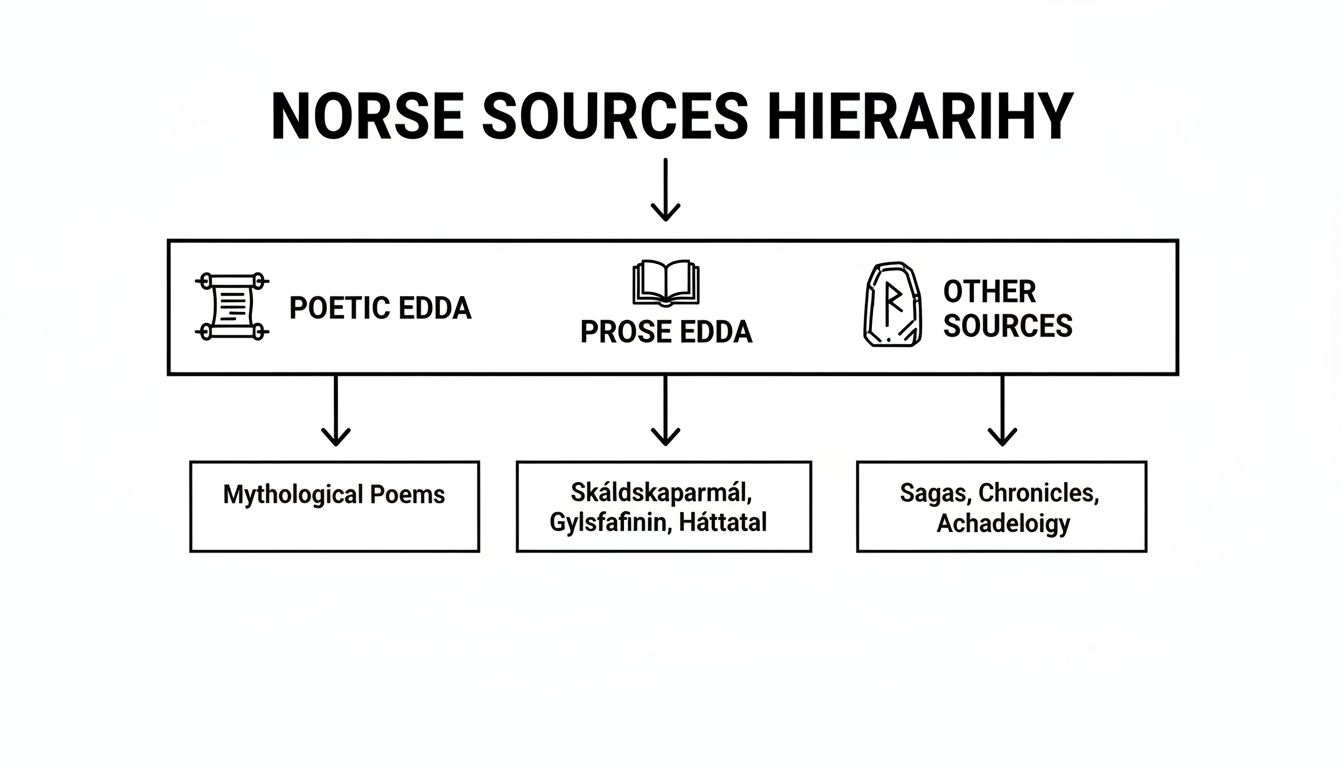
The primary literary foundations are the Poetic Edda and the Prose Edda, both compiled in 13th-century Iceland.
- The Poetic Edda is an anonymous anthology of Old Norse poems, believed to be transcriptions of a much older oral tradition. These texts contain some of the most vivid accounts of Norse cosmology, including the creation myth, the war between the Æsir and Vanir, and the prophecy of Ragnarök. Scholars often consider these poems to be the closest available source to pre-Christian pagan thought.
- The Prose Edda was authored around 1220 CE by Snorri Sturluson, an Icelandic historian, poet, and chieftain. Intended as a manual for aspiring poets, it explains the mythological allusions and complex metaphors (kennings) of skaldic poetry. However, Snorri was a Christian writing for a Christian audience. He frequently employs euhemerism, a framework that presents the gods as powerful human kings and heroes from the distant past who were later deified by mistake.
The challenge for any historian is to piece together a living faith from texts written long after its decline. One must critically assess how the Christian perspective of the scribes may have shaped the narratives, using archaeology and comparative mythology to contextualize the material.
To build a more complete picture, researchers look beyond the Eddas to other forms of evidence:
- Skaldic Poetry: Composed by court poets (skalds) during the Viking Age, these intricate verses often contain direct mythological references. As many can be dated to the pre-Christian era, they provide contemporary evidence of which deities were prominent.
- Sagas: Icelandic sagas, primarily prose histories of families and individuals, are replete with references to pagan practices, oaths sworn to gods, and instances of perceived divine intervention. They offer insight into how the Norse gods and goddesses were believed to interact with the mortal world.
- Runestones: Inscriptions on memorial stones across Scandinavia often feature mythological imagery or invoke specific gods for protection. The Altuna Runestone in Sweden, for example, depicts a scene widely interpreted as Thor’s fishing expedition to catch the world-serpent, Jörmungandr.
- Archaeological Evidence: Physical artifacts provide a tangible link to pre-Christian religious practices. The widespread discovery of Mjölnir (Thor’s hammer) amulets from Iceland to England attests to the broad popularity of Thor as a protective deity. Excavations of ritual sites, such as the cult house at Uppåkra, Sweden, offer physical proof of organized worship. To better grasp the distinction between these narratives and historical accounts, it helps to understand the difference between myth and legend.
Development and Evolution of Belief
The pantheon of Norse gods was not static; its composition and the prominence of individual deities evolved over time and varied by region. Evidence suggests that the pantheon recorded by Snorri Sturluson in the 13th century represents a late, systematized version of a more fluid and diverse set of beliefs.
The central mythological event that structures the pantheon is the Æsir-Vanir War. This narrative, detailed in poems like Völuspá and in the Prose Edda, describes a primordial conflict between the two divine tribes. The Æsir, led by Odin, were gods associated with sovereignty, war, and societal order. The Vanir, including figures like Freyja and Freyr, were deities of fertility, prosperity, and the natural world. The war concluded not with conquest, but with a truce and an exchange of hostages, leading to an integrated pantheon. Scholars like Georges Dumézil have interpreted this as a foundational myth reflecting the unification of different societal functions—the sovereign/warrior class and the cultivator class—within a single belief system.
Place-name evidence and archaeological finds suggest regional variations in worship. In Sweden, particularly around Lake Mälaren, evidence points to a strong cult centered on Freyr and the Vanir, associated with fertility and kingship. In contrast, the settlement of Iceland from the 9th century onward shows a marked preference for Thor. His name appears frequently in personal names and place names, while Odin’s is notably absent from early Icelandic toponymy. This suggests that the settlers, engaged in the difficult work of establishing new farms and communities, predominantly venerated Thor as a protector and patron.
The transition to Christianity in the 10th and 11th centuries marked the most significant shift. As formal pagan worship was suppressed, the gods were gradually reframed. Christian writers and chroniclers often depicted them either as malevolent demons or, following Snorri’s euhemeristic approach, as historical human figures. Yet, elements of their character and stories survived for centuries in folk beliefs and traditions, detached from their original religious context. For further context on such shifts, see our overview of the history of mythology.
Cultural and Religious Context
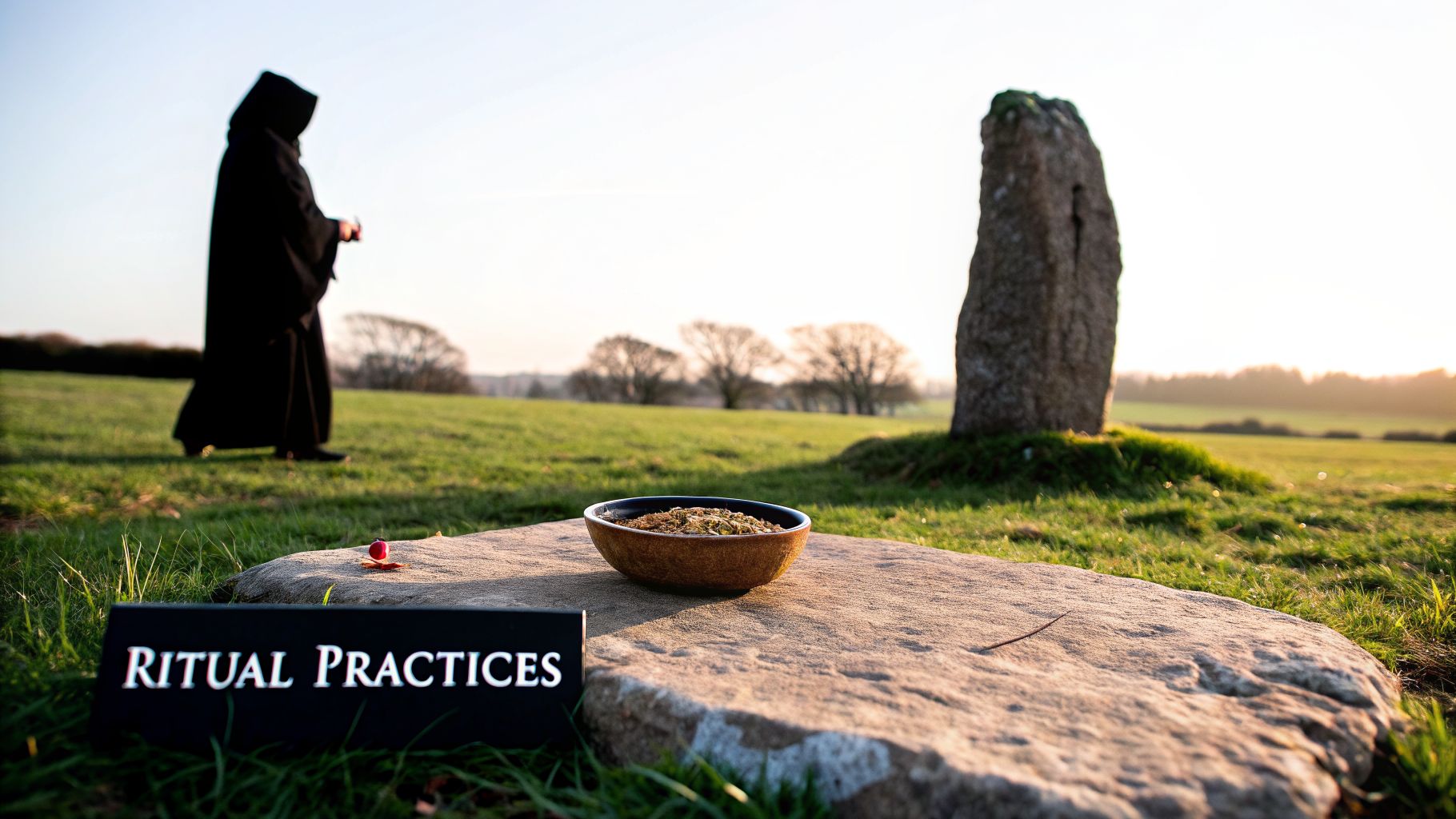
For the peoples of the Viking Age, the Norse gods and goddesses were integral to the functioning of the cosmos and society. Religious practice was not a separate sphere of life but was interwoven with agriculture, law, travel, and warfare. The core of this religious practice appears to have been based on reciprocity: gifts were given to the gods to secure their favor and maintain cosmic balance.
The central ritual was the blót, a sacrificial feast. According to sources like the Heimskringla, these were communal events where animals were sacrificed. The blood was sprinkled on altars and participants, while the meat was cooked and shared in a communal meal. These feasts served not only to honor the gods but also to reinforce social bonds within the community.
Worship was often conducted in natural settings. Hörgr (sacred stone piles or altars) and sacred groves were common sites of veneration. For larger, more formalized gatherings, chieftains sometimes maintained large wooden halls known as hof (temples or cult houses). Archaeological evidence from sites like Uppåkra in Sweden suggests these were significant centers for ritual activity over many centuries. Religious authority was often held by the local chieftain or community leader, known as a goði, who was responsible for organizing rituals and maintaining the cult site.
Different deities were invoked for specific needs. A warrior might call upon Odin for strategy or Týr for victory in a duel. A farmer would likely make offerings to Freyr or Thor for a good harvest and favorable weather. Thor’s role as a protector of Midgard (the human realm) made him an exceptionally popular deity for general protection. The proliferation of Mjölnir amulets underscores his function as a guardian figure. This practice reflects a broader human tradition; for more, see our guide on the history and use of amulets and talismans.
Freyja, a deity of the Vanir tribe, held a particularly complex and prominent position. She was associated with love, beauty, and fertility, but also with war, death, and a form of magic known as seiðr. The Prose Edda states that she receives half of the warriors slain in battle in her hall, Fólkvangr, a role that places her on equal footing with Odin. This dual association with both life-giving fertility and death makes her one of the most powerful and significant figures in the pantheon. For additional information, see the roles of Norse gods and goddesses at HistoryExtra.
Modern Interpretation and Legacy
Following the Christianization of Scandinavia, the Norse gods were relegated from objects of worship to figures of folklore and literature. They were not, however, forgotten. They persisted in folk tales, ballads, and local superstitions for centuries.
A significant revival of interest occurred during the 19th-century National Romantic movement in Germany and Scandinavia. In a search for a distinct national identity separate from Greco-Roman classicism, scholars, artists, and writers turned to their pre-Christian past. Figures like Richard Wagner, with his opera cycle Der Ring des Nibelungen, reinterpreted the myths on a grand, heroic scale. This era cemented the Norse gods as powerful symbols of a uniquely Germanic and Nordic cultural heritage, though often at the cost of the original mythological nuances.
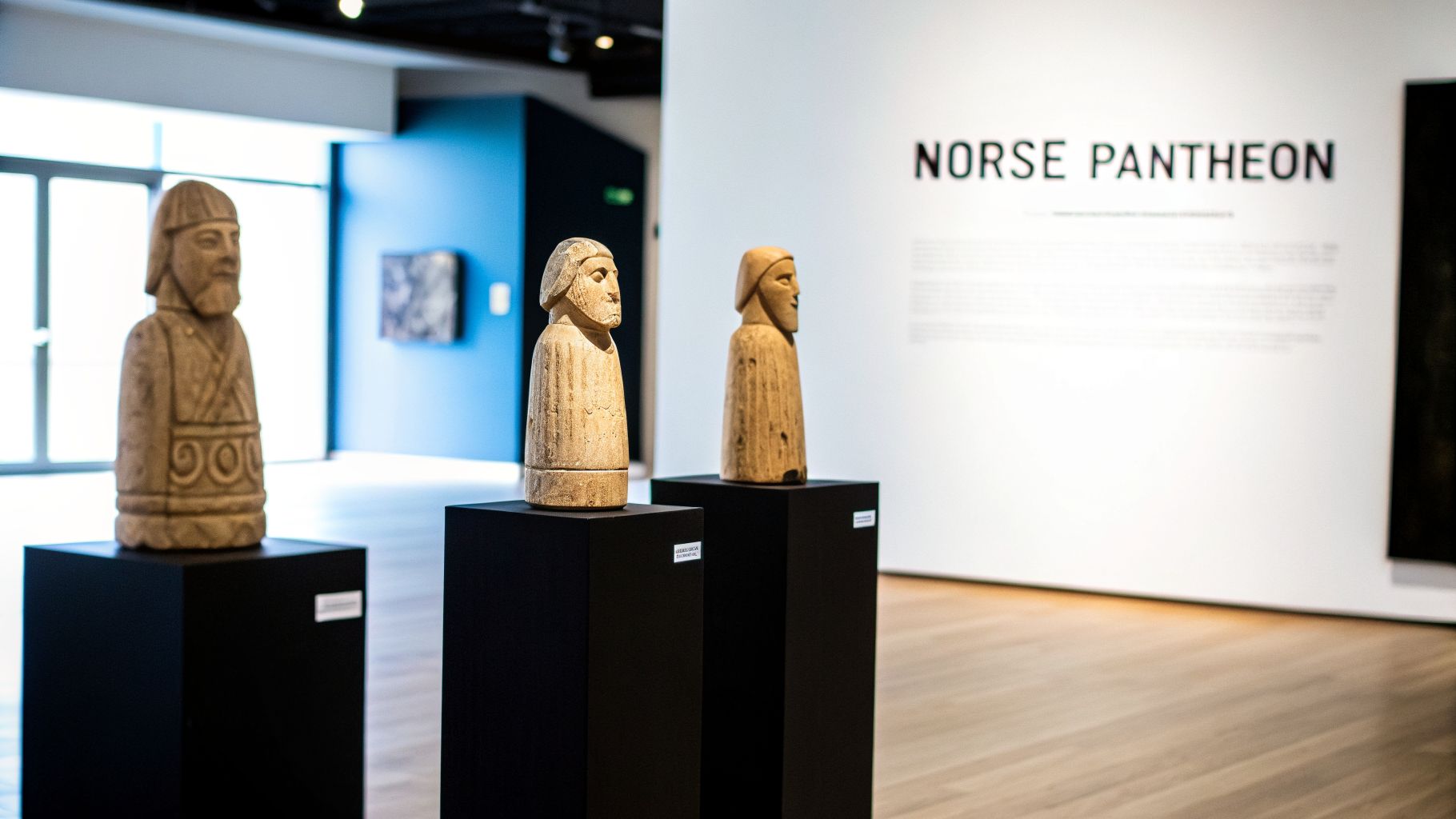
In contemporary times, this legacy has bifurcated. On one hand, the Norse gods and goddesses have become fixtures of popular culture. This trend was heavily influenced by J.R.R. Tolkien, a philologist of Old Norse, whose conception of Middle-earth drew heavily on Norse cosmology. Today, the deities are widely known through their depiction as superheroes in comic books and films, or as protagonists and antagonists in video games. These adaptations serve as the latest reinterpretations, adapting ancient figures for modern audiences.
On the other hand, the 20th and 21st centuries have seen the emergence of modern pagan religious movements, often broadly termed Heathenry or, more specifically, Ásatrú. Adherents of these faiths seek to reconstruct the pre-Christian religious practices of the Germanic peoples based on the available historical sources.
It is crucial to recognize these as modern reconstructionist religions. They do not represent an unbroken lineage from the Viking Age but are a conscious effort by contemporary individuals to build a meaningful spiritual framework from historical texts, archaeological findings, and academic research.
These living faiths demonstrate the enduring power of the Norse mythological corpus to serve as a source of cultural, spiritual, and personal identity in the modern world. More on the specifics of Norse pagan belief can be found by consulting academic sources like the entry on Old Norse religious practices on Wikipedia.
Conclusion: A Pantheon Preserved in Text and Stone
The Norse gods and goddesses represent a complex and dynamic belief system that was central to the worldview of early medieval Scandinavians. Our understanding of this pantheon is a reconstruction, pieced together from a limited number of Christian-era manuscripts, corroborating poetic verse, runic inscriptions, and archaeological finds.
The division between the Æsir and Vanir, the preeminence of figures like Odin, Thor, and Freyja, and the intricate web of relationships with other beings like the jötnar and dvergar all reflect a worldview concerned with the balance between order and chaos, society and nature, fate and free will. Ritual practices such as the blót and the veneration of sacred natural sites demonstrate a faith deeply integrated into the practicalities of daily life.
Though formal worship ceased a millennium ago, these deities have demonstrated remarkable resilience. They have transitioned from religious figures to folkloric characters, to symbols of national identity, and finally to global icons of popular culture and the focus of modern reconstructionist faiths. The study of the Norse gods and goddesses is therefore not just an exploration of ancient myth; it is an examination of how powerful stories are preserved, reinterpreted, and given new meaning across centuries.
Frequently Asked Questions (FAQ)
What is the distinction between the Æsir and the Vanir?
The Æsir and Vanir are two families of gods. The Æsir, including Odin and Thor, are generally associated with power, war, law, and social order. The Vanir, such as Freyja and Freyr, are associated with fertility, prosperity, nature, and a specific form of magic (seiðr). According to the mythology, they fought a war in primordial times that ended in a truce and their integration into a single pantheon, symbolizing the union of different societal functions.
Is there historical evidence of belief in these gods?
Yes. Belief in the Norse pantheon is well-documented through multiple streams of evidence. Archaeological finds include thousands of Thor’s hammer amulets worn for protection, sites of ritual sacrifice, and cult houses. Historical sources include runic inscriptions invoking gods, skaldic poetry composed in their honor, and accounts from both Scandinavian and external chroniclers (like Adam of Bremen). Place-names across Scandinavia also frequently incorporate the names of deities, indicating sites of worship.
What is the significance of Ragnarök?
Ragnarök (“Fate of the Gods”) is the eschatological prophecy of the end of the current world order, described most fully in the poem Völuspá. It details a final, cataclysmic battle between the gods and the forces of chaos (jötnar and the monstrous offspring of Loki). Many major gods, including Odin and Thor, are fated to die. However, Ragnarök is not simply an end; it is also a rebirth. The myth concludes with the emergence of a new, fertile world from the sea, populated by a few surviving gods and two human progenitors, Líf and Lífþrasir, who begin a new cycle. It represents a cyclical, rather than linear, view of cosmic time.
At Hidden Mythos, our passion is digging into the historical truth behind the world’s most enduring legends. If you’re hungry for more carefully researched articles on folklore, mythology, and ancient beliefs, come explore our archive.
You can find more deep dives at https://www.hiddenmythos.com.
