

Nightmares about demons are remarkably consistent across millennia: a person wakes in the night, paralyzed, a crushing weight on their chest, aware of a malevolent presence in the shadows. This phenomenon, far from being a modern anxiety, represents one of humanity’s oldest documented fears. For much of history, these were not interpreted as mere dreams but as literal assaults by demonic entities and nocturnal spirits.
The belief that supernatural beings can attack us in our sleep is a persistent thread in global folklore and religious tradition. Long before neuroscience offered explanations for sleep phenomena, cultures worldwide developed elaborate narratives to account for these terrifying nocturnal visitations. These encounters were so vivid and felt so physical that they were rarely dismissed as fantasy. Instead, they shaped folklore, influenced religious doctrine, and, in certain historical periods, were presented as admissible evidence in legal proceedings. The consistency of these reports—from ancient Mesopotamian texts to medieval European demonology—points to a universal human experience, interpreted through the lens of prevailing cultural beliefs.
This documentation will provide a neutral analysis of the phenomenon historically referred to as nightmares about demons. We will trace the evolution of its interpretation, from a belief in supernatural assault to its use as legal proof of witchcraft, and finally to its modern understanding within the fields of psychology and neuroscience.
Historical Origins: Documenting the First Nocturnal Spirits
The earliest documented accounts of nocturnal assaults do not feature the horned, winged demons of later Western theology. Instead, they describe amorphous, shadowy spirits that embodied the anxieties of the ancient world.
The first known records of such entities come from ancient Mesopotamia. Cuneiform texts describe spirits known as the lilû (male) and lilitu or ardat lilî (female), which were believed to prey upon individuals in their sleep. The lilitu, in particular, was associated with suffocation and was considered a significant danger to sleepers, especially pregnant women and newborns. This belief in a spirit that presses down upon the chest was not confined to Mesopotamia.
As cultural exchange spread these concepts, similar figures emerged throughout the ancient world. In Greco-Roman traditions, the ephialtes (Greek for “one who leaps upon”) was described as a spirit that would crush and smother its victims. These early folkloric beliefs laid the groundwork for the entity that would become the “night-mare” in medieval Europe. The term’s origin is revealing: a “mare” (from the Old English mære) was a malevolent goblin or spirit believed to sit on a sleeper’s chest, inducing paralysis and terrifying dreams. The direct link between a physical sensation—the crushing weight—and a supernatural attacker became a cornerstone of European belief for centuries.
This timeline illustrates the evolution in how these terrifying sleep experiences were interpreted, shifting from folklore to legal and, eventually, scientific frameworks.
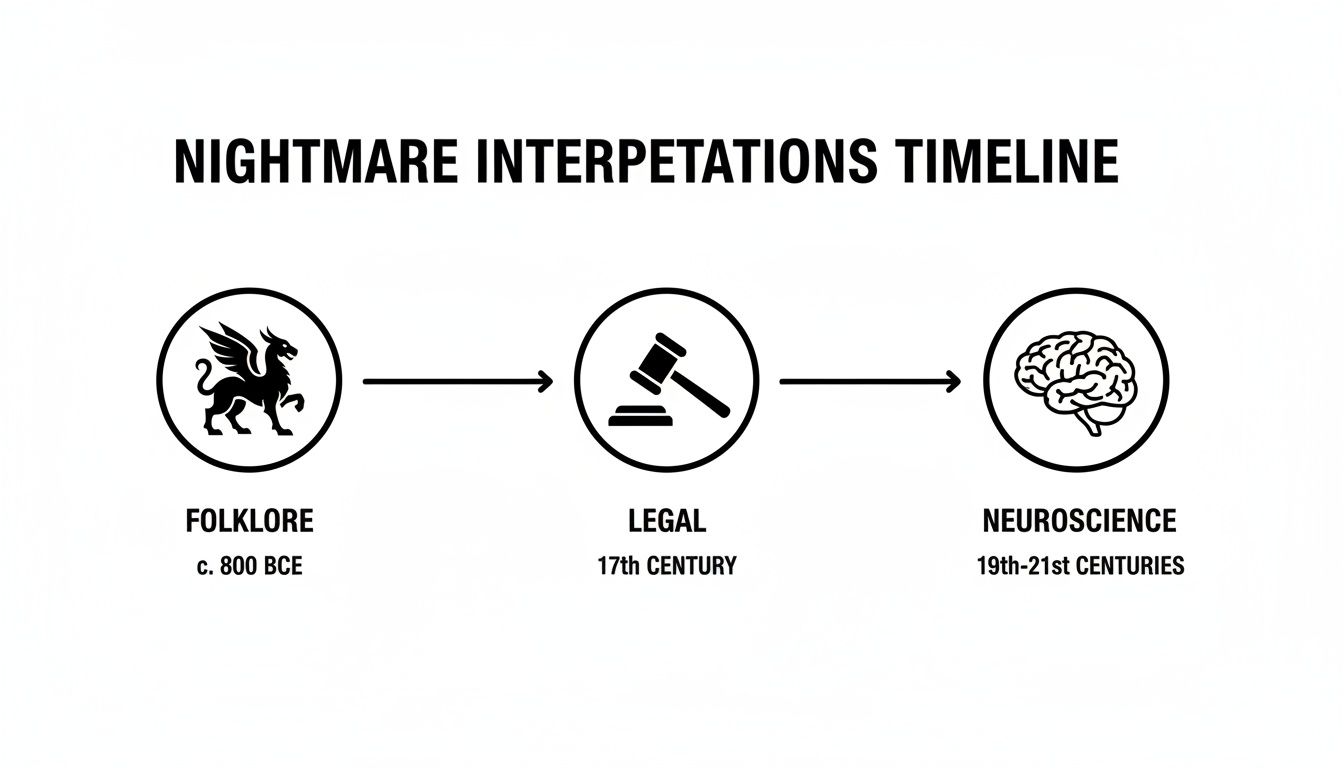
This progression demonstrates how a consistent human experience has been filtered through the dominant intellectual paradigms of different eras—mythology, theology, law, and neurology.
Development Over Time: The Formalization of the Incubus
As Europe transitioned into the medieval period, these disparate folk spirits began to coalesce into a more structured and theologically significant figure within Christian demonology: the incubus. This was no longer just a regional goblin; it was classified as a specific type of demon with a clear, sinister purpose.
The incubus (from the Latin incubare, meaning “to lie upon”) was defined as a male demon that assaulted women in their sleep. Its female counterpart, the succubus, was believed to prey upon men. The existence of these entities was treated as theological fact by prominent thinkers of the era. St. Augustine, in City of God, acknowledged the widespread belief in such attacks, and Thomas Aquinas later debated their nature in his Summa Theologica.
These beings were viewed as tangible threats capable of physical interaction and spiritual corruption. Their reported assaults were seen as a direct challenge to an individual’s faith and purity, transforming a frightening dream into a battle for the soul. This theological codification marked a significant turning point. The experience was now framed within a moral and religious context, making nightmares about demons a matter of grave spiritual concern. The distinction between a physiological event and a literal demonic attack had effectively been erased in the dominant worldview.
This connection is well-documented, tracing from Mesopotamian beliefs around 2400 BC to the European night-mare. A 1664 case study by Dutch physician Isbrand van Diemerbroeck is often cited as one of the first clinical descriptions of what is now understood as sleep paralysis, though he termed it an “Incubus or Night-Mare” assault. Similar entities, such as the Norse maras and Germanic mahrs, appear in folklore, with records showing protective charms were used in approximately 80% of Scandinavian tales from the 13th to 18th centuries. The folkloric roots of sleep paralysis are deeply embedded in these historical accounts. By formalizing these nocturnal spirits within demonology, the stage was set for these private terrors to have devastating public consequences.
Cultural and Religious Context: When Nightmares Became Legal Evidence
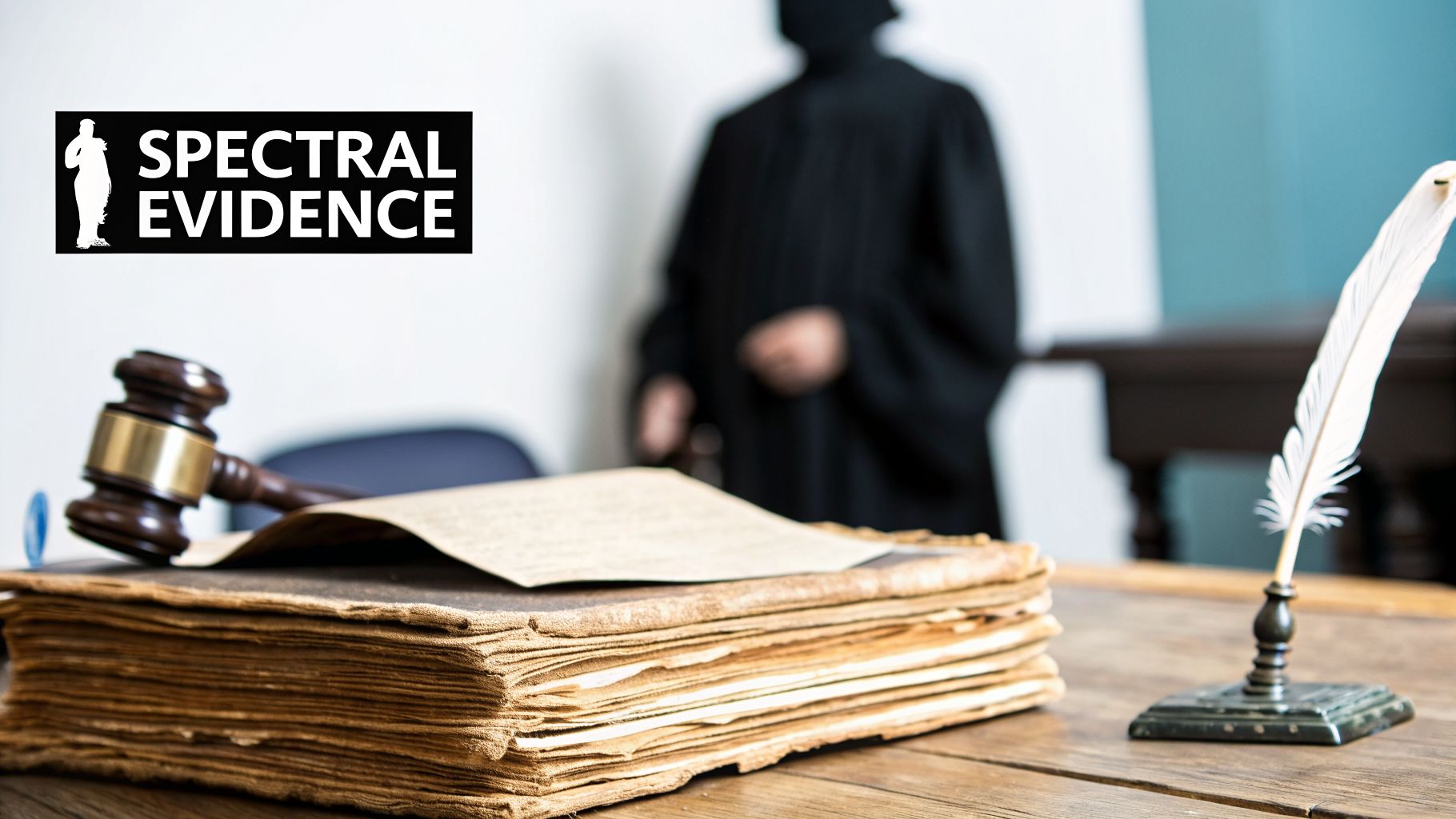
During the early modern period, particularly during the European witch hunts of the 16th and 17th centuries, the fear of demonic nightmares acquired a new and dangerous legal dimension. What had been a matter of private spiritual struggle evolved into public, actionable proof of a capital crime. The barrier between the dream world and the real world was dismantled in courtrooms, where an individual’s nightmare could be repurposed as a literal account of an assault by a witch or the Devil.
The Rise of Spectral Evidence
The legal concept that enabled this shift was known as spectral evidence. This referred to testimony in which an accuser claimed to have been visited, tormented, or attacked by the apparition—or “specter”—of an accused witch.
These spectral attacks almost invariably occurred at night while the victim was in bed, echoing classic descriptions of incubus encounters. Victims would testify under oath that their neighbor’s specter had appeared in their room, choking them, pinching them, or attempting to coerce them into a demonic pact. Legally, this testimony was treated as if the accused had been physically present. The prevailing logic held that the Devil could not assume a person’s form without their consent. Therefore, if a victim identified a specific person’s specter, it was considered proof that the accused had entered into a pact with Satan.
This legal interpretation transformed a subjective experience, likely a vivid episode of sleep paralysis, into objective “fact.” It provided prosecutors with damning evidence in communities already gripped by suspicion and fear.
Cross-Cultural Parallels and Divergences
While Christian demonology provided one powerful lens for interpreting these experiences, similar nocturnal predators appear in belief systems worldwide, though their origins and motives often differ. This comparative view reveals a universal human phenomenon—sleep paralysis and terrifying dreams—interpreted through unique cultural filters.
- Japanese Folklore: The experience known as kanashibari (“to be bound by metal”) describes sleep paralysis but is often attributed to vengeful ghosts (onryō) or local spirits, not demons in the Christian theological sense.
- Brazilian Folklore: The Pisadeira is described as a crone who stomps on the chests of those who sleep on a full stomach, causing terrifying nightmares. Her motive is tied to a specific folk belief rather than a grand divine conflict.
- Persian Mythology: The bakhtak is a goblin-like creature that sits on a sleeper’s chest, causing suffocation and bad dreams. It is regarded as a malevolent folkloric entity, not a soldier in a holy war.
These examples highlight a critical distinction. The Christian framework viewed the nightmare demon as an agent of cosmic evil with a clear theological agenda: the damnation of the human soul. This is explored in texts like the Malleus Maleficarum (1487), which presented incubi and succubi as real, corporeal demons. You can explore more of these foundational texts in our guide to the best books on demonology. The high stakes of this theological interpretation help explain why nightmares about demons were treated with such deadly seriousness in early modern Europe and its colonies, most infamously during the events covered in our documentation of what were the Salem Witch Trials. Records of these periods detail the dangers of the night as documented in historical texts, showing how internal fears were externalized with lethal outcomes.
Modern Interpretation: Psychology and Neuroscience
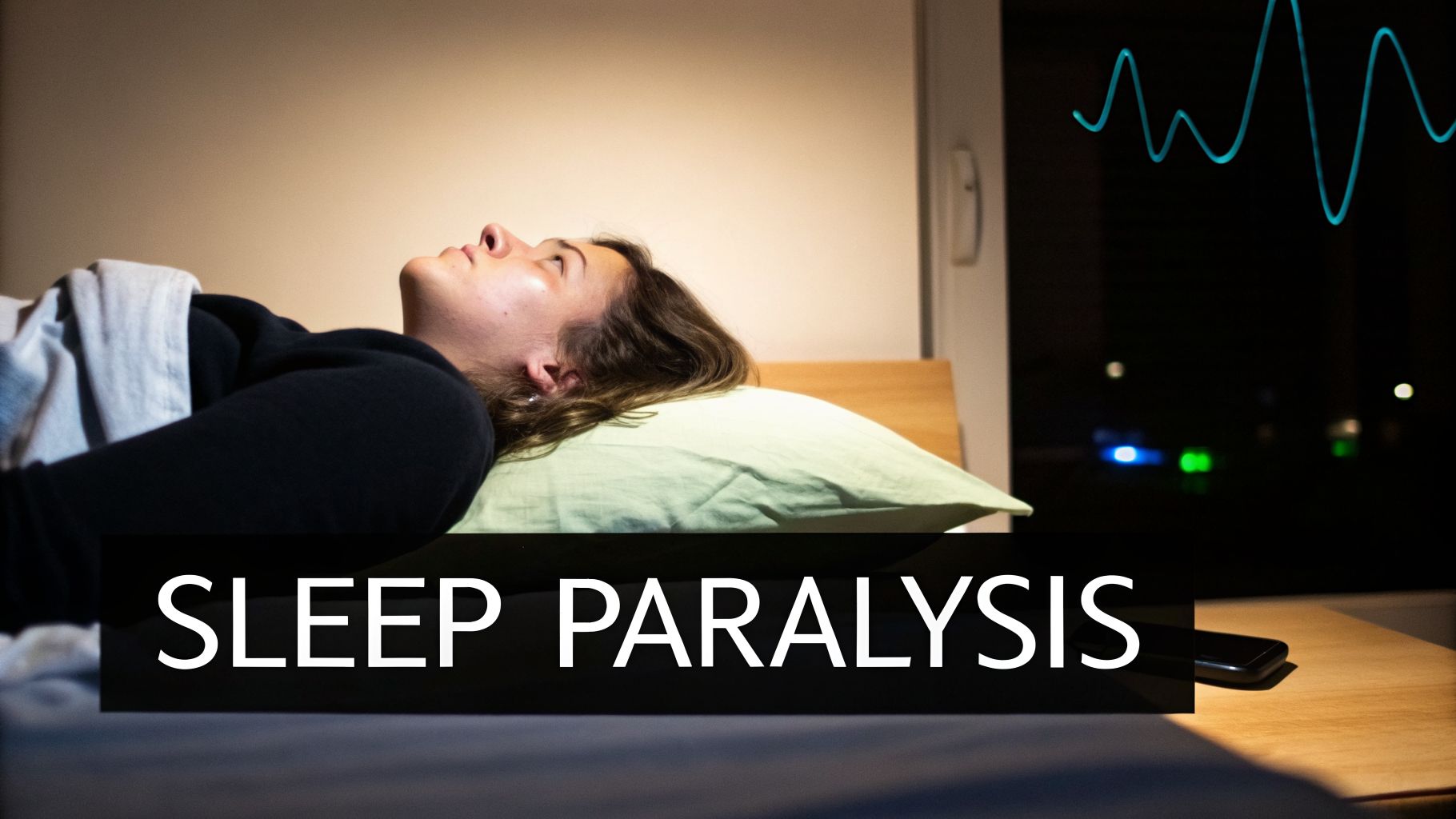
As theological and legal interpretations of nightmares about demons waned, new scientific frameworks emerged to re-examine these ancient terrors. The fields of psychology and neuroscience have provided a radically different perspective, identifying a neurological basis for experiences that were once attributed to supernatural forces. The most compelling explanation for centuries of accounts describing incubi, night-mares, and spectral assailants is the phenomenon known as sleep paralysis.
The Neurological Basis of Sleep Paralysis
Sleep paralysis is a temporary inability to move or speak that occurs upon falling asleep (hypnagogic) or awakening (hypnopompic). It represents a state of mixed consciousness, where the mind is awake but the body remains in a state of sleep-induced paralysis.
During the Rapid Eye Movement (REM) stage of sleep, when most vivid dreaming occurs, the brainstem inhibits motor neurons, causing a temporary paralysis of the body’s voluntary muscles. This protective mechanism, known as REM atonia, prevents individuals from physically acting out their dreams. Sleep paralysis is understood to occur when this timing is disrupted: the mind regains awareness while the body is still under the influence of REM atonia. The result is a conscious mind temporarily trapped within an immobile body.
This distressing state is often accompanied by powerful multi-sensory hallucinations. These are not random but tend to follow consistent patterns that align remarkably well with historical accounts of demonic attacks:
- Intruder Hallucinations: A strong perception of a malevolent presence in the room. This can range from a vague, shadowy figure to a distinct entity.
- Incubus Hallucinations: A sensation of immense pressure on the chest, often accompanied by a feeling of suffocation.
- Vestibular-Motor Hallucinations: Sensations of movement, such as floating, flying, or having an out-of-body experience.
The brain, struggling to interpret the conflicting signals of wakefulness and paralysis, draws upon deep-seated cultural fears to give form to the perceived threat. In a culture with a historical belief in demonology, that form is often interpreted as a demon. This process, termed “cultural scripting” by researchers, explains the supernatural overlay frequently applied to these experiences. The brain’s fear center, the amygdala, becomes highly active during these episodes, intensifying the terror and making the hallucination feel entirely real.
A 2011 review published by Penn State, analyzing 35 studies involving over 36,000 participants, found that while approximately 8% of the general population has experienced sleep paralysis, rates are higher among students (28%) and psychiatric patients (32%). The Penn State analysis of these sleep demons notes that about 20% of individuals report at least one episode in their lifetime.
This scientific framework does not diminish the terror of the experience. Rather, it re-attributes its source from an external, supernatural agent to the intricate and sometimes paradoxical functions of the human brain.
Conclusion: A Balanced Summary of a Persistent Phenomenon
The historical record of demonic nightmares demonstrates a significant evolution in human understanding. The phenomenon began as a literal interpretation of nocturnal spirits, such as the lilû of ancient Mesopotamia and the incubi of medieval Europe, which were believed to be tangible threats. This belief system had profound real-world consequences, most notably during the witch trials, where such visions were accepted as spectral evidence in legal proceedings, leading to convictions and executions.
The advent of the scientific revolution, particularly developments in neuroscience, offered a new explanatory model. The once-demonic encounter was reframed through the mechanisms of sleep paralysis, REM atonia, and the brain’s capacity for powerful hypnagogic and hypnopompic hallucinations. The sensation of pressure on the chest and the perception of a malevolent presence were now understood to have a biological, rather than a supernatural, basis.
Despite this scientific understanding, the archetype of the nightmare demon has not vanished. It persists in contemporary culture through horror films, literature, and art, where it serves as a potent symbol of helplessness, violation, and the fear of the unknown. The narrative of the demonic nightmare is, fundamentally, a record of humanity’s attempts to make sense of a frightening and universal human experience. By examining these beliefs from a neutral, historical perspective, we can appreciate them as a crucial component of our shared folklore and a testament to how we have always sought to give a name and a face to the terrors that haunt the night. You can find more documentation on these topics in our archive of folklore around the world.
FAQ: Common Questions on the Documentation of Demonic Nightmares
This section addresses common inquiries related to the topic, drawing upon the historical and scientific information presented.
Are nightmares about demons a sign of something supernatural?
From a historical and folkloric perspective, these experiences were almost universally interpreted as literal supernatural events. However, contemporary scientific research provides a natural explanation, primarily through the phenomenon of sleep paralysis. During this state, the mind awakens while the body remains in REM-induced paralysis, often triggering terrifying hallucinations that match historical descriptions of demonic assaults. While the experience feels undeniably real, current evidence indicates it is a product of neurological processes rather than an external entity.
How did people historically protect themselves from these nightmares?
Believing they were under genuine attack, individuals in various cultures developed protective measures based on their belief systems. In Christian Europe, common practices included prayer, the use of blessed objects like crucifixes, and the recitation of psalms. Folk traditions involved placing iron (a reputed demon repellent) near the bed, using protective herbs, or arranging shoes in a specific way to confuse spirits. In cases of persistent or severe experiences, a formal exorcism by a religious authority was sometimes sought. These practices underscore the seriousness with which these nocturnal events were regarded.
Why are demons a common theme in nightmares and sleep paralysis?
The prevalence of demonic imagery is understood as a combination of cultural programming and neurobiology. During sleep paralysis, the brain’s fear center, the amygdala, is highly activated. The brain registers the body’s immobility and often hallucinates a “presence.” To make sense of this threatening sensation, it draws upon potent symbols of fear from its cultural lexicon. In societies with a long history of demonology, the brain is more likely to interpret this shadowy figure as a demon—a powerful and instantly recognizable symbol of malevolence. This is not a conscious decision but an automatic attempt to contextualize a confusing and terrifying physiological event.
At Hidden Mythos, our work is dedicated to documenting these fascinating intersections of history, folklore, and human experience. To support our independent research and get exclusive insights delivered to your inbox, explore our archive. Visit us to continue your journey into the past.
