

The gods and goddesses of the ancient Maya represent one of the most complex theological systems in world history. This pantheon was not a collection of simple myths but the structural framework of the Maya worldview, an intricate system of belief that governed cosmology, politics, agriculture, and the human life cycle. Documented extensively on stone monuments, painted ceramics, and in the few surviving bark-paper books known as codices, this religious tradition provides a unique window into a pre-Columbian Mesoamerican civilization.
This guide provides an analytical overview of the Maya pantheon, grounded in the archaeological and epigraphic evidence available to modern researchers. It is intended to serve as a foundational resource for understanding these deities not as fictional characters, but as central components of a sophisticated cultural and religious system. By examining the primary sources, we can begin to reconstruct the Maya cosmos and the divine forces believed to govern it.
Historical Origins
The earliest documented references to Maya deities emerge from the archaeological record of the Preclassic period (c. 2000 BCE – 250 CE). Iconography on early stelae, murals, and small ceramic artifacts from this era depicts supernatural beings and symbols that would later evolve into the well-defined gods of the Classic period. These formative representations indicate a religious system deeply rooted in agricultural cycles, astronomical observation, and ancestor veneration.
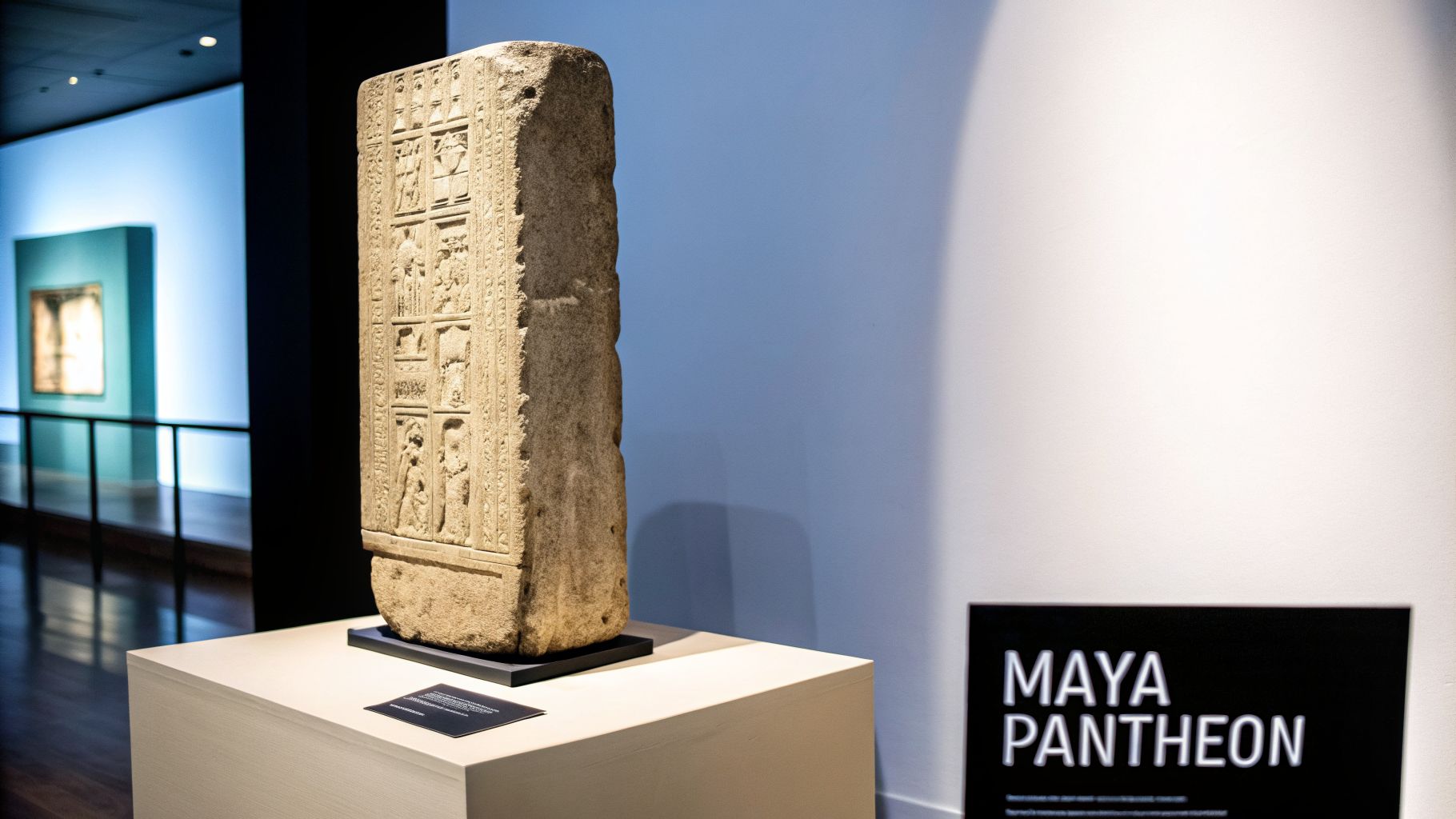
Our contemporary understanding is built upon a foundation of key primary sources:
- The Maya Codices: Of the thousands of books created by Maya scribes, only four are known to have survived the colonial era. These Postclassic (c. 950–1539 CE) documents are almanacs detailing astronomical cycles, rituals, and prophecies directly linked to specific gods. The Dresden Codex, for example, contains highly accurate tables for predicting the movements of Venus, which was understood as the manifestation of a powerful deity.
- The Popol Vuh: Transcribed in the 16th century by a K’iche’ nobleman, the Popol Vuh (“Book of the People”) preserves a comprehensive creation narrative that originated in ancient oral traditions. It documents the cosmos’s formation, the creation of humanity from maize, and the epic saga of the Hero Twins, Hunahpu and Xbalanque. It is the single most important textual source for Maya mythology.
- Stone Inscriptions and Ceramic Iconography: Glyphic texts and imagery carved on stelae, altars, and temple walls from the Classic period (c. 250–950 CE) are official records. They document rulers performing religious ceremonies, interacting with patron deities, and aligning their reigns with cosmic events. Painted ceramic vessels, often used as funerary offerings, depict vivid mythological scenes, particularly those related to the underworld journey.
A critical aspect of the Maya pantheon is its fluidity. Deities were not monolithic figures; their attributes, names, and hierarchical importance could vary significantly between different city-states and across historical periods. This reflects a dynamic religious landscape that adapted to local political and social conditions.
By synthesizing these sources, scholars can reconstruct a historical framework for how the Maya perceived and interacted with their gods. The combination of calendrical data from the codices, narrative context from the Popol Vuh, and official state records from inscriptions provides a multi-faceted, evidence-based view of this ancient belief system.
Development Over Time
Interpretations of the Maya pantheon were not static; they evolved significantly over the nearly three millennia of Maya civilization. The religious landscape shifted in response to political changes, intercultural contact, and new theological developments.
During the Classic period (c. 250–950 CE), the pantheon was closely integrated with the political structure of the city-states. Rulers, or k’uhul ajaw (“holy lords”), served as chief intermediaries between the human and divine realms. They legitimized their authority by asserting a direct lineage from the gods and impersonating them during public rituals. The iconography of this era, found on monumental stelae and temple reliefs, emphasizes patron deities of specific cities and royal dynasties. For instance, the divine triad of Palenque (Gods I, II, and III) was central to that kingdom’s political identity.
The transition to the Postclassic period (c. 950–1539 CE) saw a marked shift. Following the decline of the southern lowland cities, power centers like Chichen Itza and Mayapan emerged in the Yucatán Peninsula. This era was characterized by increased interaction with cultures from Central Mexico, leading to significant religious syncretism. The cult of the feathered serpent, known to the Maya as Kukulkan, rose to prominence, mirroring the worship of Quetzalcoatl among the Toltecs and later the Aztecs. This development is architecturally memorialized in the Temple of Kukulkan at Chichen Itza, which serves as both a shrine and a massive solar calendar.
The Colonial period brought another dramatic transformation with the arrival of Spanish missionaries. The Maya belief system was suppressed, its sacred texts largely destroyed. However, it was not eradicated. Instead, it underwent a process of syncretism, where traditional Maya deities were merged with Catholic saints. This allowed indigenous beliefs to survive under a new guise, a phenomenon that continues in many Maya communities today.
Cultural and Religious Context
The Maya pantheon was inextricably linked to the Maya conception of the cosmos. Their universe was a highly structured, multi-layered reality, and the gods were the active agents within it. This worldview provided a coherent explanation for natural phenomena, the passage of time, and the human condition.
The Tripartite Cosmos
Maya cosmology was structured around three primary realms:
- The Celestial Realm (Upperworld): A 13-layered heaven, home to deities like Itzamná and the Sun God, Kinich Ahau. The movements of celestial bodies were interpreted as the journeys of these gods through the layers of the sky.
- The Terrestrial Realm (Middleworld): The plane of human existence, conceived as the back of a giant caiman or turtle floating in a primordial sea. It was the stage where human and divine lives intersected.
- The Underworld (Xibalba): A nine-layered subterranean realm known as the “Place of Fright.” Ruled by death gods, Xibalba was not a hell of eternal punishment but a dangerous place of trial that the souls of the dead—and even gods—had to traverse.
A massive World Tree, the Wacah Chan, stood at the center of the cosmos, its roots in Xibalba and its branches in the highest celestial layer, connecting all three realms.
The Role of Deities in Daily Life
The gods were not distant, abstract forces but were deeply involved in all aspects of life. Religious practice was based on reciprocity; humans performed ceremonies, made offerings, and conducted sacrifices to nourish the gods, and in return, the gods maintained cosmic order and ensured the fertility of the earth.
- Agriculture: For a society dependent on maize, the rain god Chaac was of paramount importance. Rituals to appease him were essential for survival. The Maize God himself represented the entire agricultural cycle of life, death, and regeneration.
- Politics and Warfare: Kings waged war and performed bloodletting rituals to appease gods associated with military power and to commemorate significant dates in the sacred calendar. Victory in battle was seen as a sign of divine favor.
- Life and Death: Goddesses like Ixchel governed childbirth, healing, and weaving. The epic of the Hero Twins defeating the lords of Xibalba provided a mythological model for overcoming death and achieving a form of rebirth.
This system demonstrates a worldview where every human action had cosmic significance, and the pantheon provided the framework for navigating a world shaped by powerful supernatural forces. The study of these beliefs contributes to a broader understanding of global religious traditions and the history of mythology.
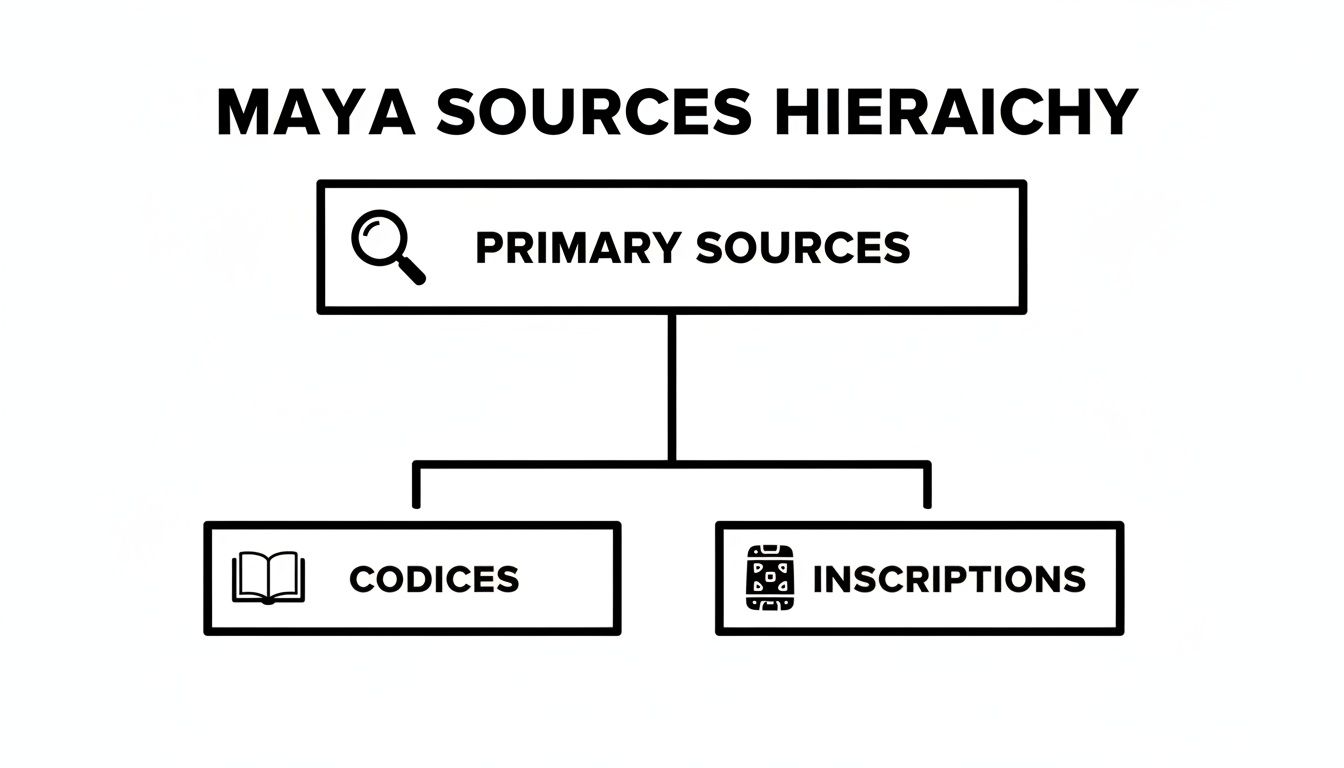
This hierarchy of sources shows how scholarly knowledge is constructed, moving from the broad archaeological record to the specific textual details found in codices and inscriptions, which together illuminate the cultural context of the gods.
Modern Interpretation
The gods and goddesses of the Maya have persisted into the modern era, though their interpretation has diversified significantly. They appear in academic scholarship, popular media, and as part of living spiritual traditions.
Academic Scholarship
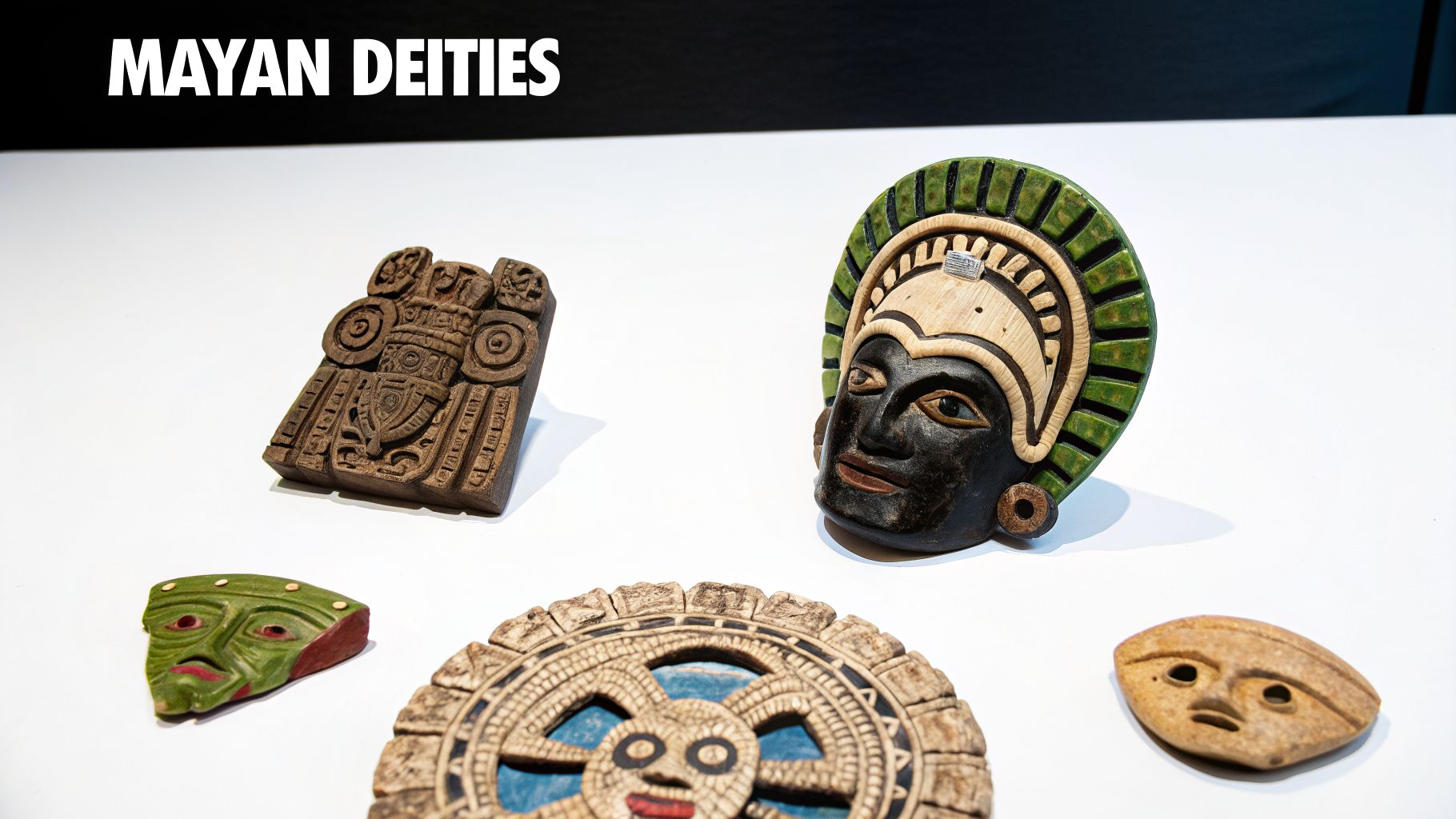
Contemporary Mayanist scholars, including epigraphers, archaeologists, and art historians, continue to refine our understanding of the pantheon. Advances in the decipherment of Maya hieroglyphs have allowed for more accurate identification of deities and a deeper comprehension of their roles in religious and political texts. Academic works, such as the historical analyses on Encyclopedia.com regarding Itzamná, approach these figures as components of a complex historical system, analyzing their evolution and cultural significance without endorsing supernatural claims.
Popular Culture and Common Misconceptions
In film, literature, and video games, Maya deities are often sensationalized. They are frequently portrayed as monstrous or singularly focused on human sacrifice, a gross oversimplification of their complex roles. Furthermore, a common error is the conflation of Maya and Aztec deities. Figures like the Aztec war god Huitzilopochtli are sometimes anachronistically placed in Maya settings, obscuring the distinctiveness of each culture’s pantheon. A research-driven approach requires differentiating these separate traditions.
Living Traditions and Religious Syncretism
It is a significant misconception to view Maya religion as extinct. Over six million Maya people live in their ancestral homelands today, and many practice a syncretic form of religion that blends pre-Columbian beliefs with Catholicism. In this living faith, a Catholic saint may be venerated in a way that corresponds to an ancient deity; for example, the Virgin Mary is often associated with the Moon Goddess, Ixchel. Traditional spiritual guides, known as ajq’ijab, continue to maintain the sacred calendars and perform ceremonies that call upon both ancient gods and Christian figures, demonstrating the resilience and adaptability of Maya spirituality.
Neopagan and New Age Adaptations
Outside of indigenous communities, Maya gods have been adopted by some modern spiritual movements. These interpretations often remove the deities from their historical and cultural context, reframing them as universal archetypes or focusing on esoteric interpretations of the Maya calendar, particularly in relation to the 2012 phenomenon. These modern adaptations are distinct from the continuous, historically grounded traditions of the Maya people.
Conclusion
The study of the Mayan gods and goddesses reveals a sophisticated and enduring belief system that was central to one of the ancient world’s most advanced civilizations. These deities were not merely folkloric characters but were the foundational principles of a worldview that integrated science, religion, and governance. They embodied the forces of nature, the cycles of time, and the structure of the cosmos itself.
Our understanding of this pantheon is built upon a rich body of evidence, from the astronomical data in the codices to the political histories carved in stone. Ongoing archaeological discoveries and advances in epigraphy continue to deepen this knowledge, allowing for a more nuanced and accurate picture of how the ancient Maya perceived their world.
To approach this topic is to engage with a profound chapter in human religious history. It requires a commitment to analyzing the available documentation—the stelae, ceramics, and surviving texts—while respecting the complexity and intellectual depth of the culture that produced them. By grounding our study in these primary sources, we can move beyond popular caricature and appreciate the Maya pantheon as a coherent and powerful system for interpreting the universe. This focus on documentation over endorsement ensures that the legacy of the Maya is understood with the analytical clarity it deserves.
Frequently Asked Questions
Who was the primary god in the Maya pantheon?
It is difficult to name a single “top” god, as importance varied by region, time period, and social context. The creator god Itzamná is often cited by scholars as a paramount deity, credited with inventing writing and the calendar. However, for agricultural communities, the rain god Chaac was arguably more central to daily life. In the Postclassic period, the feathered serpent Kukulkan became a figure of immense political and religious importance in cities like Chichen Itza. Additionally, each city-state had its own patron deity who was considered supreme within its sphere of influence.
Did the Maya have concepts of Heaven and Hell?
The Maya cosmos did not conform to the modern Western concepts of Heaven and Hell as places of eternal reward or punishment. Theirs was a multi-layered universe. Above the earth was a 13-layered celestial realm, and below was a 9-layered underworld called Xibalba. Xibalba, or the “Place of Fright,” was a treacherous landscape that souls of the deceased had to navigate by overcoming a series of trials. Successful passage was part of a cosmic cycle, not a final judgment based on mortal deeds.
Are Maya and Aztec gods the same?
No, they are not. The Maya and Aztec civilizations were distinct cultures with their own unique pantheons, mythologies, and religious practices. While there was cultural exchange between them, leading to some conceptually similar deities (such as the Maya Kukulkan and the Aztec Quetzalcoatl, both feathered serpents), their pantheons were largely separate. Conflating them is a common historical inaccuracy.
Do people still worship the ancient Maya gods?
Maya religion is not extinct. Today, millions of Maya people practice a syncretic faith that blends indigenous beliefs with Catholicism. In these living traditions, ancient deities are often venerated in the guise of Catholic saints, and traditional rituals are still performed by spiritual guides at sacred sites. This represents a continuous evolution of Maya spirituality, not a historical reenactment.
The Hidden Mythos archive is dedicated to exploring the rich tapestry of folklore, mythology, and historical belief systems from around the world. For more deep dives into ancient lore and documented supernatural history, continue exploring our research at https://www.hiddenmythos.com.
