

Ah Puch, a deity known to the Yucatec Maya, represents a significant figure within the broader Mesoamerican understanding of death, decay, and the underworld. While often sensationalized in modern media, a historical and archaeological analysis reveals a more complex entity whose role was integral to the Mayan cosmic order. As the ruler of Xibalba, the Mayan underworld, Ah Puch was not merely a symbol for the end of life; he was perceived as an active agent of decay, disease, and the cyclical transformation that governed the universe. This analysis will examine the historical origins, iconography, and cultural context of this formidable entity, grounding the narrative in surviving codices, epigraphy, and colonial-era accounts.
1. Historical Origins and Primary Sources

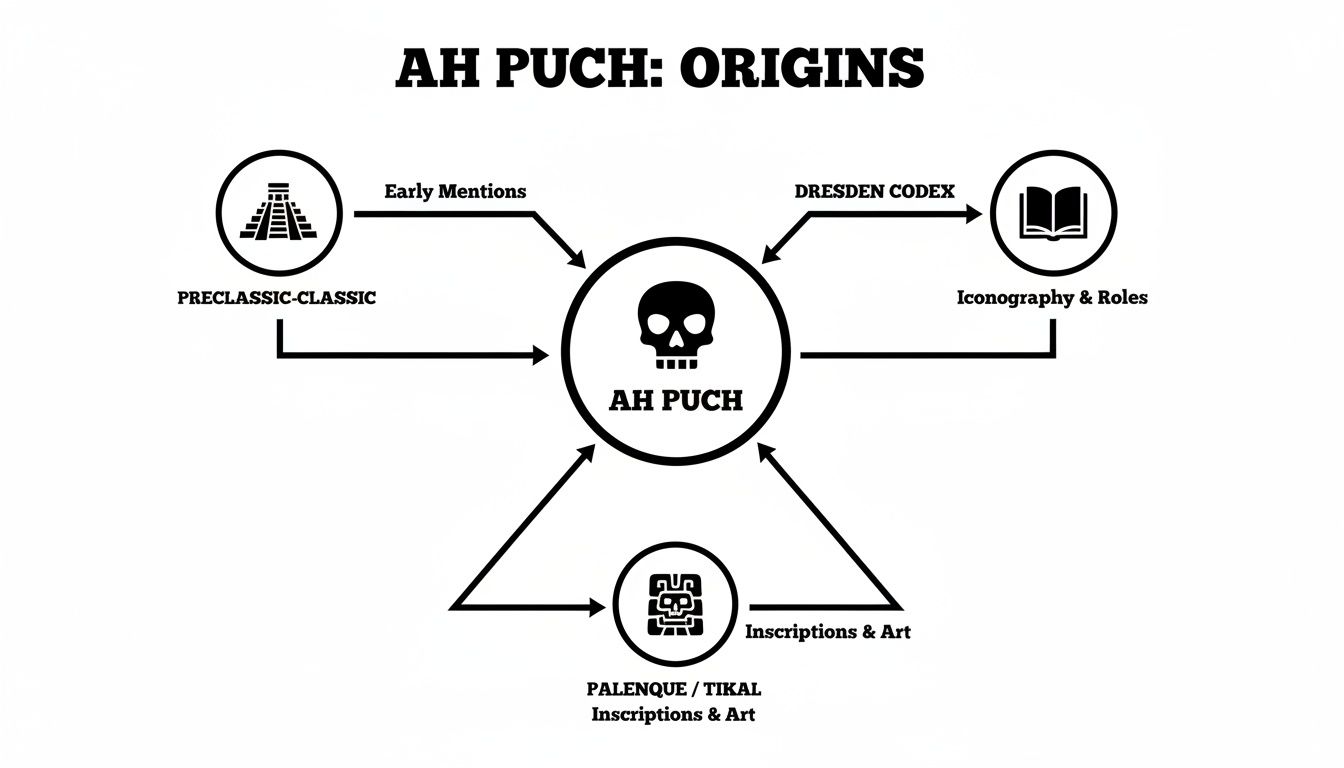
The figure identifiable as Ah Puch has ancient roots, with iconographic evidence dating back to the Classic Maya period (c. 250–900 CE). Unlike mythological figures whose origins are documented in a single narrative text, the earliest evidence for Ah Puch is primarily visual, appearing in stone carvings, ceramic vessels, and murals at major archaeological sites like Palenque, Tikal, and Copán.
These depictions establish a consistent visual profile for a primary death deity long before the name "Ah Puch" was recorded. Epigraphers and archaeologists identify him through a recurring set of symbols: a skeletal form, a bloated torso indicating putrefaction, and accessories like bells and disembodied eyes. These images are not merely artistic renderings but a form of visual documentation, communicating the god's attributes and role within the Mayan belief system.
God A of the Dresden Codex
One of the most critical primary sources for understanding this deity is the Dresden Codex, one of the few surviving pre-Columbian Maya manuscripts. Within its pages, a figure classified by scholars as "God A" is depicted numerous times. God A consistently displays the classic iconography of a death god: a skeletal body, a skull-like head, and associations with omens and sacrificial rites. Mayanist scholars overwhelmingly concur that God A is a direct representation of the deity later known as Ah Puch. His prominent and recurring presence in this vital document confirms his high status within the Postclassic Maya pantheon and religious practice.
Further context on the scholarly approach to mythological origins can be found in our guide to the history of mythology. The rich archaeological and codical records provide a clear historical trajectory for Ah Puch, establishing him not as a later invention but as a foundational figure in Mayan cosmology for over a millennium.
2. Development and Nomenclature Over Time
The identity of the Mayan death god evolved across different regions and historical periods, reflected in the variety of names attributed to him. These are not simple synonyms but often represent specific regional traditions or highlight different aspects of his terrifying function. The name Ah Puch, which may translate as "The Undoer" or relate to swelling, is a Postclassic Yucatec Mayan term popularized by later scholarship.
Alternate Names and Regional Variations
Research across different Mayan linguistic groups reveals a complex web of nomenclature for the lord of the underworld.
| Name or Title | Meaning or Context | Associated Region or Source | Codex Designation |
|---|---|---|---|
| Ah Puch | “He of the Swelling” or “The Undoer” | Yucatec Maya (Postclassic) | God A |
| Yum Cimil | “Lord of Death” | Yucatec Maya | God A |
| Cizin (Kisin) | “The Stinking One” | Lacandon Maya | God A |
| Kimi | “Death” | K’iche’ Maya (Popol Vuh) | Not Applicable |
| Hun-Came | “One Death” | K’iche’ Maya (Popol Vuh) | Not Applicable |
| Vucub-Came | “Seven Death” | K’iche’ Maya (Popol Vuh) | Not Applicable |
The name Kisin ("The Stinking One") is particularly evocative, directly linking the god to the physical process of decomposition. In the epic K'iche' text, the Popol Vuh, the rulers of Xibalba are named Hun-Came ("One Death") and Vucub-Came ("Seven Death"). While distinct characters, they function as the K'iche' equivalent of Ah Puch, presiding over the underworld and embodying its horrors.
This regional variation demonstrates how a core concept—a powerful god of death—was adapted and interpreted across the diverse cultural landscape of the Maya world. For a broader overview of the divine hierarchy, see our list of Mayan gods and goddesses.
3. Cultural and Religious Context

To understand Ah Puch, one must first grasp the Mayan conception of death. It was not viewed as a final endpoint but as a perilous, transformative journey. Ah Puch presided over this transition as the ruler of Xibalba, a terrifying subterranean realm that most souls were destined to traverse. His role was not one of moral judgment but of cosmic function; he was an administrator of an inevitable process.
The Duality of Creation and Destruction
Mayan cosmology was structured around a principle of dualism. Every force in the universe had its necessary counterpoint. Ah Puch was the direct opposite of Itzamna, the paramount creator god associated with the sky, fire, and life. This divine opposition was not a battle of "good" versus "evil" but a representation of the cosmic balance between creation and destruction, light and darkness. Without the decay overseen by Ah Puch, there could be no space for new life to emerge. This cyclical worldview is also documented in the lore surrounding sacred flora, as noted by researchers at Ancient and Sacred Trees.
This cycle of death and renewal is central to the myth of the Hero Twins in the Popol Vuh. Their journey into Xibalba, where they outwit the death gods Hun-Came and Vucub-Came, culminates in their own death and subsequent rebirth, ultimately limiting the power of the underworld over the living.
Funerary Practices and Appeasement
The profound respect and fear for Ah Puch directly influenced Mayan funerary practices. Burial rites were not simply acts of mourning but were practical preparations designed to equip the deceased for their journey and appease the lords of Xibalba. Archaeological evidence from burial sites across the Maya region reveals consistent patterns:
- Grave Goods: Jade beads were often placed in the mouths of the deceased, interpreted by scholars as a form of payment or offering to the underworld denizens. Maize, from which humans were believed to have been formed, was included as spiritual sustenance.
- Sacrificial Attendants: For elite burials, such as those of kings, retainers were sometimes sacrificed and interred with them. This practice suggests a belief that social hierarchies extended into the afterlife and that these attendants would continue to serve their lord in Xibalba.
- Symbolic Pigments: The bodies of high-status individuals were frequently covered in red cinnabar powder. This pigment symbolized blood and life, suggesting a ritual attempt to imbue the deceased with vitality for their journey and eventual rebirth.
These elaborate rituals underscore a worldview in which death was an active, dangerous transition, and Ah Puch was the formidable authority who had to be navigated with caution and respect. The use of symbolic items in this context shows parallels to the broader human use of amulets and talismans for protection and passage.
4. Analysis of Iconography
The visual representation of Ah Puch in Mayan art is a codified symbolic language, with each element carrying specific meaning. Mayan artists depicted him in two primary forms, each representing a different stage of mortality.
The Skeleton and the Corpse
The most frequent depictions show Ah Puch as either a bare skeleton or a decomposing corpse.
- The Skeletal Form: Often rendered with an articulated spine and fleshless limbs, this version represents death in its final, elemental state—the bones that endure after all else has decayed.
- The Corpse Form: This more unsettling form shows a bloated figure with dark circles on the flesh. These "death spots" are artistic renderings of putrefaction, making the abstract concept of decay visceral and immediate.
Sometimes, artists would merge these two forms into a hybrid figure that was part skeleton and part rotting flesh, embodying both the process and the result of death.
Key Symbolic Attributes
Beyond his physical form, Ah Puch was consistently associated with specific objects and animal companions that clarified his identity and domain.
- Bells: He is frequently shown wearing bells, often of copper or gold, on his wrists, ankles, or collar. The sound of bells was believed to announce his approach as he came to claim a soul.
- "Death-Eye" Collar: A common attribute is a distinctive collar from which disembodied eyeballs dangle, functioning as a grisly emblem of his office as a supernatural executioner.
- Animal Messengers: The owl (kuy), with its nocturnal habits and haunting cry, was a primary messenger of Xibalba. Bats and dogs were also associated with the underworld, serving as guides or tormentors of the dead.
The presence of these symbols in art allows for the confident identification of Ah Puch, even in complex mythological scenes, and provides direct insight into how the Maya conceptualized the tangible presence of death.
5. Modern Interpretations and Pop Culture
In contemporary popular culture, Ah Puch has been revived, but often in a form disconnected from his original cultural context. He is frequently cast as a one-dimensional villain in video games, literature, and film, a portrayal that prioritizes sensationalism over historical fidelity.
A prominent example is his inclusion in the multiplayer online battle arena game Smite, where he is a playable character titled the "Horrific God of Decay." While the visual design incorporates classic iconographic elements, his character is framed as a malevolent necromancer, aligning him more with Western concepts of evil than with his role as a necessary cosmic functionary in Mayan belief.
This trend often leads to two significant misconceptions:
- Conflation with Evil: The modern tendency is to frame Ah Puch as a purely malevolent, demonic figure. This interpretation ignores the dualistic Mayan worldview, in which he was a terrifying but essential force for cosmic balance, not an adversary of moral good.
- Conflation with Mictlantecuhtli: Ah Puch is frequently confused with Mictlantecuhtli, the Aztec god of death. While they share similar domains, they originate from distinct mythologies, rule different underworlds (Xibalba and Mictlan, respectively), and possess unique iconographies and associated myths.
These modern adaptations have kept Ah Puch's name in the public consciousness, but in doing so, they often obscure the complex belief system from which he emerged. The figure in popular culture serves as a testament more to modern narrative needs for clear antagonists than to the nuanced role he played for the ancient Maya.
6. Conclusion
The Mayan god Ah Puch, documented through archaeology, epigraphy, and ethnohistorical accounts, was a central figure in the Mayan understanding of existence. As the lord of Xibalba, he personified the terrifying but necessary forces of death and decay within a cyclical cosmos. The rich iconography associated with him—skeletal forms, signs of putrefaction, and symbols like bells and owls—constituted a shared visual language across the Maya world for representing the ever-present reality of mortality.
While modern interpretations often reduce him to a generic villain, a research-driven analysis reveals a far more complex entity. He was not an embodiment of "evil" in the Western sense but a formidable administrator of the universe's dark, transformative processes. Documenting the historical Ah Puch allows for a clearer understanding of the sophisticated Mayan worldview, where life and death were inextricably linked in an eternal, dynamic balance.
Frequently Asked Questions
Was Ah Puch considered an "evil" god by the Maya?
Applying the label "evil" is anachronistic. For the Maya, Ah Puch was a terrifying deity who embodied death and decay, but his function was seen as a necessary part of the cosmic cycle, not a malicious act. He was a force to be feared and respected, but his role was integral to the balance of the universe, standing in opposition to, but not as a moral enemy of, creation gods.
What is the difference between Ah Puch and the Aztec god Mictlantecuhtli?
Although both are Mesoamerican death gods, they belong to different cultures. Ah Puch is from Mayan mythology and rules the underworld of Xibalba. Mictlantecuhtli is from Aztec (Mexica) mythology and rules Mictlan. They have distinct iconographies, myths, and associated rituals.
Is Ah Puch mentioned in the Popol Vuh?
The name "Ah Puch," which is Yucatec Mayan, does not appear in the Popol Vuh. This K'iche' Mayan text names the rulers of Xibalba as Hun-Came ("One Death") and Vucub-Came ("Seven Death"). Scholars consider these figures to be the K'iche' counterparts to Ah Puch, as they fulfill the same mythological role as the supreme lords of the underworld.
