

The history of witchcraft is not a singular narrative but a complex tapestry woven from evolving beliefs about magic, heresy, and societal anxieties. It charts the transformation of ancient folk practices into a perceived diabolical crime, sparking centuries of persecution before the concept was reimagined in the modern era. This documented history reveals less about the individuals accused of witchcraft and more about the societies that accused them, reflecting their deepest fears and the mechanisms of their power structures.
This guide provides a neutral, analytical overview of that history. Grounded in documented evidence, it separates the mythical witch of folklore from the historical individuals who faced accusation and persecution.
Historical Origins: Magic and Sorcery in the Ancient World
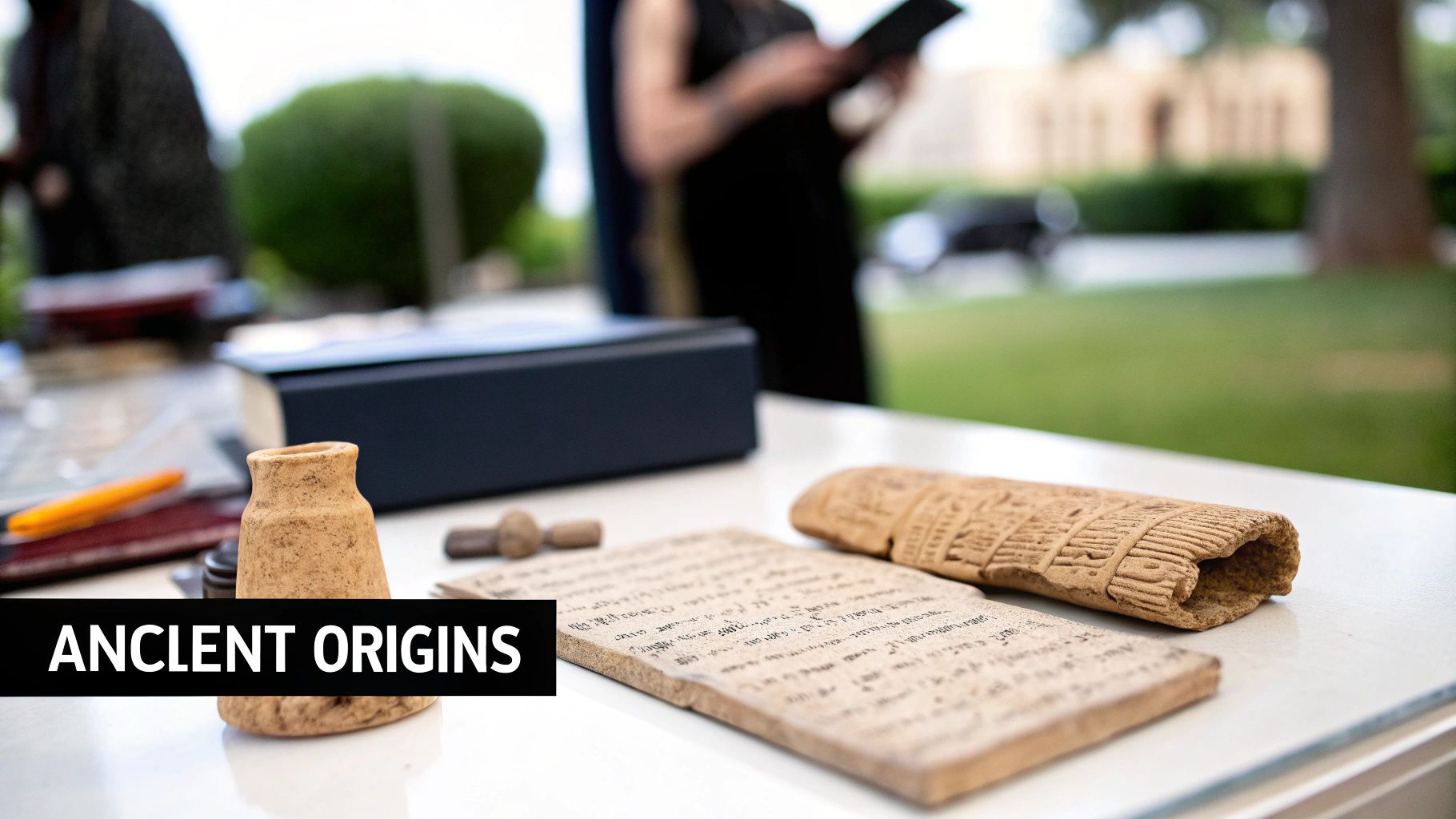
Long before the emergence of Christian demonology, the practice of magic was an integrated feature of ancient societies. In Mesopotamia, Egypt, Greece, and Rome, the supernatural was not a separate realm but a tangible force that influenced daily life. These cultures, however, drew a sharp distinction between sanctioned, state-approved magic—such as temple rituals and protective charms intended for communal benefit—and illicit sorcery used for malevolent purposes. Understanding this distinction is fundamental to tracing the origins of what would later be termed “witchcraft.”
The earliest legal codes were not concerned with heresy but with the tangible harm caused by magic. The crime was the harmful act itself, a concept later defined in Roman law as maleficium, or “evil-doing.” The Code of Hammurabi, a Babylonian legal text from circa 1754 BCE, contains specific laws addressing accusations of malevolent sorcery, indicating its significance as a societal threat. Similarly, Rome’s Twelve Tables (c. 450 BCE) outlawed the casting of harmful spells and the magical destruction of crops, treating such acts as conventional crimes causing material damage.
Ancient societies had various terms for practitioners of illicit magic, but none equated to the later concept of a devil-worshipper. These individuals were viewed as specialists in a dangerous and often forbidden craft.
Ancient Perspectives on Illicit Magic
The table below outlines how influential ancient civilizations defined and regulated harmful magic, revealing a consistent focus on the intent and outcome of the magical act rather than its theological source.
| Civilization | Term for Practitioner | Societal View | Legal Status |
|---|---|---|---|
| Mesopotamia | Kashshapu (sorcerer) | Regarded as a source of illness and misfortune; a social menace. | Illicit and punishable; countered by state-approved ashipu (exorcists/healers). |
| Ancient Greece | Pharmakis (potion-maker) | A practitioner whose skills could be used for healing or poisoning. | Harmful magic (goēteia) was condemned and subject to prosecution. |
| Ancient Rome | Venefica (poison-maker) | Associated with curses, assassination, and social disruption; highly feared. | Strictly illegal under laws like the Twelve Tables and later statutes; often punishable by death. |
| Ancient Egypt | Hekau (magic-user) | Magic (heka) was a neutral force; its use determined its legitimacy. | State-sanctioned magic was vital; harmful magic was a crime against cosmic order (Ma’at). |
This early framework, which treated harmful magic as a crime akin to assault or theft, is foundational. It establishes a world where magic was a practical, human-driven skill to be both respected and feared. This perspective laid the groundwork for the profound theological shifts that would later redefine witchcraft entirely. For a more detailed examination of these early beliefs, learn more about the specific origins of witchcraft in our detailed guide.
Development Over Time: The Medieval Fusion of Folk Magic and Demonology
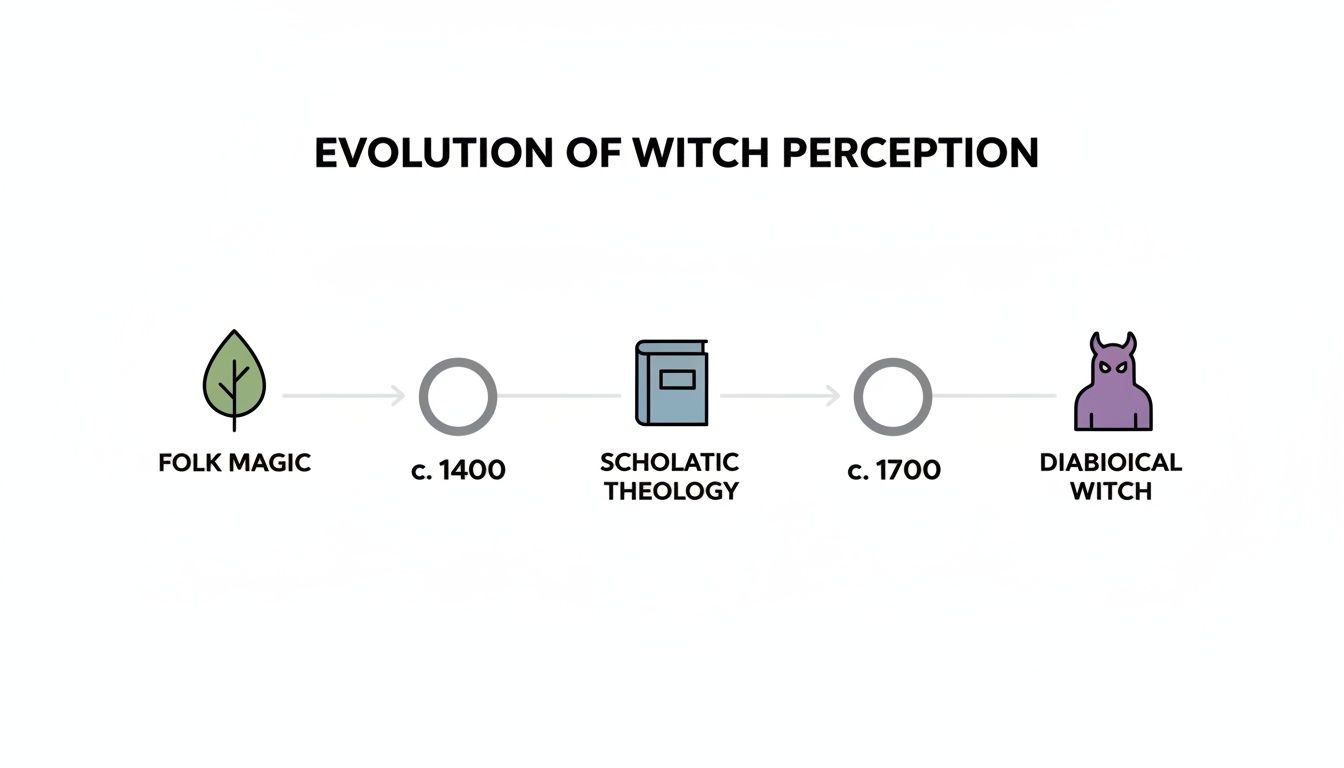
The modern stereotype of the witch was not formed in a single moment but was forged over centuries during the Middle Ages. This period saw the gradual and consequential merging of two distinct belief systems: the localized folk magic of village healers and "cunning-folk," and a structured demonology developed by Europe's religious and intellectual elite. The fusion of the village charm with the concept of the diabolical pact transformed witchcraft from a local nuisance into a cosmic crime against God.
For much of the early medieval period, the official Church position was often skeptical of extravagant claims about magic. The Canon Episcopi, an influential piece of 10th-century canon law, addressed the folk belief that certain women flew at night with the pagan goddess Diana. The Canon declared these visions to be demonic illusions or "foolish fantasies" planted in the minds of the credulous. Priests were instructed to teach that such phenomena were not real. The primary concern was eradicating pagan beliefs, not prosecuting a satanic conspiracy.
This perspective shifted dramatically with the rise of Scholasticism in the High Middle Ages. Theologians like Thomas Aquinas (c. 1225–1274) applied philosophical rigor to Christian doctrine, seeking to explain how magic could function within a divinely ordered universe. They concluded that since humans lack the innate power to alter reality through spells, any effective magic must derive its power from a supernatural source. As God would not aid in a harmful act, the only remaining source was demonic intervention. This reasoning created a direct and unbreakable link between two formerly separate concepts:
- Maleficium: The act of causing harm through magic.
- Diabolism: The formal worship of or pact with the Devil.
Under this new theological framework, a local practitioner accused of souring milk was no longer merely a social menace but a heretic who must have entered into a demonic pact to achieve their ends. This intellectual leap turned a village dispute into an act of high treason against God. By the close of the Middle Ages, the ideological foundation for the great witch hunts was firmly in place, setting the stage for centuries of persecution.
Cultural and Religious Context: The Great European Witch Hunt
The period between approximately 1450 and 1750 marks the era of the Great European Witch Hunt. This was not a single, centrally organized campaign but a series of persecutions that varied in intensity across the continent. It was the culmination of religious upheaval, social anxiety, climatic stress, and new legal theories.
Several factors converged to fuel the persecutions. The religious turmoil of the Protestant Reformation created a competitive environment where both Catholics and Protestants sought to demonstrate their piety by rooting out perceived evil. This era also coincided with the Little Ice Age, a period of climatic cooling that led to crop failures and famine. In a world that interpreted natural events as signs of divine or demonic will, it was common to attribute such misfortunes to a neighbor's malevolent magic.
The invention of the printing press was a technological accelerant. Treatises on demonology and witch-hunting manuals, once confined to monasteries, could now be widely distributed. This technology disseminated the intellectual concept of the diabolical witch with unprecedented speed, creating a shared framework for persecution. The most infamous of these texts was the Malleus Maleficarum ("The Hammer of Witches"), published in 1487 by Heinrich Kramer. Despite being condemned by the University of Cologne's theology faculty, the book became a widely consulted guide for identifying, prosecuting, and executing alleged witches. Its systematic misogyny, which argued that women were inherently more susceptible to demonic temptation, provided a theological justification for why the vast majority of the accused were female.
The legal procedures for witch trials were often a departure from standard judicial norms. Witchcraft was frequently classified as an crimen exceptum ("exceptional crime"), a designation that suspended normal legal protections for the accused. This allowed for the admission of testimony from unreliable witnesses and, crucially, the use of torture to extract confessions. A confession, once secured, was almost invariably followed by a demand to name accomplices, creating a chain reaction that could engulf entire communities.
Estimates suggest that the European witch hunts resulted in 40,000 to 50,000 executions. The Holy Roman Empire was the epicenter, accounting for a significant portion of the total fatalities. While women constituted 75–80% of the victims continent-wide, regional variations existed; in Iceland, for instance, the majority of those prosecuted were men. The intensity of the hunts often correlated with political fragmentation, where local courts could operate without oversight from a strong central authority.
Modern Interpretation: From Trial's End to Spiritual Revival

The decline of the European witch hunt was a gradual process driven by the intellectual shifts of the 18th-century Enlightenment. The new emphasis on reason, empiricism, and skepticism began to erode the foundations upon which the trials were built. The legal and intellectual elite grew increasingly doubtful of concepts like diabolical pacts and spectral evidence.
Judiciaries began demanding higher standards of proof, rendering convictions for the intangible crime of witchcraft nearly impossible. The forced confessions and spectral testimonies that had secured countless convictions, such as those in the notorious Salem Witch Trials, were now viewed as unreliable. The strengthening of central governments also played a role, as they imposed greater control over the local courts that had often been the hotbeds of persecution. By the late 18th century, state-sanctioned witch trials had effectively ceased in Europe.
With the end of the trials, the figure of the witch was transformed. No longer a legal or theological threat, the witch retreated into the realm of folklore and fairy tales, becoming a stock character in literature and popular culture. This cultural shift defanged the witch, turning a figure of intense fear into a more distant, folkloric memory.
The mid-20th century witnessed another profound transformation with the emergence of Modern Pagan Witchcraft. The founding of Wicca by Gerald Gardner in the 1950s marked the birth of a new religious movement that consciously reclaimed the term "witch." It is critical to distinguish between the historical and modern concepts:
- The Historical "Witch": This was an external label applied to accused individuals. It was a stereotype constructed by religious and legal authorities, based on fears of diabolism and heresy. Those persecuted during the hunts did not belong to any organized "witch religion."
- Modern Pagan Witchcraft (e.g., Wicca): This is a self-identified, nature-revering religion. Its practitioners, who often call themselves Witches, adhere to specific ethical codes and ritual practices.
Modern Paganism does not represent a direct, unbroken lineage from the victims of the witch hunts. Instead, it is a deliberate reclamation of a historically loaded term, transforming a symbol of persecution into one of spiritual empowerment, ecological consciousness, and resistance to religious orthodoxy.
Conclusion: A History of Belief and Persecution
The documented history of witchcraft is a complex and often tragic account of how societies have defined and persecuted perceived threats. It begins with the ancient world's practical approach to harmful magic, evolves through the medieval fusion of folklore with demonology, and culminates in the systematic persecutions of the early modern period. The decline of the trials during the Enlightenment and the subsequent modern reclamation of the term "witch" demonstrate the concept's remarkable adaptability.
Ultimately, the study of witchcraft's history offers a powerful lens through which to examine the interplay of belief, power, and social anxiety. It is a narrative not of supernatural events, but of the very human processes by which fear can be codified into law and belief can become a matter of life and death.
Frequently Asked Questions About the History of Witchcraft
What is the difference between historical witchcraft and Wicca?
Historical witchcraft refers to the set of crimes individuals were accused of during the witch hunts (c. 1450–1750). It was not a self-identified religion but a stereotype created by accusers, centered on diabolical pacts and harmful magic (maleficium). Wicca is a modern Pagan religion founded in the mid-20th century. It is a nature-based spiritual path with its own ethics and rituals. There is no direct, continuous historical line between the two.
Was the Malleus Maleficarum an official document of the Catholic Church?
No. The Malleus Maleficarum (1487), authored by Heinrich Kramer, was never officially endorsed by the Catholic Church. In fact, the theology faculty at the University of Cologne condemned the book in 1490. However, its widespread distribution via the printing press made it an exceptionally influential manual for both Catholic and Protestant witch-hunters.
Were only women accused during the witch hunts?
While women were disproportionately targeted, comprising an estimated 75–80% of those executed for witchcraft across Europe, men were also accused and executed. In certain regions, such as Iceland, Normandy, and parts of Russia, men constituted a significant percentage, and in some cases the majority, of the victims.
Did the people accused of witchcraft actually practice magic?
The academic consensus is that the vast majority of the accused did not practice the diabolical witchcraft detailed in their confessions. These confessions, often extracted under torture, reflect the beliefs and fears of the interrogators rather than the actions of the accused. Some individuals may have been folk healers or "cunning-folk" who used traditional charms and remedies, but there is no evidence of the widespread satanic conspiracy described in trial records.
At Hidden Mythos, we are committed to providing historically grounded explorations of folklore, mythology, and paranormal narratives. Discover more research-driven articles at https://www.hiddenmythos.com.
