

The history of mythology is a documented journey into the foundational narratives of human societies. It is the analytical study of how ancient cultures constructed elaborate stories to interpret a world often perceived as chaotic and mysterious. These accounts—populated by deities, heroes, and supernatural events—were not mere entertainment. They functioned as the cultural framework of a people, encoding their laws, religious tenets, and collective identity. To understand this history is to examine how our ancestors conceptualized themselves and their place within the cosmos.
Introduction: Mythology as a Historical Record

When researchers analyze the history of mythology, they are effectively excavating the intellectual frameworks of past civilizations. These stories were a culture’s collective understanding of reality, functioning as a society’s science, theology, and social contract unified within a single narrative structure. For early peoples, myths provided explanations for fundamental questions: the origin of the cosmos, the purpose of human existence, and the principles of social conduct.
This perspective requires approaching myths as significant historical artifacts. Each narrative offers a window into the values, anxieties, and aspirations of a culture. By systematically dissecting these stories, scholars can trace the evolution of social structures, religious rituals, and the origins of legal systems.
Distinguishing Key Concepts
For a methodologically sound analysis, it is essential to differentiate between related terms that are often used interchangeably in popular discourse.
- Myth: A myth is a sacred, foundational story dealing with deities, supernatural beings, or cosmogony (the origin of the universe). Myths address profound cosmological and existential “why” questions—why the world exists, the reason for human creation, or the structure of the divine order.
- Legend: Legends are narratives situated within a recognizable historical context. They often revolve around mortal heroes whose deeds, while likely embellished, are believed to have a basis in actual events. The tales of figures like King Arthur or Robin Hood are classified as legends; they pertain to what is believed to have happened in a nation’s past.
- Folklore: This is the broadest category, encompassing the entire collection of a community’s traditional beliefs, customs, and stories transmitted across generations. Folklore includes everything from superstitions and nursery rhymes to local oral histories and tales of supernatural encounters.
Correctly categorizing these narratives is critical. A regional account of a spectral haunting is folklore, whereas a complex narrative detailing how deities shaped the physical world is a myth. This guide focuses on these grand, organizing stories that underpinned entire civilizations.
As an independent folklore researcher documenting historical belief systems, the objective is not to validate or debunk the supernatural claims within these narratives. The purpose is to document their historical significance and analyze their function within their original cultural contexts. They are treated as data points that illuminate the human experience across different eras.
The Role of Myth in Ancient Societies
Myths were not passive entertainment; they were functional components of societal machinery. They served to legitimize political authority by linking a ruler’s lineage to divine origins, they provided the liturgical script for religious ceremonies, and they established the moral and ethical codes for daily life.
A creation myth, for example, was more than a story—it was the ideological foundation supporting an entire social and religious structure. By exploring the history of mythology, we uncover the intellectual bedrock upon which ancient civilizations were constructed.
Historical Origins: The Dawn of Written Myth
For millennia, mythological narratives were transmitted orally, evolving with each recitation. The invention of writing fundamentally altered this dynamic. In Mesopotamia and ancient Egypt, the world’s first major civilizations developed methods to inscribe their sacred stories onto clay and stone, providing a direct, preserved record of their belief systems.
These were not simple tales. The earliest written myths constituted the operating system of society, integrated into religious rituals, used to justify monarchical power, and employed to give meaning to the cycles of life, death, and agriculture. They explained the origins of the world and the nature of the afterlife, forming a cultural foundation that would influence subsequent civilizations for thousands of years.
Sumerian Cuneiform and the First Epics
In southern Mesopotamia, the Sumerians established the world’s first cities, complex governments, and, critically, one of its first comprehensive writing systems. Around 3400 BCE, they began impressing wedge-shaped marks into clay tablets, a script known as cuneiform. This innovation allowed for the permanent recording of complex ideas for the first time in human history.
Surviving tablets from this period contain hymns, proverbs, and mythological fragments that depict a world governed by a pantheon of powerful and often unpredictable deities. Gods such as Enlil, the lord of wind and storm, and Inanna, the goddess of love and war, were not viewed as abstract concepts but as active participants in human affairs. The Sumerians meticulously documented these divine dramas, creating a body of literature that explored themes of creation, justice, and humanity’s role in the cosmos.
This literary tradition culminated in one of the world’s earliest epic poems: the Epic of Gilgamesh. While the most complete version dates to a later period, its core stories originated as Sumerian poems around 2100 BCE. The epic follows Gilgamesh, king of Uruk, on his quest for immortality following the death of his companion, Enkidu. It is a profound meditation on grief, friendship, and the human condition.
The deluge narrative within the Epic of Gilgamesh is a primary example of mythological transmission. The story of Utnapishtim, who builds a great vessel to survive a world-destroying flood, is a clear antecedent to later flood myths, including the biblical account of Noah, demonstrating how foundational narratives were shared and adapted across cultures in the ancient Near East.
Egyptian Hieroglyphs and the Divine Afterlife
Contemporaneously, another major civilization was developing its own distinct script. The Egyptians perfected hieroglyphs around 3100 BCE. While Sumerian myths often focused on the chaotic relationship between mortals and deities, Egyptian mythology was preoccupied with cosmic order, or Ma’at. Their narratives, inscribed on tomb walls and papyrus scrolls, were designed to maintain this balance and ensure a successful transition to the afterlife.
Central to this belief system was the myth of Osiris, the god of the underworld. His story is a cornerstone of Egyptian mythology: a benevolent king murdered by his brother Set, then resurrected through the magic of his wife, Isis. Through his resurrection, Osiris became the ruler of the afterlife and a symbol of hope for eternal life for all Egyptians. Early versions of the Osiris myth are found in the Pyramid Texts, dating as far back as 2500 BCE. To better understand the parallel development of these traditions, one can explore a detailed timeline of these mythological origins.
The act of committing these myths to writing was a monumental development. It allowed complex stories to be standardized, studied, and transmitted with high fidelity, ensuring their survival and influence on future civilizations.
Development Over Time: The Great Codification of Global Mythologies
Once writing systems were established, cultures worldwide began the significant undertaking of codifying their oral traditions. This process marked the transition of fluid, orally transmitted stories into more permanent, authoritative written forms. From India to the Mediterranean, societies began to organize their myths into definitive texts.
This was not a simple act of transcription. It was a deliberate process, often directed by priestly classes or ruling elites, to select, edit, and shape these narratives into a unified cultural canon. The resulting texts became the official records of their gods, heroes, and creation stories, defining their cultural identity for centuries.
Eastern Epics and Imperial Records
In the East, this codification produced epics of immense scale. The Indian subcontinent is the origin of the Mahabharata, a colossal work that began to take its form between 826 and 823 BCE. It eventually expanded into the world’s longest epic poem, comprising over 100,000 verses. It is more than a narrative; it is a profound exploration of duty (dharma), conflict, and philosophy that remains a cornerstone of spiritual life in the region.
In Japan, the imperial court commissioned the codification of the nation’s Shinto beliefs. The Kojiki (“Record of Ancient Matters,” 712 CE) and the Nihon Shoki (“Chronicles of Japan,” 720 CE) were compiled with a clear political objective: to weave together disparate local traditions about kami (deities or spirits) into a single state mythology that traced the emperor’s lineage directly to the sun goddess, Amaterasu.
In Mesopotamia, Babylonian scribes recorded their creation epic, the Enuma Elish, on seven clay tablets around 1100 BCE. This text recounts the cosmic battle between the god Marduk and the primordial goddess Tiamat, from whose body the world is formed. Its flood narrative is considered by scholars to have influenced a significant percentage of other flood myths across the Near East. For a deeper look at these timelines, the World History Encyclopedia offers excellent resources.
The Greco-Roman Pantheon and Cultural Syncretism
In the Mediterranean, the Greeks developed a mythology characterized by its anthropomorphic deities. The Olympian gods, led by Zeus, were powerful yet possessed human-like flaws such as jealousy, vanity, and ambition. These divine dramas were documented in the epic poems of Homer (the Iliad and Odyssey, c. 8th century BCE) and Hesiod’s Theogony, which systematized the divine genealogy.
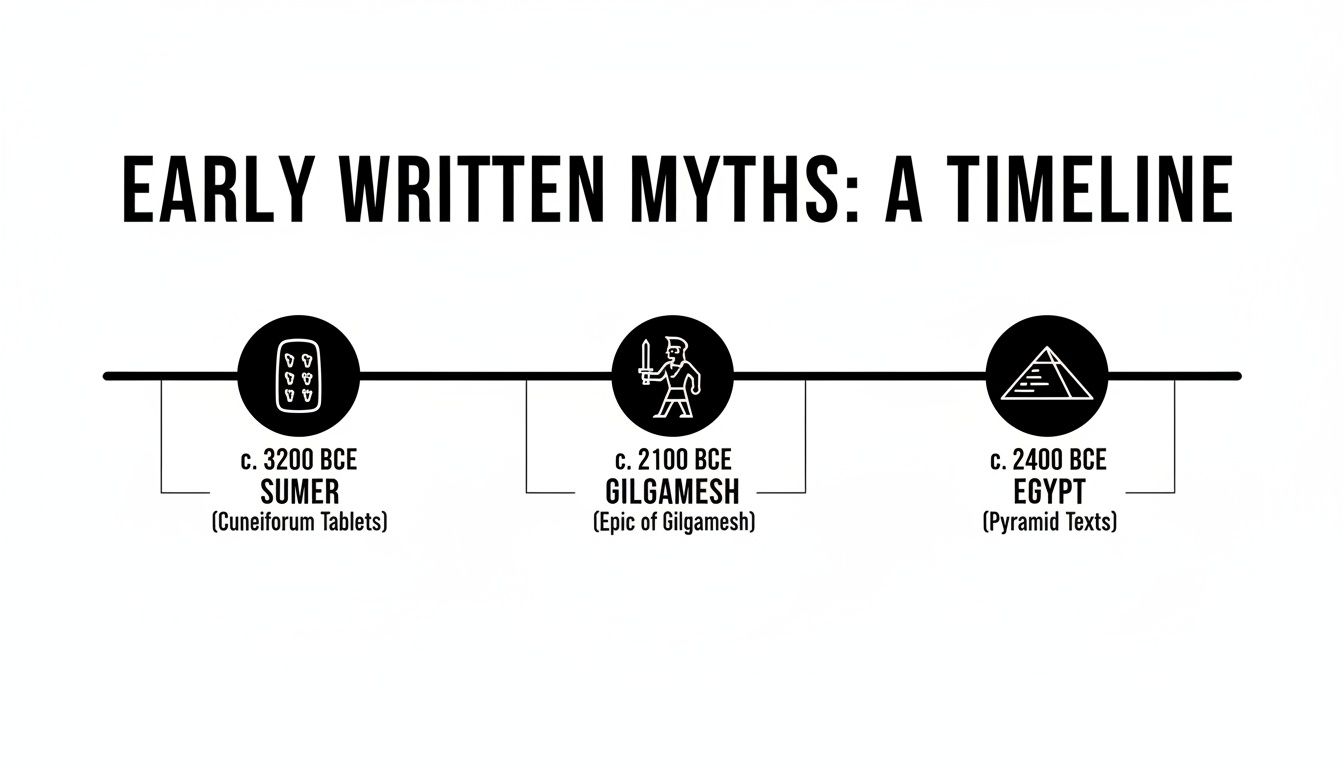
This timeline illustrates how early foundational myths like the Epic of Gilgamesh were recorded shortly after the widespread adoption of writing.
As the Roman Republic expanded, it absorbed Greek culture through a process known as syncretism. This was a strategic method of cultural integration. The Romans identified their own deities with the Greek gods.
Roman syncretism was a pragmatic and political act. By mapping their deities onto the well-established Greek pantheon—Jupiter became Zeus, Mars became Ares, Venus became Aphrodite—the Romans integrated Greek culture into their own, creating a shared Greco-Roman mythological heritage that would dominate the Western world for centuries.
This fusion was not an erasure of Roman identity but an adaptation, allowing Rome to incorporate the rich artistic and literary traditions of the Greeks while integrating them into a uniquely Roman framework. It serves as a clear example of how myths evolve to meet new political and social requirements.
The table below provides a comparative timeline for the codification of several influential mythological texts.
Timeline of Major Mythological Texts
| Civilization/Tradition | Key Text | Estimated Date of Composition/Codification |
|---|---|---|
| Sumerian | Epic of Gilgamesh | c. 2100 BCE |
| Babylonian | Enuma Elish | c. 1100 BCE |
| Chinese (Shang) | Oracle Bone Inscriptions | c. 1600–1046 BCE |
| Greek | Theogony, Iliad & Odyssey | c. 8th Century BCE |
| Indian | Mahabharata & Ramayana | c. 8th-4th Century BCE |
| Japanese | Kojiki & Nihon Shoki | 712 CE & 720 CE |
| Norse | Poetic Edda | c. 13th Century CE |
This timeline highlights the vast and varied periods during which these foundational stories were formalized across different global cultures.
The Lore of Ancient China
In ancient China, mythology was intricately linked with philosophy, history, and ancestor worship. The earliest textual evidence derives from the Shang Dynasty (c. 1600–1046 BCE), where "oracle bones" were used for divination. The inscriptions on these bones indicate a belief in a supreme deity, Shangdi, alongside a host of nature spirits and ancestral figures who could influence human affairs.
This spiritual foundation gave rise to more elaborate myths. Narratives of great culture heroes—the Yellow Emperor, the sage-kings Yao and Shun, and Yu the Great, who tamed the primordial floods—became central to Chinese cultural identity. These were not merely entertaining stories; they served as moral exemplars and provided a means for ruling dynasties to legitimize their authority by claiming descent from a divine, heroic past.
The act of committing these sacred stories to writing was a transformative moment. By creating a fixed record, these ancient cultures ensured the preservation and propagation of their worldviews, establishing the intellectual and spiritual DNA that would shape their art, politics, and beliefs for millennia.
Cultural and Religious Context: How Narratives Evolved
Myths are not static artifacts. They are living traditions that adapt and evolve in response to cultural shifts, including trade, conquest, the rise of new religions, and political exigencies. The history of mythology is a history of continuous evolution, with narratives being reinterpreted and retold for new audiences and new eras.
This evolution can manifest as a gradual blending of traditions or as a deliberate, strategic rewriting of a narrative to support a new political or religious order. By tracing these changes, researchers can map the complex interactions between different societies and their belief systems.
Syncretism and Cultural Blending
Syncretism—the fusion of different religious or cultural traditions—is a primary driver of mythological change. It was a common consequence of conquest or significant cultural exchange. Instead of eradicating local deities, a dominant power would often absorb them by identifying parallels with their own pantheon.
The Roman assimilation of the Greek pantheon is a classic example. The Romans recognized their own deities in the Greek gods and systematically mapped them onto the established Hellenic framework:
- Jupiter was equated with the Greek Zeus.
- The war god Mars was identified with Ares.
- The goddess of love, Venus, became the Roman counterpart of Aphrodite.
This was a sophisticated act of cultural and political engineering. It allowed Rome to integrate the rich artistic and literary heritage of Greece, creating a shared Greco-Roman tradition that became foundational to Western culture. This demonstrates how myths can be adapted to facilitate cultural cohesion and political unity.
Reinterpretation in New Religious Contexts
Mythologies also undergo significant transformation with the introduction of a new religion. Rather than completely erasing past beliefs, a new faith often co-opts existing stories and figures, reframing them within its own theological worldview. This process is evident in the spread of Christianity across Europe.
Many hagiographies (biographies of saints) borrowed narrative structures from pre-Christian hero myths. The hero's journey, divine intervention, and battles with monstrous figures were repurposed in the stories of Christian martyrs and saints. Folk beliefs were not discarded but recontextualized. For example, local nature spirits from older European faiths were sometimes reclassified as demons or malevolent entities within a Christian cosmology. This pattern of absorption and reinterpretation is also visible in the evolving historical beliefs about magic and its practitioners. Further documentation on this can be found in our article on witches in folklore.
A notable intellectual tool for this reinterpretation was Euhemerism, a theory proposed by the Greek writer Euhemerus around 300 BCE. He posited that the gods were not divine beings but were, in fact, historical kings and heroes whose great deeds led to their posthumous deification. Early Christian theologians adopted this concept to argue that pagan gods were merely powerful mortals, not true divinities, thus demoting them within a monotheistic framework.
Altering Myths for Political Power
Myths have consistently been altered for political purposes. A new ruler could legitimize their authority by commissioning a revised genealogy or myth that traced their lineage directly to a divine ancestor, thereby establishing a sacred and incontestable right to rule.
This is clearly demonstrated in the codification of Japan’s Shinto mythology. The compilation of the Kojiki (712 CE) and the Nihon Shoki (720 CE) was a state-sponsored project designed to forge a unified national mythology from numerous local traditions. By structuring this grand narrative around the sun goddess Amaterasu, these texts established a direct, divine lineage for the Japanese emperor, cementing the imperial family’s authority.
These examples underscore that mythology has always been a fluid and powerful tool. These narratives are not immutable; they have been continuously adapted—blended, reinterpreted, and rewritten—to both reflect and shape the societies that produced them.
Modern Interpretation: The Scholarly Study of Myth
To fully comprehend the history of mythology, one must examine not only the myths themselves but also the history of their study. The academic approach to myth has its own distinct evolution, beginning with early philosophical inquiries and developing into complex modern theories informed by psychology, anthropology, and linguistics.
Even ancient thinkers attempted rational explanations for their myths. The Greek writer Euhemerus, around 300 BCE, proposed a theory now known as Euhemerism: that the gods were originally great historical kings and heroes deified by later generations. This was one of the first systematic attempts to ground myth in history, providing a model for demystifying divine narratives that would be revisited for centuries.
The Rise of Comparative Mythology
The formal, academic study of mythology gained momentum in the 19th century, driven by advances in linguistics. The philologist Max Müller proposed that myths originated as a "disease of language," arguing that as ancient Indo-European languages evolved, the original meanings of words were lost, forcing people to invent stories to explain these now-unintelligible terms for natural phenomena like the sun and dawn.
This linguistic approach expanded into a broader comparative method, most famously championed by Sir James Frazer in his comprehensive work, The Golden Bough. Frazer compared a vast collection of myths, rituals, and folklore from around the world, arguing that human belief systems progressed through predictable stages: from magic to religion and finally to science. He viewed myths as vestiges of earlier, "primitive" stages of thought that revealed universal patterns of human cognition.
Psychological and Structuralist Approaches
The 20th century saw a significant shift in focus from historical origins to the internal structures of the human mind. The psychologist Carl Jung introduced the influential concepts of archetypes and the collective unconscious. He argued that all humans inherit a deep psychic structure populated by universal symbolic figures—the Hero, the Great Mother, the Wise Old Man—and that these archetypes form the raw material of mythology across all cultures.
"The collective unconscious… appears to consist of mythological motifs or primordial images, for which reason the myths of all nations are its real exponents. In fact, the whole of mythology could be taken as a sort of projection of the collective unconscious."
— Carl Jung, The Structure of the Psyche
This perspective reframed myths not as flawed history or proto-science, but as essential expressions of the universal human experience.
Subsequently, the anthropologist Claude Lévi-Strauss developed structuralism. Lévi-Strauss was less concerned with the narrative content of a myth and more interested in its underlying structure. He proposed that myths function as a cognitive tool for societies to mediate fundamental binary oppositions, such as life versus death or nature versus culture.
Finally, scholars like Mircea Eliade returned the focus to the sacred function of myth. He argued that myths are sacred histories that, for religious communities, are not mere stories but accounts of foundational acts by supernatural beings. Through ritual, these myths make the sacred world present and accessible. The study of such beliefs often intersects with the analysis of other historical events driven by faith, such as the Salem Witch Trials. The connections between these phenomena are explored in our analysis of what the Salem Witch Trials were.
Each of these theoretical lenses provides a different methodology for understanding the enduring power of myth, demonstrating that the interpretation of these ancient stories is an ongoing scholarly dialogue.
Conclusion: The Enduring Legacy of Myth

The history of mythology is not a closed subject confined to the ancient past. The narratives that structured early societies remain potent, echoing through contemporary culture with a remarkable capacity for reinvention. These ancient stories can be seen as the foundational source code for much of modern storytelling. From popular cinema and fantasy literature to immersive video games, myths are constantly being retold and reinterpreted to explore contemporary anxieties, values, and aspirations. These are not mere reproductions but dynamic adaptations that confirm the continued relevance of these core human narratives.
Myth as Modern Metaphor
Today, mythological frameworks are often employed to lend gravitas and meaning to new stories. The hero’s journey, the trickster archetype, and the apocalyptic final battle are all recognizable narrative structures that provide storytellers with powerful templates.
- Literature: Authors frequently draw upon figures like Odysseus or Prometheus to comment on modern themes of alienation, ambition, or rebellion.
- Film: The superhero genre is a direct continuation of ancient hero cycles. Characters such as Superman and Thor function as modern deities, grappling with immense power and human frailties.
- Video Games: Many popular games are explicitly built upon Norse, Greek, or Egyptian mythologies, allowing players to interact with and reshape these ancient worlds.
The fundamental purpose of myth—to create meaning, forge identity, and foster community—remains as relevant today as it was in ancient Sumer.
Mythology in Politics and National Identity
Mythological thinking also continues to shape political discourse and concepts of national identity. Political leaders often utilize heroic narratives or construct simplified "myths" about a nation's origins to mobilize support and cultivate a sense of shared purpose. These modern political myths serve the same function as their ancient predecessors: they define an in-group ("us") and reinforce a common set of values and historical memories. This complex relationship between belief, power, and narrative is a key theme in related historical fields, such as the documented history of witchcraft.
From oral traditions recited around ancient fires to the digital epics on our screens, the study of mythology is essential. It reveals the deep and lasting power of storytelling to shape human identity, proving that these ancient narratives are not relics but a living component of our present.
FAQ: Common Questions About the History of Mythology
This section addresses several frequently asked questions to clarify key concepts discussed in this guide.
What is the distinction between myth, legend, and folklore?
These terms describe related but distinct categories of traditional narrative.
- A myth is a foundational, often sacred story that explains the origins of the world, the nature of deities, and the cosmic order.
- A legend is a narrative believed to be rooted in a historical event or figure, though the details are often embellished over time.
- Folklore is the broadest category, encompassing the full range of a community's traditional stories, customs, beliefs, and practices passed down through generations.
How do researchers determine the age of a myth?
Dating a myth, particularly one with oral origins, requires a multi-faceted approach.
- Textual Evidence: The age of the earliest written version of a myth (e.g., on cuneiform tablets or papyrus) provides a minimum age.
- Archaeological Evidence: Artifacts such as pottery, tomb paintings, or sculptures depicting mythological scenes can be dated, indicating when the story was culturally significant.
- Comparative Linguistics: By tracing shared narrative structures and cognate words across related languages, linguists can reconstruct proto-myths that predate the earliest written records.
Why do myths from different cultures often share similar themes?
This phenomenon is explained by several scholarly theories.
- Diffusion: Stories travel through migration, trade, and conquest, leading to the adoption and adaptation of myths by different cultures.
- Common Origin: Cultures that descend from a common ancestor (like those within the Indo-European language family) may inherit shared mythological structures from a single proto-culture.
- Psychological Archetypes: Theories, such as Carl Jung's concept of the "collective unconscious," propose that all humans share innate psychological structures (archetypes) that lead different cultures to independently generate myths with similar themes and characters to address universal human experiences.
At Hidden Mythos, our mission is to present these profound narratives with historical rigor and analytical clarity. To continue your exploration of documented folklore and ancient belief systems, we invite you to browse our archive at https://www.hiddenmythos.com.
