

Folklore, the collective library of stories, beliefs, and traditions passed between generations, serves as a crucial artifact of human history. These are not merely children’s tales; they are intricate cultural records that document how ancestral societies interpreted their world, from moral frameworks and natural phenomena to unwritten histories. Approached as historical data, these narratives allow researchers to map the profound connections shared across continents and millennia. This guide offers a research-driven overview of the academic study of folklore around the world, framing it not as a collection of curiosities, but as a vital lens into cultural anthropology and human migration.
Historical Origins: The Function of Oral Tradition
Before widespread literacy, oral tradition was the primary mechanism for knowledge transfer. Folklore served several critical functions essential for societal survival and cohesion. It was the medium through which communities preserved history, transmitted social norms, and rationalized a world governed by forces beyond their understanding.
The Primary Functions of Early Folklore
Oral narratives were pragmatic tools developed to address fundamental societal needs:
- Cultural Transmission: Stories encoded the rules, ethics, and values of a society, providing a moral and behavioral blueprint for subsequent generations.
- Historical Record: In the absence of written language, oral traditions functioned as living archives, preserving genealogies, significant events, and territorial claims.
- Explanation of the Unknown: Myths provided frameworks for understanding cosmology, meteorological events, and the cycle of life and death.
- Social Cohesion: Shared narratives fostered a collective identity, reinforcing community bonds and a unified cultural consciousness.
These functions underscore the view of folklore as a sophisticated information technology. By analyzing recurring narrative elements—known as “motifs”—such as the ‘Cosmic Hunt’ or ‘Earth-Diver’ creation stories, researchers can trace prehistoric migrations and cultural interactions with a methodology analogous to genetic mapping.
Development Over Time: From Collection to Data Analysis
The academic study of folklore has evolved significantly from its origins in the 19th century. Early folklorists, such as the Brothers Grimm, focused primarily on collecting and preserving tales. Modern scholarship, however, has shifted toward analytical methods that treat folklore as a complex data set to understand cultural evolution and diffusion. The objective is not to validate supernatural claims but to investigate the historical and psychological reasons for their existence and dissemination.
The Aarne-Thompson-Uther (ATU) Index
An early and influential system for classifying folktales is the Aarne-Thompson-Uther (ATU) Index. This catalogue assigns a numerical code to common tale types based on their plot structure, such as “The Dragon-Slayer” (ATU 300). While foundational, the ATU Index is most effective for the complex, plot-driven fairy tales prevalent in European traditions and is less suited for the more fragmented or structurally diverse narratives found in other parts of the world. (For a deeper examination of these narrative categories, see our guide on the difference between myth and legend.)
Motif-Based Analysis: A Global Approach
To create a more globally applicable framework, contemporary researchers focus on motifs—the discrete, recurring building blocks of a story. A motif can be a character archetype (e.g., the trickster), a specific object (a magical cauldron), or a common event (a journey to the underworld). This “narrative genetics” approach allows for the identification of shared ancestry between stories that may appear superficially different. For example, a South American and a Siberian myth with disparate plots may both contain the “Earth-Diver” motif, suggesting a distant historical connection.
The Berezkin Catalogue
The most comprehensive modern tool for this work is the Folklore and Mythology Catalogue developed by Russian anthropologist Yuri Berezkin. This extensive database shifts the focus from whole plots to the geographical distribution of individual motifs. It is an atlas of human narrative, charting where specific story elements appear and how they cluster globally.
The catalogue meticulously documents 2,564 distinct motifs across 958 societies, revealing patterns of cultural transmission that were previously invisible. For instance, the data indicates that indigenous societies in North America north of 40°N possess the most concentrated and diverse folklore traditions globally, a statistical peak suggesting intense cultural layering from early human migrations. This data-driven methodology allows for rigorous statistical analysis of oral traditions, transforming the study of folklore around the world into a scientific discipline. You can explore insights from this research in the original study.
Cultural and Religious Context: How Stories Traveled
Myths and legends are not static; they are dynamic elements carried by people along paths of migration, trade, and conquest. Ancient trade routes were more than conduits for goods; they were information highways that facilitated the exchange of stories, ensuring that no society’s mythology developed in complete isolation.
The Silk Road of Stories
Major arteries of the ancient world, like the Silk Road, were primary vectors for narrative diffusion. A quantitative analysis of Berezkin’s global folklore database confirms this link. Research examining 477 Old World societies found that those located within 200 kilometers of ancient trade routes had, on average, twice as many trade-related motifs in their folklore compared to more isolated cultures. This provides empirical evidence that these routes were crucial for the movement of ideas. You can review the full research on folklore and trade routes to see the methodology.
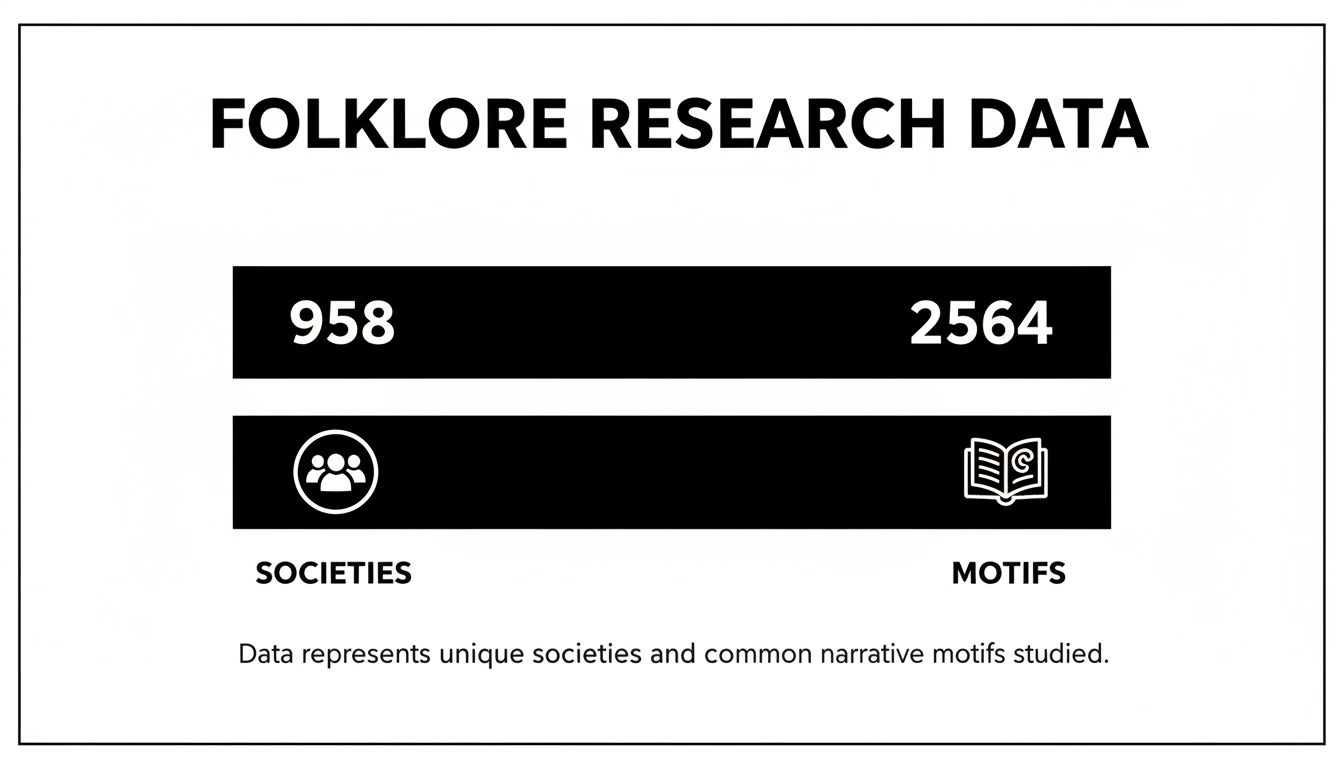
The scale of this research allows for robust, data-driven conclusions about how these narratives propagated.
Motif Prevalence Near And Far From Ancient Trade Routes
| Societal Proximity to Trade Route | Average Prevalence of Trade-Related Motifs |
|---|---|
| Within 200 km | 2.0x |
| Further than 200 km | 1.0x (Baseline) |
Other Vectors of Cultural Exchange
Beyond trade, other historical forces were instrumental in distributing folklore:
- Migration: When populations moved, their entire mythological corpus moved with them, inevitably blending with the traditions of their new homes to create hybrid narratives.
- Conquest and Empire: Imperial expansion often resulted in syncretism, where the gods and legends of conquered peoples were absorbed into the dominant culture's pantheon.
- Intermarriage: Kinship ties between different cultures created direct, personal bridges for story transmission, embedding tales in new cultural contexts.
This constant interplay created the rich, interwoven tapestry of global folklore. It explains the presence of strikingly similar motifs, such as a woman accused of sorcery transforming into an animal, in disparate European and African belief systems. To learn more about how such beliefs were documented, see our article on the origins of witchcraft.
Modern Interpretation: Tracing Humanity's Oldest Narratives

Contemporary research suggests that some mythological motifs may be as old as Homo sapiens, their distribution patterns mirroring the prehistoric peopling of the globe. This approach elevates the study of folklore around the world to a tool for paleoanthropology, providing a narrative counterpart to genetic and archaeological data. The core premise is that certain story elements are so widespread that their distribution can only be explained by a common origin deep in humanity's ancestral past.
The 'Man in the Moon' and Prehistoric Migrations
The motif of a "Man or Animal in the Moon," for instance, is found in cultures across vast and unconnected regions. Its specific global distribution suggests an origin in humanity's deep past, carried by the first waves of modern humans migrating out of Africa. The statistical patterns in Berezkin's data, which you can examine in Berezkin’s research on folklore distribution, align with established migration routes, such as the peopling of the Americas via the Bering Land Bridge.
While it is crucial to maintain scholarly caution—correlation is not definitive proof—the strength of these patterns is compelling. When narrative data aligns closely with genetic and archaeological evidence, it suggests that our oldest stories are historical artifacts, as vital to understanding our past as any stone tool or fossil.
Timeless Themes: The Trickster and The Flood
Two of the most enduring themes found in folklore around the world are the archetypal trickster figure and the cataclysmic flood myth.
The Archetypal Trickster: This figure—part hero, part villain—acts as a catalyst for change by violating established norms. West African and Caribbean traditions feature Anansi the Spider, who uses his wits to outsmart more powerful beings. In many Native American cultures, Coyote serves a similar function, acting as both a culture hero and a cautionary figure whose ego leads to trouble. Both characters embody the creative and destructive potential of chaos.
The Universal Flood Myth: The narrative of a world-destroying deluge, survived by a handful of chosen individuals in a vessel, appears in countless cultures. While likely inspired by local catastrophic events (polygenesis), the detailed similarities across traditions suggest a profoundly interconnected narrative history (diffusion).
| Mythological Tradition | Primary Source/Text | The Hero | Cause of Flood | Method of Survival |
|---|---|---|---|---|
| Mesopotamian | Epic of Gilgamesh | Utnapishtim | The gods’ annoyance with humanity’s noise | Building a great boat (a cube) |
| Hindu | The Puranas | Manu | Divine will to end a cosmic age (yuga) | A large boat guided by an avatar of Vishnu |
| Hawaiian | Oral Tradition | Nu’u | The god Kāne’s displeasure with humanity | A great canoe with a house on it (wa’a halau) |
These shared themes demonstrate how different cultures use a common narrative language to explore fundamental questions about existence, survival, and rebirth.
Conclusion: A Balanced Summary
The academic study of folklore provides a powerful, evidence-based methodology for understanding human history, culture, and cognition. By treating oral traditions as historical data, researchers can map ancient migrations, trace pathways of cultural exchange, and identify the universal psychological archetypes that connect us as a species. This approach moves beyond mere storytelling to reveal the foundational narratives that have shaped societies for millennia and continue to influence our world today. The stories our ancestors told are not lost relics; they are a living archive, offering a unique and invaluable record of the human journey.
Frequently Asked Questions
What is the difference between folklore, myth, and legend?
In academic terms, folklore is the broad category encompassing all traditional beliefs, customs, and stories of a community passed down through generations. A myth is a specific type of folklore that deals with sacred narratives about gods, creation, and the fundamental order of the universe. A legend is a story believed to have a historical basis, though often embellished with fantastic elements.
Why do so many cultures have similar myths, like a great flood?
This can be attributed to two main phenomena. Diffusion is the process where a story spreads from one culture to another through trade, migration, or conquest. Polygenesis is the independent development of similar stories in different cultures, likely because humans everywhere face similar fundamental challenges and existential questions, leading them to create similar narrative solutions.
How is oral folklore studied academically?
Researchers use several methods. Fieldwork involves recording stories directly from tradition-bearers. Comparative analysis uses databases like the ATU Index or motif-catalogues to track narrative elements across thousands of variants globally. Finally, historical contextualization uses archaeology, linguistics, and historical records to understand the world in which a story originated and evolved. The goal is not to verify the events in a tale but to understand what its persistence reveals about the culture that preserved it.
At Hidden Mythos, Michael Rupp's educational paranormal archive, we are dedicated to providing historically grounded analysis of humanity's most enduring stories. To continue your journey, explore our growing archive of deep dives into the world's myths and legends.
