

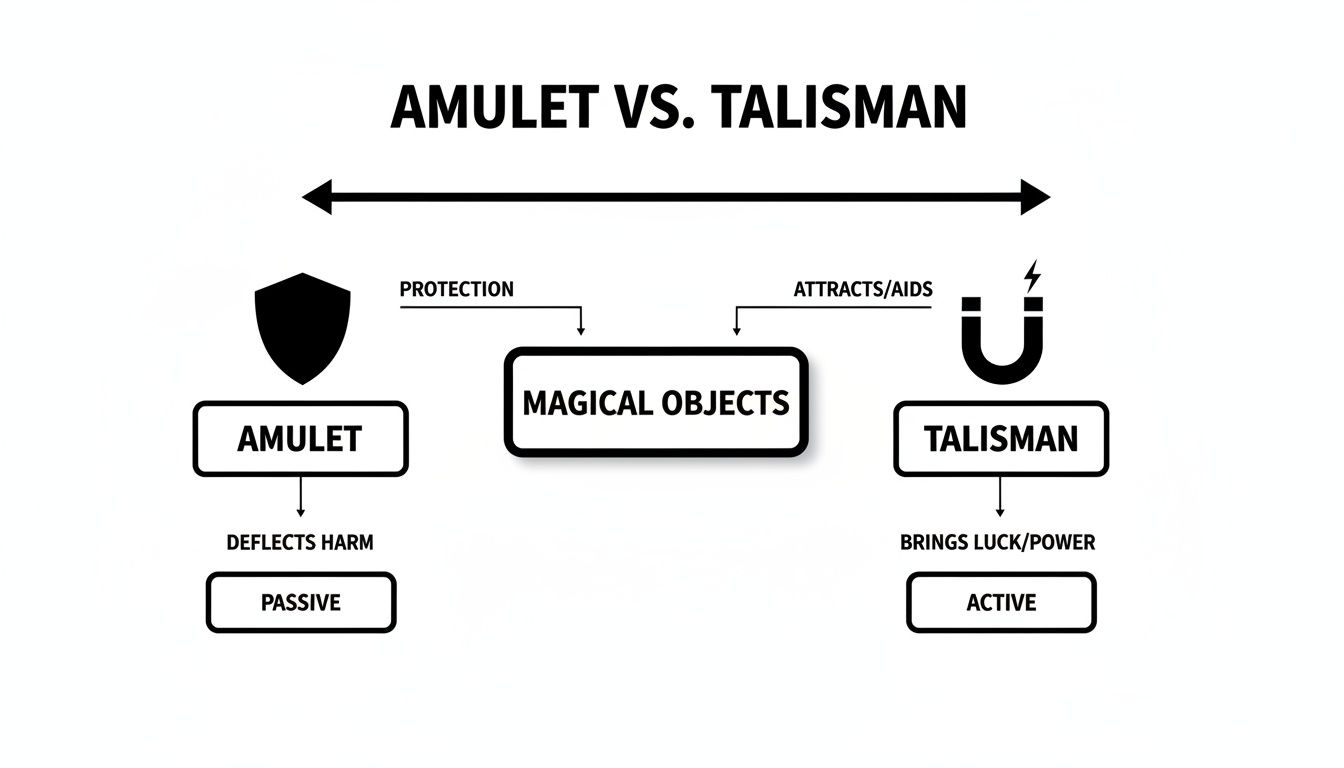
The human desire to influence fate, ward off harm, and attract good fortune has given rise to a universal class of objects: amulets and talismans. Though the terms are often used interchangeably in popular discourse, they represent distinct concepts with deep historical roots. An amulet is typically understood as a protective object, intended to passively shield its wearer from danger or malevolent forces. A talisman, by contrast, is an active agent, believed to attract a specific power, quality, or favorable outcome. Investigating the history of these objects offers a significant window into the anxieties, aspirations, and cosmological beliefs of cultures across time. This analysis will explore the historical origins, evolution, and cultural contexts of amulets and talismans, examining them as documented phenomena within human belief systems.
1. Historical Origins
The practice of carrying objects for supernatural effect is a behavior with origins in deep prehistory. Archaeological evidence from the Paleolithic era reveals that early humans carried items like unique stones, animal teeth, and shells, which are interpreted by scholars as proto-amulets. These artifacts suggest a foundational human impulse to find and possess items believed to hold a special virtue, offering a measure of psychological control in an unpredictable world.
While the practice is ancient and global, its codification is most extensively documented in Ancient Egypt. Here, amulets and talismans were not merely folk charms but integral components of state religion, medicine, and funerary practice. Their creation and use were systematized and recorded in religious works such as the Pyramid Texts (c. 2400–2300 BCE), the Coffin Texts, and later, the Book of the Dead.
The Egyptian System of Protection
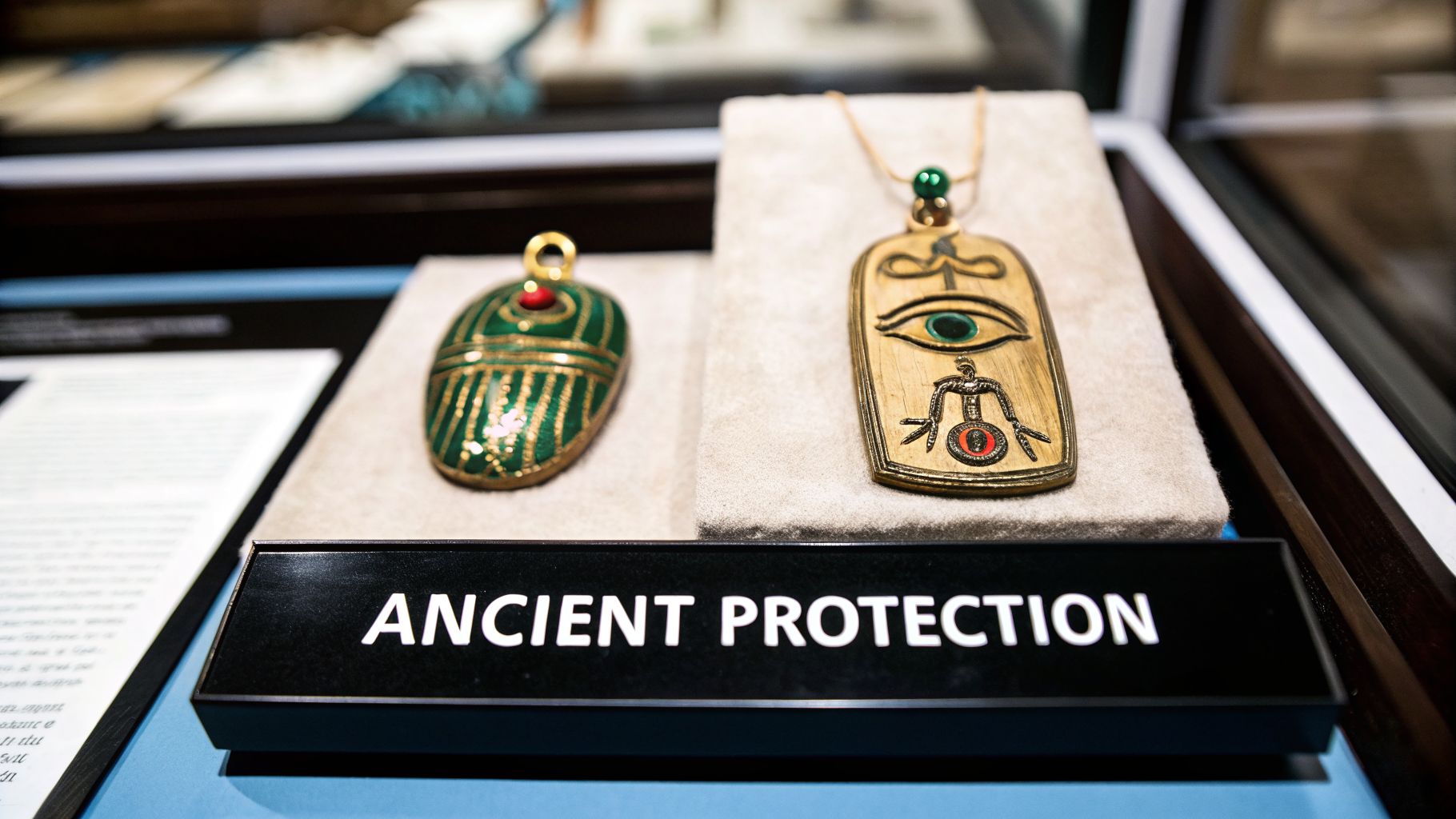
In Egyptian belief, the efficacy of an amulet depended on a precise combination of its material, color, and form. Each element held symbolic weight. For instance, carnelian, a red stone, was associated with blood and life energy, while green faience represented fertility and regeneration. This created a complex symbolic language understood across social strata.
Two of the most prominent examples from this system are the scarab beetle and the Eye of Horus (Wadjet). The scarab, modeled after the dung beetle (Scarabaeus sacer), symbolized the sun god Ra's daily journey and the concept of cyclical rebirth. "Heart scarabs," inscribed with Chapter 30B from the Book of the Dead, were placed on mummies to prevent the heart from testifying against the deceased during divine judgment. The prevalence of this practice is notable; analysis of New Kingdom mummies (c. 1550–1070 BCE), including that of Tutankhamun, shows a high frequency of such placements.
The Eye of Horus was an equally ubiquitous amulet for protection and restoration. Its origin lies in the myth of Horus losing his eye in a battle with his uncle, Set, only to have it magically restored by the god Thoth.
As documented in mythological texts, the restored eye became a potent symbol of wholeness, healing, and divine protection. It was worn by the living to ward off illness and the evil eye, and it was placed on the dead to ensure safe passage to the afterlife.
The sophisticated and widespread use of these objects in Egypt provides a clear historical baseline for the study of amuletic belief systems.
Parallels in Other Ancient Cultures
This practice was not unique to Egypt. Independent developments occurred globally, pointing to a convergent cultural evolution.
- Mesopotamia: Cylinder seals, primarily used for administrative purposes, also functioned as amulets. Carved with images of deities and protective spirits, they were worn to secure the favor and protection of the depicted entities.
- Indus Valley Civilization: Excavations have uncovered numerous small terracotta and steatite objects interpreted as talismans. Many feature animal motifs, such as the so-called "unicorn," which scholars believe held apotropaic significance.
- Pre-Columbian Americas: Indigenous cultures produced a wide array of protective objects, from the sacred medicine bundles of the Plains peoples to the intricately carved jade amulets of the Maya and Aztec civilizations. These items were deeply integrated into spiritual and communal life.
The independent emergence of these practices across disparate cultures underscores their role as a fundamental human response to perceived environmental and supernatural threats. They were tangible tools for managing anxiety and affirming one's place within a cosmic order.
2. Development Over Time
The forms and meanings of amulets and talismans were not static. As cultures interacted through trade, conquest, and intellectual exchange, symbolic systems blended and evolved. A single symbol could traverse continents, its significance adapted to fit new theological and social landscapes.
The Cross-Cultural Journey of Symbols
Perhaps no symbol illustrates this diffusion better than the swastika. Now irrevocably associated with its 20th-century appropriation, for millennia it was a positive and widespread symbol of well-being. The name derives from the Sanskrit svastika, meaning "conducive to well-being." Its earliest known appearances date to the Upper Paleolithic, with examples found at Mezin, Ukraine (c. 10,000 BCE). For over 12,000 years, it was a revered symbol in Hinduism, Buddhism, and Jainism, representing good fortune, the eternal cycle, and cosmic harmony. It also appears in the iconography of various Native American cultures and was used widely in Europe as a protective mark on objects and buildings well into the medieval period.
Another significant example is the hexagram, or Seal of Solomon. This six-pointed star features prominently in Jewish, Christian, and Islamic traditions. In Jewish folklore, it was believed to be engraved on King Solomon's signet ring, granting him power over spirits.
In medieval Islamic esotericism, the Seal of Solomon (Khātam Sulaymān) was a common motif on talismans designed to offer protection from djinn. Its geometric harmony was seen to reflect a divine order capable of subordinating chaotic forces.
The symbol also appeared in Christian contexts, often in church architecture, where it was associated with divine creation. The shared use of this symbol across Abrahamic faiths demonstrates how amuletic traditions often transcended religious boundaries, forming a common symbolic vocabulary. This is a recurring theme in the global history of mythology.
3. Cultural and Religious Context
Contrary to the modern perception of amulets as fringe or "superstitious" items, they were often deeply embedded within the institutional frameworks of organized religion and state power. Rather than being suppressed, these objects were frequently formalized, sanctified, and deployed to reinforce social and theological order.
The Royal Touch and the "Angel" Amulet
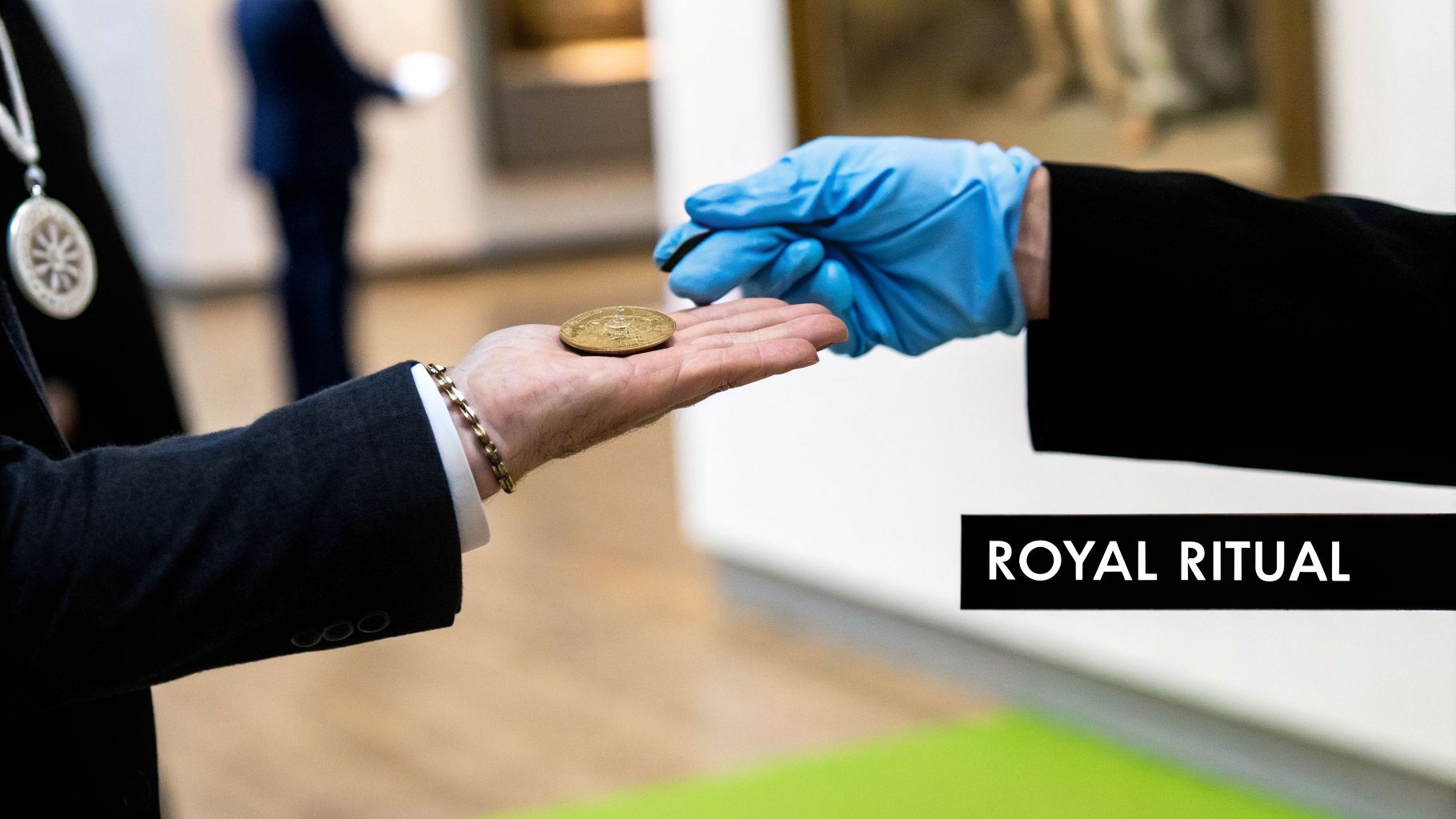
A prime example is the European ritual of the "Royal Touch" for scrofula, a form of tuberculosis known as the "King's Evil." Practiced in England and France from the 11th century until the 18th century, the ceremony centered on the belief that the monarch, as God's anointed representative, possessed a divine healing touch.
The ritual was a highly organized public event. The afflicted would be presented to the monarch, who would touch their sores while reciting prayers. Each person was then given a specific coin, typically a gold "angel" depicting the Archangel Michael slaying a dragon, to be worn as an amulet. Records indicate the scale of this practice; during his reign (1660-1685), Charles II of England is estimated to have "touched" over 100,000 individuals.
This coin was not currency but a state-sanctioned amulet. It was believed that the monarch's healing power was transferred to the coin, and its continuous presence was necessary to prevent a relapse. Losing the amulet was thought to result in the return of the disease. The Science Museum Group's research provides detailed analysis of these "touch-pieces" as historical medical objects.
The touch-piece coin served as a tangible, lasting reminder of this royal power. Each amulet was a personal link between a common subject and the monarch, a physical token of the crown's sacred duty and protective reach.
This practice served a crucial political function. By performing these "miraculous" healings, the monarchy visibly demonstrated its divine right to rule, reinforcing its legitimacy and mystical authority. It was a calculated act of statecraft, blending religious belief, political theater, and amuletic tradition. The practice coexisted with the rise of empirical science, illustrating the blurred lines between "magic," faith, and medicine during the period, a complexity also seen in the history of witchcraft.
4. Modern Interpretation
In contemporary scholarship, the study of amulets and talismans has moved beyond questions of efficacy to focus on their cultural, psychological, and sociological significance. Academics in anthropology, archaeology, and religious studies analyze these objects to understand the worldviews of the people who created and used them. This scholarly perspective contrasts sharply with their frequent depiction in popular culture, where they are often reduced to generic "magic items" in fantasy narratives.
Amulets and Material Religion
A key analytical framework is that of material religion. This subfield examines how beliefs and religious experiences are mediated through physical objects. From this perspective, an amulet is not merely a symbol of belief but the physical embodiment of it. It serves as a tangible focus for hope, fear, and faith.
Scholars of material religion investigate the sensory experience of an amulet—its weight, texture, and inscriptions—to understand how its physical properties reinforced its perceived power. The act of carrying or wearing the object created a constant, tactile reminder of its protective or aspirational function, providing its owner with a sense of agency and security.
Material religion shifts our view of amulets away from simple "superstitions." It reframes them as essential parts of a living belief system, helping us understand how a physical object can shape someone's reality, rituals, and daily life.
This approach allows researchers to analyze the worldview of the believer without passing judgment on the belief itself. The inquiry becomes not "Did it work?" but "What does its use reveal about the society that valued it?"
Insights from Archaeology and Museology
Archaeological discoveries continually provide new data. The provenance of an amulet can reveal ancient trade networks, while the discovery of workshops for mass-producing them can illuminate economic aspects of their use. Museums play a vital role in this research by preserving these artifacts and presenting them with their full historical context, focusing on:
- Provenance: Tracing an object's origin and history of ownership.
- Material Analysis: Using scientific techniques to identify its composition and method of manufacture.
- Cultural Context: Explaining the belief system that gave the object meaning.
This contextual approach transforms amulets from curiosities into valuable primary sources for understanding the social, spiritual, and economic lives of past societies. It reveals our enduring fascination with amulets and talismans as part of a long historical continuum of human behavior. More information on similar global traditions can be found in our exploration of folklore around the world.
5. Conclusion
An examination of the historical record demonstrates that amulets and talismans are far more than simple trinkets. They represent a fundamental and cross-cultural human practice, manifesting in response to a deep-seated need for protection, control, and meaning. From prehistoric artifacts to the elaborate systems of Ancient Egypt and the state-sanctioned rituals of European monarchies, these objects serve as a direct, physical link to the belief systems of the past.
The scholarly value in studying these items lies not in validating their perceived supernatural efficacy, but in what they reveal about the human condition. Each amulet and talisman is a miniature archive, a material artifact that preserves the anxieties, hopes, and cosmological frameworks of the culture that produced it.
Our goal here has been to document, not to endorse. In that spirit, the true legacy of amulets and talismans is what they teach us. They are a physical record of humanity's intricate worldviews—a testament to our shared anxieties and our relentless search for meaning and security.
As these objects have transitioned from items of ritual use to subjects of academic study, their story continues. They remain a powerful testament to the human impulse to make the intangible tangible, and to seek a measure of security in a complex and often unpredictable world.
Frequently Asked Questions About Amulets and Talismans
The following section addresses common questions about amulets and talismans, with answers grounded in historical and scholarly evidence.
| Question | In-Depth Answer |
|---|---|
| What is the primary distinction between an amulet and a talisman? | The core difference lies in their function. An amulet is a defensive object intended for passive protection. Its purpose is apotropaic—to ward off harm, illness, or negative influences like the evil eye. A talisman is an active object, created to attract a specific outcome or power, such as luck, wealth, or success. While an amulet acts as a shield, a talisman functions as a magnet. |
| Was the use of these objects confined to “magical” or folk practices? | No. The modern distinction between “religion” and “magic” is not applicable to most historical contexts. These objects were deeply integrated into mainstream religious and social life. A Christian reliquary holding a saint’s bone, intended for healing, functioned as a powerful amulet within an orthodox religious framework. Likewise, the “touch-piece” coins distributed by English monarchs were part of a state-sanctioned royal ceremony, not a covert ritual. |
| What materials were commonly used and why was the material significant? | Material choice was integral to an object’s perceived power. Selections were based on symbolic associations. In Ancient Egypt, the red stone carnelian was linked to life and vitality, while blue lapis lazuli, resembling a starry sky, signified divinity and royalty. Precious metals like gold and silver were almost universally associated with the sun and moon, representing purity and eternal power. The material was considered an inherent part of the object’s efficacy. |
| Are there well-documented historical examples of amulets or talismans? | Yes, numerous examples are confirmed by archaeology and historical texts. The tomb of Tutankhamun contained a vast collection of amulets, including heart scarabs and figures of protective deities. The “angel” coins from the Royal Touch ceremony are another extensively documented example. The Seal of Solomon is a motif found on surviving talismans and is described in multiple medieval Jewish, Christian, and Islamic esoteric texts. These are not merely legendary items but tangible artifacts of past belief systems. |
| How are amulets and talismans viewed in modern scholarship? | Contemporary academic study, particularly in fields like anthropology and religious studies, approaches these objects as “material culture.” The focus is not on their supernatural claims but on their role as physical expressions of human belief, anxiety, and social structures. Scholars analyze their materials, iconography, and context to understand the worldviews of the people who used them. They are treated as primary source documents that offer insights into human psychology, religion, and social history. |
